
UNITED STATES
SECURITIES AND EXCHANGE COMMISSION
Washington, D.C. 20549
FORM 10-Q
| QUARTERLY REPORT PURSUANT TO SECTION 13 OR 15(d) OF THE SECURITIES EXCHANGE ACT OF 1934 | |||||
For the quarterly period ended March 31, 2026
OR
| TRANSITION REPORT PURSUANT TO SECTION 13 OR 15(d) OF THE SECURITIES EXCHANGE ACT OF 1934 | |||||
Commission file number 1-14287
| (State of incorporation) | (I.R.S. Employer Identification No.) | ||||
(301 ) 564-3200
Securities registered pursuant to Section 12(b) of the Act:
| Title of Each Class | Trading Symbol | Name of Each Exchange on Which Registered | ||||||
Indicate by check mark whether the registrant (1) has filed all reports required to be filed by Section 13 or 15(d) of the Securities Exchange Act of 1934 during the preceding 12 months (or for such shorter period that the registrant was required to file such reports), and (2) has been subject to such filing requirements for the past 90 days. Yes ☒ No ☐
Indicate by check mark whether the registrant has submitted electronically, if any, every Interactive Data File required to be submitted pursuant to Rule 405 of Regulation S-T (§232.405 of this chapter) during the preceding 12 months (or for such shorter period that the registrant was required to submit such files). Yes ☒ No ☐
Indicate by check mark whether the registrant is a large accelerated filer, an accelerated filer, a non-accelerated filer, a smaller reporting company or an emerging growth company. See the definitions of “large accelerated filer,” “accelerated filer,” “smaller reporting company,” and “emerging growth company” in Rule 12b-2 of the Exchange Act.
| ☒ | Accelerated filer | ☐ | Non-accelerated filer | ☐ | |||||||||||||||||||
| Smaller reporting company | Emerging growth company | ||||||||||||||||||||||
If an emerging growth company, indicate by check mark if the registrant has elected not to use the extended transition period for complying with any new or revised financial accounting standards provided pursuant to Section 13(a) of the Exchange Act. ☐
Indicate by check mark whether the registrant is a shell company (as defined in Rule 12b-2 of the Exchange Act). Yes ☐ No ☒
As of May 1, 2026, there were 18,953,594 shares of the registrant’s Class A Common Stock, par value $0.10 per share, and 719,200 shares of the registrant’s Class B Common Stock, par value $0.10 per share, outstanding.
TABLE OF CONTENTS
| Page | ||||||||
| PART I – FINANCIAL INFORMATION | ||||||||
| PART II – OTHER INFORMATION | ||||||||
2
Glossary of Certain Terms and Abbreviations
| Centrus Energy Corp. and Related Entities | |||||
ACO | American Centrifuge Operating LLC, a subsidiary of Centrus | ||||
| Board | Centrus Energy Corp.’s Board of Directors | ||||
| Centrus | Centrus Energy Corp. | ||||
| Enrichment Corp. | United States Enrichment Corporation, a subsidiary of Centrus | ||||
| Paducah GDP | Paducah Gaseous Diffusion Plant, an enrichment plant in Paducah, Kentucky, formerly operated by Enrichment Corp. | ||||
| Piketon | Production facility in Piketon, Ohio | ||||
| Portsmouth GDP | Portsmouth Gaseous Diffusion Plant, an enrichment plant near Portsmouth, Ohio, formerly operated by Enrichment Corp. | ||||
| USEC-Government | Enrichment Corp. prior to 1993, a wholly-owned government corporation prior to its privatization in July 1998 | ||||
| Other Terms and Abbreviations | |||||
0% Convertible Notes | 0% Convertible Senior Notes, maturing August 2032 unless repurchased, redeemed or converted | ||||
2.25% Convertible Notes | 2.25% Convertible Senior Notes, maturing November 2030 unless repurchased, redeemed or converted | ||||
| 2002 DOE-USEC Agreement | June 17, 2002 agreement between Centrus (then known as USEC Inc.) and the DOE | ||||
5B Cylinders | Storage cylinders for HALEU UF6 produced by the HALEU demonstration cascade | ||||
| 8.25% Notes | 8.25% Notes, originally maturing February 2027, redeemed in March 2025 | ||||
American Centrifuge | Advanced uranium enrichment gas centrifuge technology previously developed, based on the proven workable U.S. centrifuge technology developed by DOE in the mid-1980s and utilized in a demonstration facility in 2012-2013 | ||||
American Centrifuge Plant | Refers to a demonstration facility in Piketon, Ohio where USEC planned to install a lead cascade of centrifuge machines to demonstrate the American Centrifuge technology under the terms of the 2002 DOE-USEC Agreement | ||||
| ARDP | DOE’s Advanced Reactor Demonstration Program | ||||
| ATM | At the Market | ||||
| Class A Common Stock | Class A common stock, $0.10 par value per share | ||||
| Class B Common Stock | Class B common stock, $0.10 par value per share | ||||
| Common Stock | Class A Common Stock and Class B Common Stock | ||||
| D&D | Decontamination & Decommissioning | ||||
| DOC | U.S. Department of Commerce | ||||
| DOE | U.S. Department of Energy | ||||
EPC Contract | Engineering, procurement and construction contract | ||||
| EU | European Union | ||||
| Exchange Act | Securities Exchange Act of 1934, as amended | ||||
| HALEU | High Assay Low-Enriched Uranium | ||||
HALEU Deconversion Contract | An IDIQ contract awarded by DOE to ACO on October 4, 2024 for the deconversion of HALEU | ||||
| HALEU Demonstration Contract | Three-year, $115.0 million cost-share contract with DOE signed in 2019 by Centrus’ subsidiary, ACO | ||||
HALEU Production Contract | An IDIQ contract awarded by DOE to ACO on October 16, 2024 for the production of HALEU | ||||
3
| HALEU Operation Contract | HALEU production contract with DOE signed in 2022 | ||||
IDIQ | Indefinite Delivery, Indefinite Quantity, a type of government contract that provides for an indefinite quantity, within stated limits, of supplies or services during a fixed period under which the government places orders for individual requirements | ||||
| IEA | International Energy Agency | ||||
Import Ban Act | The “Prohibiting Russian Uranium Imports Act” enacted in May 2024 that bans imports of LEU from Russia into the U.S., effective August 11, 2024, subject to issuance of waivers by the DOE | ||||
| LEU | Low-Enriched Uranium; term is also used to refer to the Centrus Energy Corp. business segment which supplies commercial customers with various components of nuclear fuel | ||||
LEU Production Contract | An IDIQ contract awarded by DOE to ACO on December 10, 2024 for expansion of domestic LEU production | ||||
Natural Uranium | Raw material needed to produce LEU and HALEU | ||||
| NOL | Net Operating Loss | ||||
| NRC | U.S. Nuclear Regulatory Commission | ||||
| NUBIL | Net unrealized built-in loss | ||||
| Orano | Orano Cycle | ||||
| Orano Supply Agreement | Long-term supply of SWU contained in LEU, signed by Enrichment Corp. with Orano in 2018 | ||||
| Power MOU | Memorandum of understanding between the DOE and USEC-Government | ||||
| Price-Anderson Act | Price-Anderson Nuclear Industries Indemnity Act (Section 170 of the U.S. Atomic Energy Act of 1954, as amended) | ||||
RFP | Request for Proposal | ||||
| Rights Agreement | Section 382 Rights Agreement, dated as of April 6, 2016, by and among the Company and Computershare Trust Company, N.A. and Computershare Inc., as rights agent, as amended | ||||
Rosatom | Russian State Atomic Energy Corporation | ||||
| RSA | 1992 Russian Suspension Agreement, as amended | ||||
Russian Decree | Russian Federal Decree No. 1544, passed on November 14, 2024, that rescinded TENEX’s general license to export LEU to the United States or to entities registered in the United States, effective through December 31, 2025 and extended through December 31, 2027 by Russian Federal Decree No. 1516, enacted on October 2, 2025 | ||||
| SARs | Stock appreciation rights | ||||
| SEC | U.S. Securities & Exchange Commission | ||||
| SWU | Separative work unit | ||||
Technical Solutions | The Centrus business segment focused on uranium enrichment for the nuclear industry and the U.S. government and advanced manufacturing, engineering and other technical services to government and private sector customers | ||||
| TENEX | Russian government-owned entity TENEX, Joint-Stock Company | ||||
| TENEX Supply Contract | March 23, 2011 Enriched Product Transitional Supply Contract with TENEX through 2028 | ||||
U.S. GAAP | Generally Accepted Accounting Principles in the United States | ||||
U3O8 | Uranium oxide, aka “yellowcake” | ||||
UF6 | Uranium hexafluoride | ||||
| WNA | World Nuclear Association | ||||
4
FORWARD-LOOKING STATEMENTS
CAUTIONARY STATEMENTS REGARDING FORWARD-LOOKING INFORMATION
This Quarterly Report on Form 10-Q of Centrus (the “Company,” “we” or “us”) contains “forward-looking statements” within the meaning of Section 21E of the Exchange Act of 1934, and the Private Securities Litigation Reform Act of 1995. In this context, forward-looking statements mean statements related to future events, which may impact our expected future business and financial performance, and often contain words such as “expects”, “anticipates”, “intends”, “plans”, “believes”, “will”, “should”, “could”, “would” or “may” and other words of similar meaning. These forward-looking statements are based on information available to us as of the date of this Quarterly Report on Form 10-Q and represent management’s current views and assumptions with respect to future events and operational, economic and financial performance. Forward-looking statements are not guarantees of future performance, events or results and involve known and unknown risks, uncertainties and other factors, which may be beyond our control and which may be exacerbated by any worsening of the global business and economic environment including but not limited to, risks and uncertainties related to the following:
•the war in Ukraine and other geopolitical conflicts, including the resulting bans, laws, tariffs, sanctions or other government measures, and actions by third parties, including contractual counterparties, as a result of such conflicts that could directly or indirectly impact our ability to obtain, deliver, transport, sell or collect payment for, LEU or the SWU and natural uranium hexafluoride components of LEU;
•our reliance on third party suppliers to provide essential products and services to us;
•restrictions on imports and exports, including those imposed under the RSA, and related international trade legislation;
•our lease to our facility in Piketon, Ohio and our government contracts, including related to government shutdowns, changes to the U.S. government’s appropriated funding levels for HALEU and the government’s inability to satisfy its obligations;
•our receipt of additional task orders under the HALEU Production Contract, LEU Production Contract and HALEU Deconversion Contract and, if awarded, the nature, timing and amount thereof;
•our ability to obtain new contracts or funding to be able to continue operations;
•whether or when government demand for HALEU or LEU for government or commercial uses will materialize and at what level;
•the impact and potential extended duration of a supply/demand imbalance in the market for LEU;
•significant competition from major LEU producers, including foreign competitors, who may be less cost sensitive than we are;
•limitations on our ability to compete in foreign markets;
•pricing trends and demand in the uranium and enrichment markets, especially in light of the potential of limited supply and our dependence on others for deliveries of LEU;
•our ability to successfully implement our planned expansion projects in Piketon, Ohio and Oak Ridge, Tennessee;
•our ability to successfully integrate artificial intelligence technologies into our operations;
•natural and other disasters;
•pandemics and other health crises;
•the fact that our revenue is largely dependent on our largest customers and our sales backlog;
•our long-term liabilities, including our postretirement health and life benefit obligations, our 0% Convertible Notes and our 2.25% Convertible Notes;
•failures or security, including cybersecurity, breaches of our information technology systems; and
•the impact of, or changes to, government regulation and policies or interpretation of laws or regulations, including by the SEC, DOE, DOC and the NRC.
5
For a more detailed discussion of these risks and others that could cause actual results to differ materially from those contained in our forward-looking statements, please see our Annual Report on Form 10-K for the year ended December 31, 2025 and Part II, Item 1A, Risk Factors, of this Quarterly Report on Form 10-Q. These factors may not constitute all factors that could cause actual results to differ from those discussed in any forward-looking statement. Accordingly, forward-looking statements should not be relied upon as a predictor of actual results, and readers are cautioned not to place undue reliance on these forward-looking statements, which apply only as of the date of this Quarterly Report. The Company does not undertake any obligation to publicly release any revision to its forward-looking statements to reflect events or circumstances that may arise after the date of this Quarterly Report on Form 10-Q unless required by law.
6
CENTRUS ENERGY CORP.
CONDENSED CONSOLIDATED BALANCE SHEETS
(Unaudited; in millions, except share and per share data)
| March 31, 2026 | December 31, 2025 | ||||||||||
| ASSETS | |||||||||||
| Current assets: | |||||||||||
| Cash and cash equivalents | $ | $ | |||||||||
| Accounts receivable | |||||||||||
| Inventories | |||||||||||
| Deferred costs associated with deferred revenue | |||||||||||
| Other current assets | |||||||||||
| Total current assets | |||||||||||
Property, plant and equipment, net of accumulated depreciation of $ | |||||||||||
| Deposits for financial assurance | |||||||||||
| Intangible assets, net | |||||||||||
| Deferred tax assets | |||||||||||
| Other long-term assets | |||||||||||
| Total assets | $ | $ | |||||||||
LIABILITIES AND STOCKHOLDERS’ EQUITY | |||||||||||
| Current liabilities: | |||||||||||
| Accounts payable and accrued liabilities | $ | $ | |||||||||
| Payables under inventory purchase agreements | |||||||||||
| Inventories owed to customers and suppliers | |||||||||||
| Deferred revenue and advances from customers | |||||||||||
Short-term inventory loans | |||||||||||
| Current debt | |||||||||||
| Total current liabilities | |||||||||||
| Long-term debt | |||||||||||
| Postretirement health and life benefit obligations | |||||||||||
| Pension benefit liabilities | |||||||||||
| Other long-term liabilities | |||||||||||
| Total liabilities | |||||||||||
Commitments and contingencies (Note 11) | |||||||||||
Stockholders’ equity: | |||||||||||
Preferred stock, par value $1.00 per share, | |||||||||||
| Series A Participating Cumulative Preferred Stock, none issued | |||||||||||
| Series B Senior Preferred Stock, none issued | |||||||||||
Class A Common Stock, par value $ | |||||||||||
Class B Common Stock, par value $ | |||||||||||
| Excess of capital over par value | |||||||||||
Retained earnings | |||||||||||
Accumulated other comprehensive loss | ( | ( | |||||||||
Total stockholders’ equity | |||||||||||
Total liabilities and stockholders’ equity | $ | $ | |||||||||
The accompanying notes are an integral part of these unaudited condensed consolidated Financial Statements.
7
CENTRUS ENERGY CORP.
CONDENSED CONSOLIDATED STATEMENTS OF OPERATIONS AND COMPREHENSIVE INCOME
(Unaudited; in millions, except share and per share data)
| Three Months Ended March 31, | |||||||||||
| 2026 | 2025 | ||||||||||
| Revenue: | |||||||||||
| Separative work units | $ | $ | |||||||||
| Uranium | |||||||||||
| Technical solutions | |||||||||||
| Total revenue | |||||||||||
| Cost of Sales: | |||||||||||
| Separative work units and uranium | |||||||||||
| Technical solutions | |||||||||||
| Total cost of sales | |||||||||||
Gross profit | |||||||||||
| Advanced technology costs | |||||||||||
| Selling, general and administrative | |||||||||||
| Amortization of intangible assets | |||||||||||
Operating income | |||||||||||
Nonoperating components of net periodic benefit loss | |||||||||||
| Interest expense | |||||||||||
| Investment income | ( | ( | |||||||||
Extinguishment of long-term debt | ( | ||||||||||
Other expense, net | |||||||||||
Income before income taxes | |||||||||||
Income tax expense | |||||||||||
Net income and comprehensive income | $ | $ | |||||||||
Net income per share: | |||||||||||
| Basic | $ | $ | |||||||||
| Diluted | $ | $ | |||||||||
| Average number of common shares outstanding (in thousands): | |||||||||||
| Basic | |||||||||||
| Diluted | |||||||||||
The accompanying notes are an integral part of these unaudited condensed consolidated Financial Statements.
8
CENTRUS ENERGY CORP.
CONDENSED CONSOLIDATED STATEMENTS OF CASH FLOWS
(Unaudited; in millions)
| Three Months Ended March 31, | |||||||||||
| 2026 | 2025 | ||||||||||
| OPERATING | |||||||||||
Net income | $ | $ | |||||||||
Adjustments to reconcile net income to cash used in operating activities: | |||||||||||
| Depreciation and amortization | |||||||||||
| Deferred tax assets | |||||||||||
Equity-related compensation | |||||||||||
Revaluation of inventory borrowings | ( | ||||||||||
Gain on extinguishment of 8.25% Notes | ( | ||||||||||
Amortization of debt issuance costs and discount | |||||||||||
Other reconciling adjustments, net | |||||||||||
| Changes in operating assets and liabilities: | |||||||||||
| Accounts receivable | ( | ||||||||||
| Inventories | ( | ( | |||||||||
| Inventories owed to customers and suppliers | ( | ||||||||||
| Other current assets | ( | ||||||||||
| Accounts payable and other liabilities | ( | ||||||||||
| Payables under inventory purchase agreements | |||||||||||
| Deferred revenue and advances from customers, net of deferred costs | ( | ||||||||||
| Pension and postretirement benefit liabilities | ( | ( | |||||||||
Other changes, net | ( | ||||||||||
Cash (used in) provided by operating activities | ( | ||||||||||
| INVESTING | |||||||||||
| Capital expenditures | ( | ( | |||||||||
| Cash used in investing activities | ( | ( | |||||||||
| FINANCING | |||||||||||
| Proceeds from the issuance of common stock, net | |||||||||||
Common stock withheld for tax obligations under stock-based compensation plan | ( | ||||||||||
| Payment of interest classified as debt | ( | ||||||||||
Payment of principal to redeem 8.25% Notes | ( | ||||||||||
Cash used in financing activities | ( | ( | |||||||||
Effect of exchange rate changes on cash, cash equivalents and restricted cash | ( | ( | |||||||||
Decrease in cash, cash equivalents and restricted cash | ( | ( | |||||||||
| Cash, cash equivalents and restricted cash, beginning of period (Note 3) | |||||||||||
| Cash, cash equivalents and restricted cash, end of period (Note 3) | $ | $ | |||||||||
9
| Three Months Ended March 31, | |||||||||||
| 2026 | 2025 | ||||||||||
Supplemental cash flow disclosures: | |||||||||||
Cash paid for interest | $ | $ | |||||||||
Cash paid for income taxes | |||||||||||
Federal | $ | — | $ | — | |||||||
State | $ | — | $ | — | |||||||
Foreign | $ | — | $ | — | |||||||
| Non-cash activities: | |||||||||||
| Property, plant and equipment included in accounts payable and accrued liabilities | $ | $ | |||||||||
Common stock withheld for tax obligations under stock-based compensation plan | $ | $ | |||||||||
The accompanying notes are an integral part of these unaudited condensed consolidated Financial Statements.
10
CENTRUS ENERGY CORP.
CONDENSED CONSOLIDATED STATEMENTS OF STOCKHOLDERS’ EQUITY
(Unaudited; in millions, except per share data)
| Preferred Stock, Series B | Common Stock, Class A, Par Value $0.10 per Share | Common Stock, Class B, Par Value $0.10 per Share | Excess of Capital Over Par Value | Retained Earnings (Accumulated Deficit) | Accumulated Other Comprehensive Loss | Total | |||||||||||||||||||||||||||||||||||
Balance at December 31, 2024 | $ | $ | $ | $ | $ | ( | $ | ( | $ | ||||||||||||||||||||||||||||||||
Net income for the three months ended March 31, 2025 | |||||||||||||||||||||||||||||||||||||||||
| Issuance of common stock | |||||||||||||||||||||||||||||||||||||||||
Equity-related compensation shares withheld for income taxes | ( | ( | |||||||||||||||||||||||||||||||||||||||
| Other comprehensive loss | ( | ( | |||||||||||||||||||||||||||||||||||||||
Equity-related compensation | |||||||||||||||||||||||||||||||||||||||||
Balance at March 31, 2025 | $ | $ | $ | $ | $ | ( | $ | ( | $ | ||||||||||||||||||||||||||||||||
| Preferred Stock, Series B | Common Stock, Class A, Par Value $0.10 per Share | Common Stock, Class B, Par Value $0.10 per Share | Excess of Capital Over Par Value | Retained Earnings (Accumulated Deficit) | Accumulated Other Comprehensive Loss | Total | |||||||||||||||||||||||||||||||||||
Balance at December 31, 2025 | $ | $ | $ | $ | $ | $ | ( | $ | |||||||||||||||||||||||||||||||||
Net income for the three months ended March 31, 2026 | |||||||||||||||||||||||||||||||||||||||||
Equity-related compensation shares withheld for income taxes | ( | ( | |||||||||||||||||||||||||||||||||||||||
Equity-related compensation | |||||||||||||||||||||||||||||||||||||||||
Balance at March 31, 2026 | $ | $ | $ | $ | $ | $ | ( | $ | |||||||||||||||||||||||||||||||||
The accompanying notes are an integral part of these unaudited condensed consolidated Financial Statements.
11
CENTRUS ENERGY CORP.
NOTES TO CONDENSED CONSOLIDATED FINANCIAL STATEMENTS
1. BASIS OF PRESENTATION
Basis of Presentation and Principles of Consolidation
The unaudited condensed consolidated financial statements (the “Financial Statements”) of Centrus (the “Company”), which include the accounts of the Company, its principal subsidiary, Enrichment Corp., and its other subsidiaries, as of March 31, 2026, and for the three months ended March 31, 2026, and 2025, have been prepared pursuant to the rules and regulations of the SEC. The unaudited condensed Consolidated Balance Sheet as of December 31, 2025, was derived from audited Consolidated Financial Statements, but does not include all disclosures required by U.S. GAAP. In the opinion of management, the Financial Statements reflect all adjustments, including normal recurring adjustments, necessary for a fair statement of the financial results for the interim period. Certain prior year amounts have been reclassified for consistency with the current year presentation. Certain information and notes normally included in financial statements prepared in accordance with U.S. GAAP have been omitted pursuant to such rules and regulations. All material intercompany transactions have been eliminated. The Company’s components of comprehensive income for the three months ended March 31, 2026 and 2025, are insignificant.
Operating results for the three months ended March 31, 2026 are not necessarily indicative of the results that may be expected for the year ending December 31, 2026. The Financial Statements should be read in conjunction with the Consolidated Financial Statements included in the Annual Report on Form 10-K for the year ended December 31, 2025.
Significant Accounting Policies
The accounting policies of the Company are set forth in Note 1, Summary of Significant Accounting Policies, of the Consolidated Financial Statements in the Company’s Annual Report on Form 10-K for the year ended December 31, 2025. There has not been a material change to the Company’s accounting policies since that report.
New Accounting Standards
Accounting Standards Effective in Future Periods
In November 2024, the FASB issued ASU 2024-03, Income Statement-Reporting Comprehensive Income-Expense Disaggregation Disclosures (Subtopic 220-40): Disaggregation of Income Statement Expenses, requiring public entities to disclose additional information about specific expense categories in the notes to the financial statements on an interim and annual basis. This pronouncement is effective for fiscal years beginning after December 15, 2026, and for interim periods beginning after December 15, 2027, and early adoption is permitted. The Company is evaluating the impact this pronouncement will have on its Financial Statements.
12
In December 2025, the FASB issued ASU 2025-10, Government Grants (Topic 832), Accounting for Government Grants Received by Business Entities, to establish authoritative guidance on the accounting for government grants received by business entities. The amendments in this pronouncement establish the accounting for a government grant received by a business entity, including guidance for (1) a grant related to an asset and (2) a grant related to income. A grant related to an asset is a government grant, or part of a government grant, that is conditioned on the purchase, construction, or acquisition of an asset (for example, a long-lived asset or inventory). A grant related to income is a government grant, or part of a government grant, other than a grant related to an asset (for example, a grant that reimburses a business entity for operating expenses). This pronouncement is effective for annual reporting periods beginning after December 15, 2028, and for interim periods within those annual periods, and early adoption is permitted. The Company is evaluating the impact this pronouncement will have on its Financial Statements.
In December 2025, the FASB issued ASU 2025-11, Interim Reporting (Topic 270): Narrow-Scope Improvements to clarify the applicability of Topic 270 and the form and content of interim financial statements. The amendments in this pronouncement require entities to disclose material events occurring since the last annual reporting period. This pronouncement is effective for interim periods beginning January 1, 2028, and can be applied on a prospective or retrospective basis. The Company is evaluating the impact this pronouncement will have on its Financial Statements.
2. REVENUE AND CONTRACTS WITH CUSTOMERS
Revenue for the LEU segment is derived from the sales of the SWU component of LEU, from sales of both the SWU and uranium components, and from sales of UF6 and U3O8, to electric utility customers and other nuclear fuel related companies. Technical Solutions revenue is derived from advanced manufacturing and other technical services provided to the U.S. government and private sector customers.
LEU Segment
SWU and uranium revenue is recognized when the customer obtains control of the SWU or uranium components. The SWU component of LEU typically is sold under contracts with deliveries over several years. The Company’s agreements for natural uranium hexafluoride and uranium concentrate sales generally are shorter-term, fixed-commitment contracts. Most of the Company’s customer contracts provide for fixed purchases of SWU during a given year. Depending on the terms of specific contracts, the customer may be able to increase or decrease the quantity delivered within an agreed range.
13
Disaggregation of Revenue
The following table presents revenue from SWU and uranium sales disaggregated by geographical region based on the billing addresses of customers (in millions):
| Three Months Ended March 31, | |||||||||||
| 2026 | 2025 | ||||||||||
| United States | $ | $ | |||||||||
| Foreign | |||||||||||
| Revenue - SWU and uranium | $ | $ | |||||||||
Refer to Note 12, Segment Information, for disaggregation of revenue by segment.
Technical Solutions Segment
Revenue for the Technical Solutions segment, representing the Company’s uranium enrichment, advanced manufacturing, and other technical services offered to public and private sector customers, is recognized over time as the performance obligation is satisfied or at the point in time in which each performance obligation is fully satisfied.
The Company’s work on HALEU began under the HALEU Demonstration Contract, signed with the DOE in 2019, to construct a cascade of 16 centrifuges to demonstrate production of HALEU for advanced reactors. Following the HALEU Demonstration Contract, in November 2022, the DOE awarded the HALEU Operation Contract to the Company with an initial base contract value of approximately $150.0 million in two phases through 2024, with three optional periods for up to nine additional years of production beyond the base contract. Those options are at the DOE’s sole discretion and subject to the availability of Congressional appropriations.
In November 2023, the Company announced that it made its first contractual delivery of HALEU to the DOE, completing Phase 1 of the HALEU Operation Contract. As a result of delays in obtaining 5B Cylinders DOE is contractually obligated to provide under the HALEU Operation Contract, Phase 2 of the HALEU Operation Contract was extended through June 2025, when Centrus contractually delivered 900 kilograms of HALEU UF6 to DOE, completing Phase 2. The fee for the Phase 2 period of performance that was extended beyond November 30, 2024 was not definitized and is subject to negotiation.
On June 17, 2025, the DOE issued an amendment to the HALEU Operation Contract that split the first three-year option period into a first option period of one year (“Option 1a”) and a second option period of two years (“Option 1b”). The amendment established a target cost and fee for Option 1a of approximately $99.3 million and $8.7 million, respectively, and a target cost and fee for Option 1b of $163.5 million and $15.2 million, respectively. In conjunction with the amendment, the DOE exercised Option 1a and extended the period of performance to June 30, 2026. As of March 31, 2026, Option 1a is funded for the contract value of $108.2 million.
Costs under the HALEU Operation Contract include program costs, including direct labor and materials and associated indirect costs that are classified as Cost of Sales, and an allocation of corporate costs supporting the program that are classified as Selling, General and Administrative Expenses. The HALEU Operation Contract is funded incrementally, and as of March 31, 2026, DOE is obligated for costs up to $317.0 million in the aggregate for Phase 1, Phase 2, Option 1a of Phase 3, and the additional scope work. The Company has received aggregate cash payments under the HALEU Operation Contract of $247.8 million through March 31, 2026.
14
The Company does not have a contractual obligation to perform work in excess of the funding provided by the DOE. If the DOE does not commit to additional costs above the existing funding, the Company may incur material additional costs or losses in future periods that could have an adverse impact on its financial condition and liquidity. The DOE owns any HALEU produced from the demonstration cascade. Pursuant to an amendment to the Company’s lease for the Piketon facility, the DOE assumed all D&D liabilities arising out of the HALEU Operation Contract.
Remaining Performance Obligations
The Company’s remaining performance obligations represent the aggregate amount of the total contract transaction price that is unsatisfied or partially unsatisfied. Performance obligations are recognized as revenue in future periods as work is performed or deliveries of SWU and uranium are made. The Company’s total remaining performance obligations were $0.8 billion and $0.6 billion as of March 31, 2026, and December 31, 2025, respectively, and extend to 2030.
The remaining performance obligations in the LEU segment, primarily related to medium and long-term contracts with fixed commitments, were approximately $0.7 billion and $0.6 billion as of March 31, 2026 and December 31, 2025, respectively, and extend to 2030. The remaining performance obligations represent the estimated aggregate dollar amount of revenue for future SWU and uranium deliveries and include approximately $112.8 million and $131.1 million of Deferred Revenue and Advances from Customers at March 31, 2026, and December 31, 2025, respectively. The remaining performance obligations are partially based on customer estimates of the timing and size of the customers’ fuel requirements and other assumptions that are subject to change. The remaining performance obligations include estimates of selling prices, which may be subject to change. Depending on the terms of specific contracts, prices may be adjusted based on escalation using a general inflation index, published SWU price indicators prevailing at the time of delivery, and other factors, all of which are variable. The Company uses external composite forecasts of future market prices and inflation rates in its pricing estimates.
The remaining performance obligations in the Technical Solutions segment were approximately $48.1 million and $79.1 million, as of March 31, 2026, and December 31, 2025, respectively, and extend through 2026. The remaining performance obligations in Technical Solutions include both funded (services for which funding has been both authorized and appropriated by the customer) and unfunded (services for which funding has not been appropriated) amounts. The Company does not include unexercised options or potential services under indefinite-delivery, indefinite-quantity agreements in its remaining performance obligations. If any of the Company’s contracts were to be terminated, its remaining performance obligations would be reduced by the expected value of the cancelled performance obligations of such contracts.
15
Accounts Receivable
The following table presents the components of accounts receivable (in millions):
| March 31, 2026 | December 31, 2025 | |||||||||||||
| Accounts receivable: | ||||||||||||||
| Billed | $ | $ | ||||||||||||
| Unbilled * | ||||||||||||||
| Accounts receivable | $ | $ | ||||||||||||
* Billings under certain contracts in the Technical Solutions segment are invoiced based on approved provisional billing rates. Unbilled revenue represents the difference between actual costs incurred and invoiced amounts. The Company expects to invoice and collect the unbilled amounts after actual rates are submitted to and approved by the customer. Unbilled revenue also includes unconditional rights to payment that are not yet billable under applicable contracts due to timing of invoice processing or pending the compilation of supporting documentation. | ||||||||||||||
Contract Liabilities
The following table presents changes in contract liability balances (in millions):
| March 31, 2026 | December 31, 2025 | Year-To-Date Change | ||||||||||||||||||
| Deferred revenue - current | $ | $ | $ | ( | ||||||||||||||||
3. CASH, CASH EQUIVALENTS AND RESTRICTED CASH
The following table summarizes the Company’s cash, cash equivalents and restricted cash as presented on the Condensed Consolidated Balance Sheets to amounts on the Condensed Consolidated Statements of Cash Flows (in millions):
| March 31, 2026 | December 31, 2025 | ||||||||||
| Cash and cash equivalents | $ | $ | |||||||||
| Deposits for financial assurance - current (a) | |||||||||||
| Deposits for financial assurance - noncurrent | |||||||||||
| Total cash, cash equivalents and restricted cash | $ | $ | |||||||||
(a) Deposits for financial assurance - current is included within Other Current Assets in the Condensed Consolidated Balance Sheets.
16
The Company has $0.1 0.3 million in transaction losses in the three months ended March 31, 2026 and $0.1 million in transaction losses in the three months ended March 31, 2025.
The following table provides additional detail regarding the Company’s deposits for financial assurance (in millions):
| March 31, 2026 | December 31, 2025 | ||||||||||||||||||||||
| Current | Long-Term | Current | Long-Term | ||||||||||||||||||||
Escrow | $ | $ | $ | $ | |||||||||||||||||||
| Workers Compensation | |||||||||||||||||||||||
| Other | |||||||||||||||||||||||
| Total deposits for financial assurance | $ | $ | $ | $ | |||||||||||||||||||
The Company occasionally deposits cash into escrow accounts for financial assurance according to sales contracts and other contracts. In February 2026, the Company entered into an engineering, procurement and construction (“EPC”) contract with Fluor Federal Services, Inc. (“Fluor”), a third-party contractor, for the commercial expansion and deployment of LEU and HALEU production capability at the American Centrifuge Plant (“ACP”) in Piketon, Ohio.
4. INVENTORIES
Centrus holds uranium at licensed locations (e.g., fabricators) in the form of natural uranium hexafluoride and as the uranium component of LEU in transit to meet book transfer requests by customers and suppliers. Centrus also holds SWU as the SWU component of LEU at licensed locations or in transit to meet book transfer requests by customers and suppliers. Fabricators process LEU into fuel for use in nuclear reactors. Inventories are valued at the lower of cost or net realizable value. The components of the Company’s inventories are as follows (in millions):
| March 31, 2026 | December 31, 2025 | ||||||||||||||||||||||||||||||||||
| Current Assets | Current Liabilities (a) | Inventories, Net | Current Assets | Current Liabilities (a) | Inventories, Net | ||||||||||||||||||||||||||||||
| Separative work units | $ | $ | $ | $ | $ | $ | |||||||||||||||||||||||||||||
| Uranium | |||||||||||||||||||||||||||||||||||
| Total | $ | $ | $ | $ | $ | $ | |||||||||||||||||||||||||||||
The Company may borrow SWU or uranium from customers, suppliers or fabricators, in which case the Company will record the SWU and/or uranium and the related liability for the borrowing using the projected and forecasted purchase price over the borrowing period.
In the three months ended March 31, 2025, the Company repaid SWU inventory loans borrowed from a customer valued at $26.5 million, by utilizing advances of SWU from the fabricator under an existing optimization agreement. In the three months ended March 31, 2026, the Company repaid $35.8 million of advances of SWU owed to the fabricator related to these SWU inventory loans.
17
5. INTANGIBLE ASSETS
Intangible assets originated from the Company’s reorganization and application of fresh start accounting as of the date the Company emerged from bankruptcy, September 30, 2014. The intangible asset related to the LEU segment backlog is amortized as the backlog, existing at emergence, is reduced, as a result of deliveries to customers. The intangible asset related to customer relationships is amortized using the straight-line method over the estimated average useful life of 15 years. Amortization expense is presented below gross profit on the Condensed Consolidated Statements of Operations and Comprehensive Income. Intangible asset balances are as follows (in millions):
| March 31, 2026 | December 31, 2025 | ||||||||||||||||||||||||||||||||||
| Gross Carrying Amount | Accumulated Amortization | Net Amount | Gross Carrying Amount | Accumulated Amortization | Net Amount | ||||||||||||||||||||||||||||||
Backlog | $ | $ | $ | $ | $ | $ | |||||||||||||||||||||||||||||
| Customer relationships | |||||||||||||||||||||||||||||||||||
| Total | $ | $ | $ | $ | $ | $ | |||||||||||||||||||||||||||||
6. DEBT
The principal amounts of our long-term debt consists of the following (in millions):
| Maturity | Interest Rate | March 31, 2026 | December 31, 2025 | |||||||||||||||||
| 2030 | 2.25% | $ | $ | |||||||||||||||||
| 2032 | 0% | |||||||||||||||||||
| Total | ||||||||||||||||||||
A summary of interest expense and amortization of debt issuance costs is as follows (in millions):
| Three Months Ended March 31, | |||||||||||
| 2026 | 2025 | ||||||||||
Contractual interest expense | $ | 2.3 | $ | 2.3 | |||||||
Amortization of debt issuance costs and discount | 1.3 | 0.5 | |||||||||
Total interest expense on debt | $ | 3.6 | $ | 2.8 | |||||||
18
Convertible Notes
In November 2024, the Company issued $402.5 million of 2.25% Convertible Notes due 2030 and in August 2025, the Company issued $805.0 million of 0% Convertible Notes due 2032. There are no required principal payments prior to the maturity of the 2.25% Convertible Notes or the 0% Convertible Notes. The 2.25% Convertible Notes bear interest at an annual rate of 2.25%, payable semi-annually in arrears on May 1 and November 1 of each year. The 0% Convertible Notes will not bear regular interest and the principal amount will not accrete.
For calendar quarters in which the Convertible Notes became convertible at the option of the holders, the Company provided notice to the holders of the Convertible Notes that the notes became convertible beginning on the first day of the respective subsequent quarter, and ending at the close of business on the last day of said quarter. As of April 30, 2026, no notes were converted during those periods. Additional terms and conditions of the 2.25% Convertible Notes and 0% Convertible Notes are described in Note 8, Debt, of the Consolidated Financial Statements in the Company’s Annual Report on Form 10-K for the year ended December 31, 2025.
8.25% Notes
19
7. FAIR VALUE
Fair value is the price that would be received from selling an asset or paid to transfer a liability in an orderly transaction between market participants at the measurement date. When determining the fair value of assets and liabilities, the following hierarchy is used in selecting inputs, with the highest priority given to Level 1, as these are the most transparent or reliable:
•Level 1 assets include investments with quoted prices in active markets that the Company has the ability to liquidate as of the reporting date.
•Level 2 assets include investments in U.S. government agency securities, corporate and municipal debt whose estimates are valued based on observable inputs, other than quoted prices.
•Level 3 assets include investments with unobservable inputs, such as third-party valuations, due to little or no market activity.
Financial Instruments Recorded at Fair Value (in millions):
| March 31, 2026 | December 31, 2025 | ||||||||||||||||||||||||||||||||||||||||||||||
| Level 1 | Level 2 | Level 3 | Total | Level 1 | Level 2 | Level 3 | Total | ||||||||||||||||||||||||||||||||||||||||
| Assets: | |||||||||||||||||||||||||||||||||||||||||||||||
| Cash and cash equivalents | $ | $ | $ | $ | $ | $ | $ | $ | |||||||||||||||||||||||||||||||||||||||
Deferred compensation asset (a) | |||||||||||||||||||||||||||||||||||||||||||||||
| Liabilities: | |||||||||||||||||||||||||||||||||||||||||||||||
Deferred compensation obligation (a) | $ | $ | $ | $ | $ | $ | $ | $ | |||||||||||||||||||||||||||||||||||||||
There were no transfers between Level 1, 2 or 3 during the periods presented.
20
Other Financial Instruments
As of March 31, 2026, and December 31, 2025, the Condensed Consolidated Balance Sheets carrying amounts for Accounts Receivable, Accounts Payable and Accrued Liabilities (excluding the deferred compensation obligation described above), and Payables under Inventory Purchase Agreements approximate fair value because of their short-term nature.
The carrying value and estimated fair value of long-term debt were as follows (in millions):
| March 31, 2026 | December 31, 2025 | ||||||||||||||||||||||
| Carrying Value | Estimated Fair Value (a) | Carrying Value | Estimated Fair Value (a) | ||||||||||||||||||||
2.25% Convertible Notes | $ | (b) | $ | $ | (c) | $ | |||||||||||||||||
0% Convertible Notes | $ | (c) | $ | $ | (c) | $ | |||||||||||||||||
(a) Estimated fair value is based on bid/ask quotes as of or near the balance sheet date, which are considered Level 2 inputs.
(b)As of March 31, 2026 and December 31, 2025, the carrying value of the 2.25% Convertible Notes is net of $10.8 million and $11.3 million of unamortized debt issuance costs, respectively. Refer to Note 6, Debt.
(c)As of March 31, 2026 and December 31, 2025, the carrying value of the 0% Convertible Notes is net of $20.5 million and $21.3 million of unamortized debt issuance costs, respectively. Refer to Note 6, Debt.
8. PENSION AND POSTRETIREMENT HEALTH AND LIFE BENEFITS
The Company provides retirement benefits to certain employees and retirees. The Company has one qualified defined benefit pension plan, one postretirement health and life benefit plan and two nonqualified plans.
The components of net periodic benefit costs (credits) for the defined benefit pension plans were as follows (in millions):
| Three Months Ended March 31, | |||||||||||
| 2026 | 2025 | ||||||||||
| Service costs | $ | $ | |||||||||
| Interest costs | |||||||||||
| Expected return on plan assets (gains) | ( | ( | |||||||||
Net periodic benefit costs (credits) | $ | $ | |||||||||
The components of net periodic benefit costs for the postretirement health and life benefit plan were as follows (in millions):
| Three Months Ended March 31, | |||||||||||
| 2026 | 2025 | ||||||||||
| Interest costs | $ | $ | |||||||||
| Net periodic benefit costs | $ | $ | |||||||||
21
The Company reports service costs for its defined benefit pension plans and its postretirement health and life benefit plans in Cost of Sales and Selling, General and Administrative Expenses. The remaining components of net periodic benefit costs (credits) are reported as Nonoperating Components of Net Periodic Benefit Loss (Income).
9. NET INCOME PER SHARE
Basic net income per share is calculated by dividing net income allocable to common stockholders by the weighted average number of shares of Common Stock outstanding during the period. In calculating diluted net income per share, the number of shares is increased by the weighted average number of potential common shares related to stock compensation awards, including restricted stock units, restricted stock, and stock options and shares issuable under convertible notes. No dilutive effect is recognized in a period in which a net loss has occurred.
On November 7, 2024, Centrus issued $402.5 million aggregate principal amount 2.25% Convertible Notes due 2030. On August 18, 2025, Centrus issued $805.0 million aggregate principal amount 0% Convertible Notes due 2032. The dilutive impact of both the 2.25% Convertible Notes and 0% Convertible Notes on the calculation of diluted income per share is considered using the if-converted method. However, because the principal amount of the 2.25% Convertible Notes and 0% Convertible Notes must be settled in cash, the dilutive impact of applying the if-converted method is limited to the in-the-money portion, if any, of the 2.25% Convertible Notes and 0% Convertible Notes.
The weighted average number of common and common equivalent shares used in the calculation of basic and diluted net income per share are as follows:
| Three Months Ended March 31, | |||||||||||
| 2026 | 2025 | ||||||||||
| Numerator (in millions): | |||||||||||
Net income | $ | $ | |||||||||
| Denominator (in thousands): | |||||||||||
| Average common shares outstanding - basic | |||||||||||
Potentially dilutive shares related to equity-compensation awards | |||||||||||
Potentially dilutive shares related to 2.25% Convertible Notes | |||||||||||
Potentially dilutive shares related to 0% Convertible Notes | |||||||||||
| Average common shares outstanding - diluted | |||||||||||
Net income (loss) per share (in dollars): | |||||||||||
| Basic | $ | $ | |||||||||
| Diluted | $ | $ | |||||||||
22
10. STOCKHOLDERS’ EQUITY
Common Stock Issuance
Pursuant to a sales agreement with its agents, the Company sold through ATM offerings an aggregate of 258,197 shares of its Class A Common Stock at the market price in the three months ended March 31, 2025 for a total of $26.1 million. After expenses and commissions paid to the Agents, the Company’s proceeds totaled $25.4 million in the three months ended March 31, 2025. Additionally, the Company recorded direct costs of $0.1 million in the three months ended March 31, 2025 related to the issuance. As of June 30, 2025, the ATM offering was completed. The Company did not issue any shares of its Class A Common Stock under the ATM offerings in the three months ended March 31, 2026.
The shares of Class A Common Stock were issued pursuant to the Company’s 2023 shelf registration statement on Form S-3 (File No. 333-272984), which was filed with the SEC on June 28, 2023 and became effective on July 10, 2023. This filing was supplemented by prospectus supplements dated February 9, 2024 and May 9, 2025, respectively. Pursuant to this shelf registration statement, the Company may offer and sell up to an aggregate of $200.0 million in securities.
Unless otherwise specified in any prospectus supplement, the Company has used and/or intends to use the net proceeds from the sale of its securities offered under these prospectuses for working capital and general corporate purposes including, but not limited to, capital expenditures, working capital, investment in technology development and deployment, repayment of indebtedness, potential acquisitions and other business opportunities. Pending any specific application, the Company may initially invest funds in short-term marketable securities or apply them to the reduction of indebtedness.
Awards under Equity Incentive Plan
Under the Company’s 2014 Equity Incentive Plan, as amended, participating employees are eligible to receive grants of equity awards such as restricted stock, restricted stock units (“RSUs”), notional stock units and SARs, and other stock-based awards.
In March 2022, 2023, and 2024 and in February 2025, RSUs were granted to participating executives with a vesting period ending in March 2025, 2026, 2027, and 2028, respectively. The RSU awards are time based and payable in shares of the Company’s Class A Common Stock, subject to the Company achieving a threshold level of cumulative net income over the respective vesting period. The grant-date fair value is included in Excess of Capital Over Par Value as the value is amortized over the vesting period.
The Class A Common Stock issued for the 2022-2024 performance period were issued in March 2025. The Class A Common Stock issued for the 2023-2025 performance period were issued in March 2026. Under the terms of the incentive plan, the Company withheld $0.3 million of shares for the shares issued in both March 2025 and March 2026 to fund the tax withholding obligations of the share recipients.
The Company has also issued time-based restricted stock units periodically in connection with onboarding new executive officers.
23
11. COMMITMENTS AND CONTINGENCIES
Commitments under SWU Purchase Agreements
TENEX
The Russian government-owned entity TENEX is a major supplier of SWU to the Company. Under the 2011 TENEX Supply Contract, the Company purchases SWU contained in LEU received from TENEX, and the Company delivers natural uranium hexafluoride to TENEX for the LEU’s uranium component. The LEU that the Company obtains from TENEX is subject to quotas and other restrictions applicable to commercial Russian LEU. Further, the ability of the Company or TENEX to perform under the TENEX Supply Contract is vulnerable to (i) sanctions or restrictions that have been or might be imposed by Russia, the United States, or other countries as a result of the war in Ukraine, or otherwise, (ii) customers and other parties who may object to receiving or handling Russian LEU or SWU, or (iii) suppliers and service providers seeking to limit their involvement with business related to Russia.
The TENEX Supply Contract was originally signed with commitments through 2022 but was modified in 2015 to give the Company the right to reschedule certain original commitments of SWU quantities into the period 2023 and beyond, in return for the purchase of additional SWU quantities in those years. The Company has exercised this right to reschedule SWU quantities in each year through December 31, 2024. As a result of exercising this right, the Company has purchase commitments that could extend to 2028.
The TENEX Supply Contract provides that the Company must pay for all SWU in its minimum purchase obligation each year, even if it fails to submit orders for such SWU. In such a case, the Company would be required to pay for the SWU and required to take the unordered SWU in the following year.
Under the TENEX Supply Contract, pricing terms for SWU are based on a combination of market-related price points and other factors. This formula was subject to an adjustment at the end of 2018 that reduced the unit costs of SWU under this contract in 2019 and for the duration of the contract.
Orano
In 2018, the Company entered into the Orano Supply Agreement with a French state-owned company, Orano Cycle, for the long-term supply of SWU contained in LEU. The Orano Supply Agreement was subsequently assigned by Orano Cycle to its affiliate, Orano CE. Under the amended Orano Supply Agreement, the supply of SWU runs through 2030. The Orano Supply Agreement provides significant flexibility to adjust purchase volumes, subject to annual minimums and maximums in fixed amounts that vary year by year. The pricing for the SWU purchased by the Company is determined by a formula that uses a combination of market-related price points and other factors and is subject to certain floors and ceilings.
Engineering, Procurement and Construction Contract
On February 9, 2026, ACO entered into an EPC contract with Fluor Federal Services, Inc. (“Fluor”), a third-party contractor, for the commercial expansion and deployment of LEU and HALEU production capability at the American Centrifuge Plant (ACP) in Piketon, Ohio. The contract provides for compensation on a time and materials basis at agreed labor rates and extends until the completion of performance.
24
Under the contract, Fluor’s services will include design, engineering, procurement, construction and construction management, and related services to support full commercial HALEU and LEU operations. Fluor will be paid a reimbursable amount for all costs incurred in connection with the relevant work (such as labor, equipment, materials, and other direct costs), plus other agreed upon margins. ACO will fund the services by establishing a zero-balance and escrow general disbursement account that will be administered in accordance with agreed-upon procedures. ACO will authorize funds incrementally in accordance with stage gates and Fluor’s performance is limited by the authorized funding. The Company has not incurred any costs under the contract and has not deposited any funds into the escrow account. The total price paid to the Contractor will depend on the scope of the services authorized by the ACO, in accordance with the terms of the contract.
The contract may be terminated or suspended by ACO or Fluor for cause, or by ACO for convenience, in which case Fluor is entitled to compensation for services and any applicable fee provided through termination. In the event of cancellation by ACO for reasons other than Fluor’s default, Fluor is also entitled to a cancellation fee in the initial amount of $24.0 million on February 9, 2026, subsequently decreasing by $2.0 million per month until reaching $0 .
Milestones Under the 2002 DOE-USEC Agreement
The Company’s predecessor, USEC Inc., and DOE signed the 2002 DOE-USEC Agreement dated June 17, 2002, pursuant to which the parties made long-term commitments directed at resolving issues related to the stability and security of the domestic uranium enrichment industry. This agreement requires Centrus to develop, demonstrate and deploy advanced enrichment technology in accordance with milestones, including the deployment of a commercial American Centrifuge Plant, and provides for remedies in the event of a failure to meet a milestone under certain circumstances, including terminating the agreement, revoking Centrus’ access to DOE’s centrifuge technology that is required for the success of the Company’s ongoing work with the American Centrifuge technology, requiring Centrus to transfer certain rights in the American Centrifuge technology and facilities to DOE, and requiring Centrus to reimburse DOE for certain costs associated with the American Centrifuge technology. The agreement further provides that if a delaying event beyond the control and without the fault or negligence of Centrus occurs that could affect Centrus’ ability to meet the American Centrifuge Plant milestones under the agreement, DOE and the Company will jointly meet to discuss in good faith possible adjustments to the milestones as appropriate to accommodate the delaying event. In 2014, the 2002 DOE-USEC Agreement and other agreements between the Company and DOE were assumed by Centrus subject to an express reservation of all rights, remedies and defenses by DOE and the Company under those agreements. DOE and the Company have agreed that all rights, remedies and defenses of the parties with respect to any missed milestones and all other matters under the 2002 DOE-USEC Agreement continue to be preserved, and that the time limits for each party to respond to any missed milestones continue to be tolled.
25
Legal Matters
From time to time, the Company is involved in various pending legal proceedings, including the pending legal proceedings described below.
In 1993, USEC-Government entered into a lease for the Paducah and Portsmouth GDPs with the DOE. As part of that lease, DOE and USEC-Government also entered into a memorandum of understanding (“Power MOU”) regarding power purchase agreements between DOE and the providers of power to the GDPs. Under the Power MOU, DOE and USEC-Government agreed upon the allocation of rights and liabilities under the power purchase agreements. In 1998, USEC-Government was privatized and became Enrichment Corp., now a principal subsidiary of the Company. Pursuant to legislation authorizing the privatization, the lease for the GDPs, which included the Power MOU as an Appendix, was transferred to Enrichment Corp., and Enrichment Corp. was given the right to purchase power from DOE. The Paducah GDP was shut down in 2013 and deleased by Enrichment Corp. in 2014. On August 4, 2021, DOE informally informed Enrichment Corp. that the Joppa Power Plant, which had supplied power to the Paducah GDP, was planned to undergo D&D. According to DOE, the power purchase agreement with Electric Energy Inc. requires DOE to pay for a portion of the D&D costs of the Joppa Power Plant, and DOE has asserted that a portion of DOE’s liability is the responsibility of Enrichment Corp. under the Power MOU in the amount of approximately $9.6 million. The Company is assessing DOE’s assertions including whether all or a portion of any such potential liability had been previously settled. The Company has not formed an opinion on the merits of DOE’s claim nor is it able to estimate its potential liability, if any, for such claim and no expense or liability has been accrued.
On May 26, 2019, the Company, Enrichment Corp., and six other DOE contractors who have operated facilities at the Portsmouth GDP (including, in the case of the Company, the American Centrifuge Plant site located on the premises) were named as defendants in a class action complaint filed by Ursula McGlone, Jason McGlone, Julia Dunham, and K.D. and C.D., minor children by and through their parent and natural guardian Julia Dunham (collectively, the “McGlone Plaintiffs”) in the U.S. District Court in the Southern District of Ohio, Eastern Division. The complaint seeks damages for alleged off-site contamination allegedly resulting from activities on the Portsmouth GDP site. The McGlone Plaintiffs are seeking to represent a class of (i) all current or former residents within a seven-mile radius of the Portsmouth GDP site; and (ii) all students and their parents at the Zahn’s Corner Middle School from 1993-present. The complaint was amended on December 10, 2019, and on January 10, 2020 to add additional plaintiffs and new claims. On July 31, 2020, the court granted in part and denied in part the defendants’ motion to dismiss the case. The court dismissed ten of the fifteen claims and allowed the remaining claims to proceed to the next stage of the litigation process. On August 18, 2020, the McGlone Plaintiffs filed a motion for leave to file a third amended complaint and notice of dismissal of three of the individual plaintiffs. On March 18, 2021, the McGlone Plaintiffs filed a motion for leave to file a fourth amended complaint to add new plaintiffs and allegations. On March 19, 2021, the court granted the McGlone Plaintiffs’ motion for leave to amend the complaint to include Price-Anderson Act and eight other state law claims. On May 24, 2021, the Company, Enrichment Corp., and the other defendants filed their motion to dismiss the complaint. On March 31, 2022, the court granted the Company’s motion in part by dismissing claims brought on behalf of the minor children but allowed the other claims to proceed. As such, the discovery stage of litigation is continuing. On April 28, 2022, the Company, Enrichment Corp., and the other defendants filed their answer to the fourth amended complaint. The Company believes that its operations at the Portsmouth GDP site were fully in compliance with the NRC’s regulations. Further, the Company and Enrichment Corp. believe that any such liability should be indemnified under the Price-Anderson Act. The Company and Enrichment Corp. have provided notifications to DOE required to invoke indemnification under the Price-Anderson Act and other contractual provisions.
26
On June 8, 2022, the Company, Enrichment Corp., and six other DOE contractors who operated facilities at the Portsmouth GDP were named as defendants in a complaint filed by Brad Allen Lykins, as administrator of the estate of Braden Aaron Lee Lykins in the U.S. District Court in the Southern District of Ohio, Eastern Division (the “Lykins Complaint”). In March 2021, Brayden Lykins, who was thirteen years old, passed away from leukemia. The complaint alleges that the defendants released radiation into the environment in violation of the Price-Anderson Act causing Lykins’ death and seeks monetary damages. On August 30, 2022, the Company, Enrichment Corp., and the other defendants filed their answer to the Lykins Complaint. The Company and Enrichment Corp. believe that their operations at the Portsmouth GDP site were fully in compliance with the NRC’s regulations. Further, the Company and Enrichment Corp. believe that any such liability should be indemnified by DOE under the Price-Anderson Act. The Company and Enrichment Corp. have provided notifications to DOE required to invoke indemnification under the Price-Anderson Act and other contractual provisions.
On March 8, 2023, the Company, Enrichment Corp., and six other DOE contractors that operated facilities at the Portsmouth GDP were named as defendants in a complaint filed by Christian Rose in the U.S. District Court in the Southern District of Ohio, Eastern Division (the “Rose Complaint”). Christian Rose was diagnosed with cancer in June 2022. Although Mr. Rose is an adult, he attended the Zahn’s Corner Middle School, which was closed a few years ago due to contamination and is in the vicinity of the plant. The Rose Complaint alleges that the defendants released radiation into the environment in violation of the Price-Anderson Act causing death – even though the plaintiff is still alive – and seeks monetary damages in the nature of past and future medical expenses, pain and suffering and punitive damages, among others. On May 15, 2023, the Company, Enrichment Corp. and the other defendants filed their answers to the Rose Complaint. The Company and Enrichment Corp. believe that their operations at the Portsmouth GDP site were fully in compliance with the NRC’s regulations. Further, the Company and Enrichment Corp. believe that any such liability should be indemnified under the Price-Anderson Act. The Company and Enrichment Corp. have provided notifications to the DOE required to invoke indemnification under the Price-Anderson Act and other contractual provisions.
On November 27, 2023, the Company, Enrichment Corp. and six other DOE contractors who operated facilities at the Portsmouth GDP were named as defendants in a complaint filed by Joshua Shaw in the U.S. District Court in the Southern District of Ohio, Eastern Division (the “Shaw Complaint”). Joshua Shaw was diagnosed with Acute Myeloid Leukemia (“AML”) in August 2008 and after going through chemotherapy continues to experience aftereffects of AML, including anxiety and fatigue. The Shaw Complaint alleges that the defendants released radiation into the environment exposing Mr. Shaw to radiation in violation of the Price-Anderson Act and causing Mr. Shaw’s AML and other injuries. Mr. Shaw seeks monetary damages in the nature of past and future medical expenses for treatment and care, pain and suffering and punitive damages, among others. On February 26, 2024, the Company, Enrichment Corp. and the other defendants filed their motion to dismiss the Shaw Complaint, which was thereafter amended on March 14, 2024. On March 28, 2024, the Company, Enrichment Corp. and the other defendants filed their motion to dismiss the amended Shaw Complaint, and, on May 31, 2024 filed their reply to support their motion to dismiss the amended Shaw Complaint. On March 31, 2025, the Court did not grant the Company’s motion to dismiss the Complaint for being time-barred. On April 14, 2025, the Company, Enrichment Corp., and the other defendants filed their answer to the amended complaint. The Company and Enrichment Corp. believe that their operations at the Portsmouth GDP site were fully in compliance with the NRC’s regulations. Further, the Company and Enrichment Corp. believe that any such liability should be indemnified under the Price-Anderson Act. The Company and Enrichment Corp. have provided notifications to the DOE required to invoke indemnification under the Price-Anderson Act and other contractual provisions.
27
On November 24, 2025, the Company, Enrichment Corp., and five other DOE contractors who operated facilities at the Portsmouth GDP were named as defendants in a complaint filed by Julia Dunham in the U.S. District Court in the Southern District of Ohio, Eastern Division (“Dunham Complaint”). In November 2015, Cheyenne Dunham, who was nineteen years old, passed away due to complications following a bone marrow transplant. The complaint alleges that the defendants released radiation into the environment in violation of the Price-Anderson Act causing Ms. Dunham’s death and seeks monetary damages. On March 23, 2026, the Company, Enrichment Corp. and the other defendants filed their motion to dismiss the Dunham Complaint, which motion is now pending. The Company and Enrichment Corp. believe that their operations at the Portsmouth GDP site were fully in compliance with the NRC’s regulations. Further, the Company and Enrichment Corp. believe that any such liability should be indemnified by DOE under the Price-Anderson Act. The Company and Enrichment Corp. have provided notifications to the DOE required to invoke indemnification under the Price-Anderson Act and other contractual provisions.
Centrus is subject to various legal proceedings and claims, either asserted or unasserted, which arise in the ordinary course of business. While the outcome of these claims cannot be predicted with certainty, Centrus does not believe that the outcome of any of these legal matters, individually and in the aggregate, will have a material adverse effect on its cash flows, results of operations, or consolidated financial condition.
12. SEGMENT INFORMATION
Gross profit is the Company’s measure for segment reporting. Total revenues for each of the Company’s business segments in the following tables exclude intersegment sales as these activities are eliminated in consolidation and thus are not included in management’s evaluation of performance of each segment. Sales between segments are recorded as if the sales were to third parties, that is, at contractual or market prices at the time of the sale. Such intercompany operating income is eliminated in consolidation, so that the Company’s total sales and total operating income reflect only those transactions with external customers. Refer to Note 2, Revenue and Contracts with Customers, for additional details on revenue for each segment. The following table presents the Company’s segment information (in millions):
28
| Three Months Ended March 31, | |||||||||||
| 2026 | 2025 | ||||||||||
| Revenue | |||||||||||
| LEU segment: | |||||||||||
| Separative work units | $ | $ | |||||||||
| Uranium | |||||||||||
Intersegment revenue, eliminated on consolidation | |||||||||||
| Total | |||||||||||
| Technical Solutions segment | |||||||||||
| Total | |||||||||||
Elimination of intersegment revenue | ( | ||||||||||
| Total revenue | $ | $ | |||||||||
Cost of Sales | |||||||||||
| LEU segment: | |||||||||||
Separative work units and uranium | $ | $ | |||||||||
Intersegment cost of sales, eliminated on consolidation | |||||||||||
| Total | |||||||||||
Technical Solutions segment | |||||||||||
| Total | |||||||||||
Elimination of intersegment cost of sales | ( | ||||||||||
| Total cost of sales | $ | $ | |||||||||
Segment Gross Profit | |||||||||||
LEU segment: | |||||||||||
| LEU segment | $ | $ | |||||||||
Intersegment gross profit (loss), eliminated on consolidation | |||||||||||
Total | |||||||||||
Technical Solutions segment: | |||||||||||
Technical Solutions | |||||||||||
Total | |||||||||||
Elimination of intersegment gross profit (loss) | ( | ||||||||||
Gross profit | $ | $ | |||||||||
Reconciliation to Income before income taxes | |||||||||||
| Advanced technology costs | $ | $ | |||||||||
| Selling, general and administrative | |||||||||||
| Amortization of intangible assets | |||||||||||
| Nonoperating components of net periodic benefit loss | |||||||||||
| Interest expense | |||||||||||
| Investment income | ( | ( | |||||||||
| Extinguishment of long-term debt | ( | ||||||||||
| Other expense, net | |||||||||||
| Income before income taxes | $ | $ | |||||||||
29
The Company’s total assets are not presented for each reportable segment as they are not reviewed by, nor otherwise regularly provided to the chief operating decision maker (“CODM”), the CEO. The CODM uses revenue, cost of sales and gross profit to allocate resources (including personnel and financial or capital resources) for each segment, predominantly in the annual budget and quarterly financial review and forecasting process. The CODM considers budget-to-actual variances on a quarterly basis using revenue, cost of sales and gross profit when making decisions about allocating capital and personnel to the segments. Centrus’ long-term or long-lived assets, which include property, plant and equipment and other assets reported on the Condensed Consolidated Balance Sheet, were located in the United States as of March 31, 2026 and December 31, 2025.
Revenue from Major Customers (10% or More of Total Revenue)
In the three months ended March 31, 2026, three customers in the LEU segment individually represented $18.5 million, $14.2 million, and $8.8 million of revenue, respectively. One customer in the Technical Solutions segment individually represented $31.5 million of revenue in the three months ended March 31, 2026.
13. GOVERNMENT INCENTIVES
On January 5, 2026, the DOE announced that Centrus subsidiary, ACO, was awarded a $900.0 million task order to expand its uranium enrichment facility in Piketon, Ohio, to include commercial-scale production of HALEU. The award also includes options, at the DOE’s discretion, for up to $170.0 million to produce and deliver HALEU to the DOE. The task order is subject to negotiation of a definitive agreement and there are no guarantees about whether or when funding by the DOE for such expansion would be awarded.
14. SUBSEQUENT EVENT
In April 2026, Centrus announced that it has selected Geiger Brothers, Inc. (“Geiger Brothers”) as the construction contractor for the expansion of our uranium enrichment capacity in Piketon, Ohio. Fluor is serving as the project’s EPC contractor, while Geiger Brothers will conduct the on-the-ground construction work in Ohio.
The contract provides for compensation on a time and materials basis at agreed labor rates with a performance period through January 2031. The total price paid to the Geiger Brothers will depend on the scope of the services authorized by the Company in accordance with the terms of the contract.
30
Item 2. Management’s Discussion and Analysis of Financial Condition and Results of Operations
The following discussion should be read in conjunction with, and is qualified in its entirety by reference to, the unaudited Condensed Consolidated Financial Statements and related notes appearing elsewhere in this report.
This discussion contains forward-looking statements that involve risks and uncertainties. Actual results could differ significantly from the results discussed in the forward-looking statements particularly in light of the economic, social, and market uncertainty created by, among other things, the war in Ukraine and changes in laws, tariffs or other government measures. See “Forward-Looking Statements” at the beginning of this Quarterly Report on Form 10-Q.
Overview
Centrus Energy Corp., a Delaware corporation (“Centrus,” the “Company,” “we” or “us”), is a trusted supplier of nuclear fuel components for the nuclear power industry, which provides a reliable source of carbon free energy and provides enrichment and technical services for public and private customers. References to “Centrus,” the “Company”, “our”, or “we” include Centrus Energy Corp. and its wholly owned subsidiaries as well as the predecessor to Centrus, unless the context indicates otherwise.
Centrus operates two business segments: (a) LEU, which supplies various components of nuclear fuel to commercial customers from our global network of suppliers, and (b) Technical Solutions, which provides advanced uranium enrichment for the nuclear industry and the U.S. government and advanced manufacturing and other technical services to government and private sector customers.
Our LEU segment provides most of the Company’s revenue and involves the sale of enriched uranium, the fissile component of nuclear fuel, primarily to utilities that operate commercial nuclear power plants. The majority of these sales are for the enrichment component of LEU, which is measured in SWU. Centrus also sells natural uranium hexafluoride (the raw material needed to produce LEU) and occasionally sells uranium concentrates, uranium conversion, or LEU with the natural uranium hexafluoride and SWU components combined into one sale.
LEU is a critical component in the production of nuclear fuel for reactors that produce electricity. We supply LEU and its components to both domestic and international utilities for use in nuclear reactors worldwide. We provide LEU from multiple sources, including medium- and long-term supply contracts, spot purchases and our inventory. As a long-term supplier of LEU to our customers, our objective is to provide value through the reliability and diversity of our supply sources.
Published spot price indicators for SWU reached previous historic highs in April 2009 at $163 per SWU. In the years following the 2011 Fukushima accident in Japan, spot prices declined more than 75%, bottoming out in August 2018 at $34 per SWU. This was followed by a period of price increases, reaching $200 per SWU by December 31, 2025, which surpassed the previous historic high. As of March 31, 2026, spot prices remained steady at $200 per SWU. This represents an increase of 488% over the 2018 historic low. This surge in the SWU spot price beginning in 2022 has been driven primarily by uncertainty created as a result of the war in Ukraine, coupled with growing interest in nuclear power as a source of reliable carbon-free energy. The contemplation of the imposition of tariffs on LEU, if ultimately imposed, may put additional upward pressure on the price of SWU.
When Russian supply is included, the uranium enrichment segment of the global nuclear fuel market is oversupplied. But without Russian supply, the global market for uranium enrichment would be undersupplied. Further, it is not clear that there are sufficient inventories of enriched uranium in the United States to compensate for a loss of Russian supply, absent new capacity that will take a number of years to deploy.
31
Changes in the supply-demand balance and in the competitive landscape arising from the war in Ukraine or the imposition of tariffs, may affect pricing trends, change customer spending patterns, and create additional uncertainty in the uranium market. At the same time, uncertainty remains about future demand for nuclear power generation. To address such changes and uncertainty, we continue to evaluate opportunities to grow our business organically or through acquisitions and other strategic transactions.
Our Technical Solutions segment is focused on uranium enrichment for the nuclear industry and the U.S. government and advanced manufacturing, engineering and other technical services to government and private sector customers. Under a contract with the DOE, our Technical Solutions segment is operating uranium enrichment capacity for HALEU production, and other capabilities necessary for production of advanced nuclear fuel to meet the evolving needs of the global nuclear industry and the U.S. government. We are also leveraging our unique technical expertise, operational experience, and specialized facilities to expand and diversify our business beyond uranium enrichment, offering new services to existing and new customers in complementary markets.
Our Technical Solutions segment is committed to the restoration of America’s domestic uranium enrichment production capabilities for LEU and HALEU, in order to play a critical role in meeting U.S. national security and energy security requirements and advancing America’s clean energy, energy security, and national security objectives. Our Technical Solutions segment is also focused on repairing broken and vulnerable supply chains, providing clean energy jobs, and supporting the communities in which we operate. Our goal is to deliver major components of the next-generation nuclear fuels that will provide reliable carbon-free power around the world.
The Company’s work on HALEU began under the HALEU Demonstration Contract, signed with the DOE in 2019 to construct a cascade of 16 AC100M centrifuges in Piketon, Ohio to demonstrate HALEU production. Following the HALEU Demonstration Contract, in November 2022, the DOE awarded the HALEU Operation Contract to the Company with an initial base contract value of approximately $150.0 million in two phases through 2024, with three optional periods for up to nine additional years of production beyond the base contract. Those options are at the DOE’s sole discretion and subject to the availability of Congressional appropriations.
In November 2023, the Company announced that it made its first contractual delivery of HALEU to the DOE, completing Phase 1 of the HALEU Operation Contract. As a result of delays in obtaining 5B Cylinders DOE is contractually obligated to provide under the HALEU Operation Contract, Phase 2 of the HALEU Operation Contract was extended through June 2025, when Centrus contractually delivered the Phase 2 production target of 900 kilograms of HALEU to DOE, completing Phase 2. The fee for the Phase 2 period of performance that was extended beyond November 30, 2024 was not definitized and is subject to negotiation.
On June 17, 2025, the DOE amended the HALEU Operation Contract to divide the first three-year option period into a first option period of one year (“Option 1a”) and a second option period of two years (“Option 1b”). The amendment established a target cost and fee for Option 1a of approximately $99.3 million and $8.7 million, respectively, and a target cost and fee for Option 1b of $163.5 million and $15.2 million, respectively. In conjunction with the amendment, the DOE exercised Option 1a — launching Phase 3 of the contract effective June 30, 2025, with a period of performance through June 30, 2026. As of March 31, 2026, Option 1a is funded for the contract value of $108.2 million. The current fiscal year 2027 DOE budget proposal does not include funding for the operation of this cascade.
The Company does not have a contractual obligation to perform work in excess of the funding provided by the DOE. If the DOE does not commit to additional costs above the existing funding, the Company may incur material additional costs or losses in future periods that could have an adverse impact on its financial condition and liquidity. The DOE owns any HALEU produced from the demonstration cascade. Pursuant to an amendment to the Company’s lease for the Piketon facility, the DOE assumed all D&D liabilities arising out of the HALEU Operation Contract.
32
The DOE continues to pursue the availability of HALEU for the ARDP and for the advanced reactor market and the availability of domestically enriched uranium in a quantity that would be sufficient to address a supply disruption and gaps in domestic production and enrichment. Congress appropriated a total of approximately $3.4 billion to the DOE to jumpstart U.S. nuclear fuel production, including both LEU and HALEU enrichment. Based on this funding, the DOE issued a series of three RFPs covering HALEU production, HALEU deconversion, and LEU production. In late 2024, the DOE made initial selections under each of the RFPs. Centrus was among the awardees for all three RFPs under IDIQ structures (the HALEU Deconversion Contract, HALEU Production Contract, and the LEU Production Contract).
Each of these IDIQ awards carries a $2.0 million contract minimum for each awardee and is subject to an overall contract ceiling covering all awardees. Under the IDIQ awards, the DOE can issue task orders to the awardees and then allocate available funding to those task orders.
On January 5, 2026, the DOE announced one LEU and two HALEU task order awards to three companies for $900 million each, including one $900 million task order to Centrus subsidiary, ACO, under the HALEU Production Contract. Centrus was not selected for a task order award under the LEU Production Contract. Centrus remains eligible to compete for any future LEU or HALEU task orders from the DOE should additional funding become available, but additional government funding has not been requested or announced.
The DOE has not yet issued any RFP under the HALEU Deconversion Contract. Centrus plans to compete for any future task orders under this contract.
The $900 million task order award to ACO under the HALEU Production Contract calls for the Company to expand its uranium enrichment facility in Piketon, Ohio, to include commercial-scale production of HALEU. The award also includes options, exercisable at the DOE’s discretion, for up to an additional $170.0 million to produce and deliver HALEU to the DOE. The task order is subject to negotiation of a definitive agreement and there are no guarantees about whether or when funding by the DOE for such expansion would be awarded or whether we will successfully perform any awarded contract.
In November 2024, the Company announced an anticipated $60 million investment over an 18-month period to expand the capacity of its centrifuge manufacturing facility in Oak Ridge, Tennessee. In January 2025, the Company announced plans to invest more than $560 million over several years to transition its Oak Ridge centrifuge manufacturing plant to high-rate manufacturing and support the production of thousands of advanced centrifuges. Centrifuge manufacturing began in Oak Ridge in December 2025, with the first new centrifuges expected to come online in Ohio in 2029.
In September, 2025, the Company announced plans for a major expansion of its uranium enrichment capacity in Piketon, Ohio, including plans for large-scale production of both LEU and HALEU to meet commercial and government requirements.
In December 2025, the Company initiated design work on a 150,000 square foot training, operations and maintenance facility in Piketon, Ohio – a critical piece of site infrastructure necessary to support the Company's plans for a major expansion of its uranium enrichment capacity in Piketon. The project involves a significant renovation and rehabilitation of an existing, largely vacant building on the site of the American Centrifuge Plant in Piketon, Ohio. Construction activities began in early 2026. The facility is expected to include a mix of office space, training facilities, and maintenance bays to support plant operations.
33
Also in December 2025, the Company began domestic centrifuge manufacturing to support commercial LEU enrichment activities at its Piketon, Ohio, facility. This enables the Company to capitalize on its many first-mover advantages in U.S.-owned domestic uranium enrichment, and marks one of the most consequential transformations in the Company's and the United States' uranium enrichment history. Centrus plans to leverage its pending multi-billion-dollar uranium enrichment expansion to meet its growing backlog of $2.4 billion in contingent LEU sales to U.S. and international customer contracts, along with commercial-scale HALEU production. There is no assurance that the Company will successfully complete the announced expansion of its uranium enrichment capacity in Piketon, Ohio, or execute plans for large-scale production of both LEU and HALEU to meet commercial and government requirements.
The Company was selected for the $900 million task award from DOE on January 5, 2026. Later that month, the Company announced plans to invest more than $560 million over several years to transition its Oak Ridge centrifuge manufacturing plant to high-rate manufacturing and support the production of thousands of advanced centrifuges. Centrifuge manufacturing began in Oak Ridge in December 2025, with the first new centrifuges expected to come online in Ohio in 2029.
In February 2026, ACO entered into an engineering, procurement and construction contract with Fluor Federal Services, Inc. (“Fluor”), a third-party contractor, for the commercial expansion and deployment of LEU and HALEU production capability at the American Centrifuge Plant in Piketon, Ohio. The contract provides for compensation on a time and materials basis at agreed labor rates and extends until the completion of performance.
Under the contract, Fluor’s services will include design, engineering, procurement, construction and construction management, and related services to support full commercial HALEU and LEU operations. Fluor will be reimbursed amount for all costs incurred in connection with the relevant work (such as labor, equipment, materials, and other direct costs), plus other agreed upon margins. ACO will fund the services by establishing a zero-balance and escrow general disbursement account that will be administered in accordance with agreed-upon procedures. ACO will authorize funds incrementally in accordance with stage gates and Fluor’s performance is limited by the authorized funding. The total price paid to Fluor will depend on the scope of the services authorized by the ACO, in accordance with the terms of the contract.
The contract may be terminated or suspended by ACO or Fluor for cause, or by ACO for convenience, in which case Fluor is entitled to compensation for services and any applicable fee provided through termination. In the event of cancellation by ACO for reasons other than Fluor’s default, Fluor is also entitled to a cancellation fee in the initial amount of $24.0 million on February 9, 2026, subsequently decreasing by $2.0 million per month until reaching $0.
In April 2026, Centrus entered into a contract with Geiger Brothers, Inc. (“Geiger Brothers”) as the construction contractor for the expansion of our uranium enrichment capacity in Piketon, Ohio. Fluor is serving as the project’s EPC contractor, while Geiger Brothers will conduct the on-the-ground construction work in Ohio.
In March 2026, Centrus announced that the Company is exploring a joint venture with Oklo Inc. (“Oklo”) focused on deconversion services for HALEU – which currently does not exist commercially. Activities under this contemplated joint venture would occur at Centrus’ site in Piketon, Ohio, to be co-located with Centrus’ enrichment operations and adjacent to Oklo’s planned 1.2 GW power campus.
34
Centrus believes developing enrichment and deconversion services at its Piketon location will raise efficiency, expand domestic capacity, and help solve what is widely viewed as a potential nuclear fuel bottleneck to the pace of large-scale deployment of advanced nuclear power technology. There are numerous HALEU-fueled reactor technologies under development today in the U.S., each of which may have its own separate fuel fabrication plant to meet the unique requirements of the design. A central hub for deconversion services co-located with HALEU enrichment could eliminate the need for each fuel fabrication facility to establish its own deconversion line and could simplify and reduce the cost of shipping HALEU. Centrus and Oklo plan to explore opportunities for potential coordination of regulatory and research and development activities, including joint engagement with U.S. federal agencies to propose solutions that support co-location of deconversion and enrichment services.
The Qualifying Advanced Energy Project Credit (“§48C”) was established by the American Recovery and Reinvestment Act of 2009 and renewed and expanded under the IRA. The §48C program aims to strengthen U.S. industrial competitiveness and clean energy supply chains. On October 18, 2024, the Company submitted an application for a clean energy manufacturing and recycling project associated with re-equipping our manufacturing property at our manufacturing facility in Oak Ridge. This will recreate a viable enrichment supply chain and allow ACO to manufacture centrifuge parts to be used in centrifuge machines to enrich uranium. Our application requested an allocation of $62.4 million based on a qualified investment in eligible property of $208.0 million made by Centrus. On January 10, 2025, the Company was informed that the Internal Revenue Service (“IRS”) granted our request for a $62.4 million credit allocation for this facility. Centrus has until January 10, 2027 to provide evidence that the requirements of the credit have been met thus certifying our credit allocation. Upon certification of our credit allocation, we then have two years from that date to notify the DOE that the qualified investment in eligible property is placed in service to receive the credit allocation. It is uncertain how Executive Order 14154, “Unleashing American Energy,” will impact the IRS determination regarding our application request. For further discussion on Executive Order 14154, “Unleashing American Energy,” refer to Part I, Item 1A, Risk Factors in our Annual Report on Form 10-K for the year ended December 31, 2025.
On November 7, 2024, the Company issued 2.25% Convertible Notes with an aggregate principal amount of $402.5 million, due November 1, 2030, unless earlier repurchased, redeemed or converted. On August 18, 2025, the Company issued 0% Convertible Notes with an aggregate principal amount of $805.0 million, due August 15, 2032, unless earlier repurchased, redeemed or converted. The proceeds from the 2.25% Convertible Notes and the 0% Convertible Notes have been or will be used for general working capital and corporate purposes, which may include investment in technology development or deployment, repayment or repurchase of outstanding debt, capital expenditures, potential acquisitions and other business opportunities and purposes. The 2.25% Convertible Notes bear interest at an annual rate of 2.25%, payable semi-annually in arrears on May 1 and November 1, of each year, beginning on May 1, 2025. There are no required principal payments prior to the maturity of the 0% Convertible Notes or the 2.25% Convertible Notes.
Pursuant to a notice of redemption issued on February 24, 2025, on March 26, 2025, the Company redeemed all 8.25% Notes at a redemption price equal to 100% of the $74.3 million aggregate principal amount, together with any accrued and unpaid interest. The Company recorded a gain of $11.8 million related to the extinguishment of the long-term debt.
For calendar quarters in which the Convertible Notes became convertible at the option of the holders, the Company provided notice to the holders of the Convertible Notes that the notes became convertible beginning on the first day of the respective subsequent quarter, and ending at the close of business on the last day of said quarter. As of April 30, 2026, no notes were converted during those periods.
35
The war in Ukraine, along with the Import Ban Act and the Russian Decree, have contributed to a significant increase in market prices for enrichment and prompted calls for public and private investment in new, domestic uranium enrichment capacity not only for HALEU production, but also for LEU production to support the existing fleet of reactors. As a result, coupled with the Company’s contract awards for HALEU and LEU production, Centrus is exploring the opportunity to deploy LEU enrichment alongside HALEU enrichment to meet a range of commercial and U.S. government requirements, which would bring cost synergies while increasing revenue opportunities. Our ability to deploy LEU and/or HALEU enrichment, and the timing, sequencing, and scale of those capabilities, is subject to the availability of funding and/or offtake commitments.
The Energy Act of 2020 (“The Energy Act”) required the DOE to establish a program to support the availability of HALEU for civilian domestic research, development, demonstration, and commercial use. The Energy Act also reauthorized DOE nuclear energy research, development, demonstration, and commercial application activities, including advanced fuel, research and development for advanced reactors, used fuel technologies, and integration of nuclear energy systems for both existing plants and advanced nuclear concepts. It also authorized the funding of an ARDP which was launched by the DOE in May 2020. There are a number of advanced reactors under development that would use HALEU. Nine of the ten advanced reactor designs initially selected by the DOE for its ARDP will require HALEU. Various agencies of the U.S. government, including the U.S. Department of Defense, the Defense Advanced Research Projects Agency, and the DOE are building small modular reactors and microreactors, which demonstrates the focus on both the development of microreactors and HALEU. We believe our investments in advanced enrichment technology and our progress in demonstrating HALEU production will position the Company to meet the needs of government and commercial customers in the future as they deploy advanced reactors and next generation fuels and also offers potential cost synergies for a return to LEU production. Further, the Company is taking steps to pursue, including through the exploration of strategic partnerships, technologies that are complementary to HALEU production and critical to the HALEU ecosystem, including deconversion and fuel fabrication.
While the monthly price indicators have increased for several years, the uranium enrichment segment of the nuclear fuel market remains oversupplied and faces uncertainty about future demand for nuclear power generation. However, without Russian supply, the global market would be undersupplied for uranium enrichment. Recent data from the International Trade Commission shows a significant increase in the importation of enriched uranium into the U.S. from China beginning in 2023. If this trend continues, it will likely result in significant changes in the competitive landscape that will affect pricing trends, affect customer spending patterns, create uncertainty and will likely have a negative impact on our business. To address these changes, we have taken steps to adjust our cost structure; we may seek further adjustments to our cost structure and operations and evaluate opportunities to grow our business organically or through acquisitions and other strategic transactions.
We are also actively considering and expect to consider potential strategic transactions from time to time, which could involve, without limitation, acquisitions and/or dispositions of businesses or assets, joint ventures or investments in businesses, products or technologies or changes to our capital structure. In connection with any such transaction, we may seek additional debt or equity financing, contribute or dispose of assets, assume additional indebtedness, or partner with other parties to consummate a transaction. For further discussion, refer to Liquidity and Capital Resources in this Quarterly Report on Form 10-Q.
Market Conditions and Outlook
The global nuclear industry outlook has improved after many years of decline or stagnation. The development of advanced small and large-scale reactors, the innovation of advanced fuel types, and the commitment of nations to begin deploying nuclear power or to increase the share of nuclear power in their nations has created optimism in the market. Part of the momentum has resulted from efforts to lower greenhouse gas emissions to combat climate change and improve health and safety.
36
According to the WNA, as of March 2026, there were 78 reactors under construction worldwide, approximately one-half of which are in China. The United States, with 94 operating reactors, remains the world’s largest market for nuclear fuel. The nuclear industry in the United States, Japan, and Europe faces headwinds as well as opportunities. In the United States, the industry has been under pressure from the expansion of subsidized renewable energy as well as relatively low-cost natural gas resources in recent years. Eight U.S. reactors have prematurely shut down in the past ten years, and others could shut down in the next few years. At the same time, construction was completed, and commercial operations began in the second quarter of 2024 on one large reactor and two formerly shutdown reactors have plans to restart.
The IEA projects that global nuclear energy generation will grow substantially in the next three decades. In the IEA’s 2025 World Energy Outlook, nuclear generation is forecasted to grow by 38% by 2035 and 62% by 2040 under the “Stated Policies” scenario. In the “Net Zero Emissions by 2050” scenario, nuclear generation would grow by 70% by 2035 and more than double by 2040.
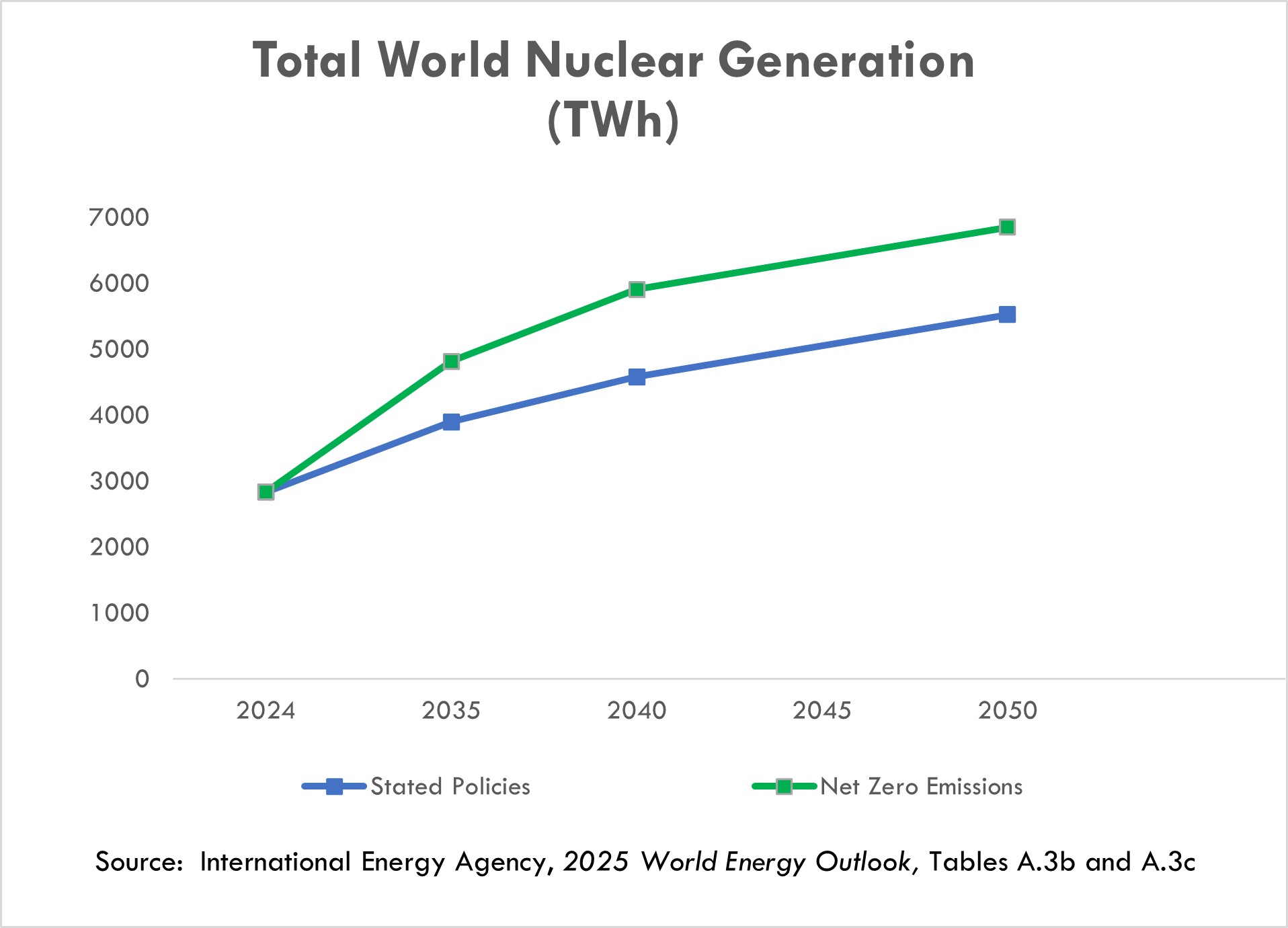
As a consequence of the March 2011 earthquake and tsunami in Japan, over 60 reactors in Japan and Germany were taken offline, and other countries curtailed or slowed their construction of new reactors or accelerated the retirement of existing plants. In Japan, 15 reactors have restarted, and an additional 10 reactors are in the process of restart approval. Due to the war in Ukraine, the EU is encouraging its member countries to reconsider the planned early retirement of existing plants in order to reduce reliance on Russian gas imports.
37
In October 2020, the DOC reached an agreement with the Russian Federation on an extension of the RSA, a trade agreement that allows for Russian-origin nuclear fuel to be exported to the United States in limited quantities. The two parties agreed to extend the agreement through 2040 and to set aside a significant portion of the quota for Centrus’ shipments to the United States through 2028 to perform under our TENEX Supply Contract. This outcome allowed for sufficient quota for Centrus to continue serving its utility customers and support its investments in building new capacity. Use of this quota is subject to compliance with limitations under the RSA. These limitations include a requirement that we return natural uranium to TENEX for the LEU we receive under the TENEX Supply Contract at approximately the same time that we deliver the LEU to our customers. Our ability to meet this requirement depends on the capacity or willingness of the facilities where natural uranium is supplied to us by customers to allow us to deliver this natural uranium to TENEX. We were notified by one facility that it will no longer receive natural uranium for TENEX. As a result, we will need to rely to a greater extent on deliveries at other processors or explore other options in order to comply with the RSA’s natural uranium delivery requirement.
The war in Ukraine escalated tensions between Russia and the international community. As a result, the United States and other countries imposed, including through the United States’ enactment of the Import Ban Act discussed below, and may continue imposing, additional sanctions, tariffs, and export controls against certain Russian products, services, organizations, and/or individuals and Russia passed the Russian Decree as discussed below. Such additional restrictions, and any Russian response thereto, could affect our ability to purchase, take delivery of, transport, or re-sell Russian uranium enrichment, engage in transactions with TENEX, or implement the TENEX Supply Contract, which would have a negative material impact on our business. Further, tariffs or sanctions by the United States, Russia or other countries may impact our ability and the cost to transport, export, import, take delivery, or make payments related to the LEU we purchase and may require us to increase purchases from non-Russian sources to the extent available. For example, due to restrictions imposed by Canada on the ability of Canadian persons and entities to provide ocean transportation services to Russia, a permit is required for our shipper, a Canadian company, to transport the LEU that we procure under the TENEX Supply Contract to the United States. A Canadian permit issued to our shipper was extended to March 2027, but for so long as the sanctions remain in place, the shipper will require further extensions beyond the expiration of the permit for continued shipments of LEU imports.
In response to the war in Ukraine, on May 13, 2024, the U.S enacted the Import Ban Act which banned imports of LEU from Russia into the U.S. beginning August 11, 2024, subject to issuance of waivers by the DOE. In accordance with the instructions published by the DOE, in 2024, the Company filed waiver request applications with the DOE and has received waivers allowing importation of LEU from Russia for deliveries already committed by the Company to its (i) U.S. customers in years 2024 through 2027 and (ii) foreign customers for processing and reexport. On December 11, 2024, the Company filed a third waiver request application to allow for importation of LEU from Russia in 2026 and 2027 for use in future sales to our U.S. customers. The U.S. ban on imports of Russian LEU, without the grant of additional timely waivers, would have a negative material impact on our business. Through 2027, well over one-half of the LEU that we expect to deliver to customers was sourced under the TENEX Supply Contract. While we have other sources of supply, they are not sufficient to replace the TENEX supply. It is uncertain whether any waiver would be granted in response to our pending or any potential future applications and, if granted, whether any waiver would be granted in a timely manner for us to benefit from it.
On November 14, 2024, the government of the Russian Federation passed the Russian Decree, which has been extended through December 31, 2027, that rescinded TENEX’s general license to export LEU to the United States or to entities registered in the United States. TENEX is required to obtain a specific export license from the Russian authorities for each shipment to Centrus through 2027. Except for isolated delays, TENEX has received specific licenses to satisfy shipments to Centrus in the regular course of business. However, Centrus has been informed that there is no certainty whether additional licenses will be issued by the Russian authorities and if issued, whether they will be issued in a timely manner and not rescinded prior to the shipment taking place.
38
Since the enactment of the Import Ban Act and through the issuance of the Russian Decree, TENEX has continued to implement the TENEX Supply Contract while we pursue waivers from the DOE. However, we do not know what future actions, including in response to the Russian Decree, TENEX might take. If TENEX refuses to make future deliveries or otherwise suspends deliveries for an extended period under the TENEX Supply Contract, our delivery obligations to our customers would be negatively impacted, which would have a material adverse effect on the Company.
On April 15, 2025, the President of the United States signed an Executive Order initiating a DOC investigation under Section 232 of the Trade Expansion Act of 1962, to determine whether imports of processed critical minerals, including uranium, and their derivative products threaten to impair national security. Following the investigation, on January 14, 2026, the President issued Proclamation 11001, which directed the Secretary of Commerce and the United States Trade Representative (“USTR”) to pursue negotiations with trading partners over the subsequent 180 days to ensure the United States maintains adequate supplies of critical minerals while mitigating supply-chain vulnerabilities affecting processed critical minerals and their derivative products. Proclamation 11001 indicated that, depending on the status or outcome of those negotiations, alternative remedies may be considered in the future, including the imposition of an additional sectoral tariff. The imposition of new or increased tariffs on these products or other trade restrictions from our international suppliers could significantly increase our costs and have a material adverse effect on our financial position and results of operations.
In addition to limitations targeted specifically at imports of LEU, the expanding sanctions imposed by the United States and foreign governments on the mechanisms used to make payments to Russia and to obtain services, including transportation and other services, have increased the risk that implementation of the TENEX Supply Contract may be disrupted in the future. For example, effective January 10, 2025, the U.S. Secretary of the Treasury, made a determination pursuant to section l(a)(i) of Executive Order 14024, to apply certain sanctions to any person determined, pursuant to that section, to operate or have operated in “the energy sector of the Russian Federation economy.” TENEX’s financial institutions have had challenges in accepting payments denominated in U.S. dollars and the Company and TENEX had for a period of time agreed to delay certain payments under the TENEX Supply Contract as the parties reviewed payment processing options. Additionally, on April 17, 2025, the Office of the USTR released a notice issuing the results of its investigation into China’s dominance in the maritime, logistics, and shipbuilding sectors pursuant to Section 302(a) of the Trade Act of 1974, as amended. The USTR imposed new service fees on Chinese-built vessels entering U.S. ports above certain capacity. Our shipper of Russian LEU from Russia to the U.S. uses ships manufactured in China which happen to be exempt from the new fees under this notice. However, these fees would be significant if they were to be imposed on our shipper. If the USTR changes its position and does not exempt the type of vessel our shipper uses, then the additional fees imposed on our shipper for docking at U.S. ports would be cost prohibitive, would have a significant impact on our ability to transport Russian LEU and would also have a material adverse effect on our financial position and results of operations. If the U.S. government were to prohibit companies and individuals from engaging in transactions with Rosatom and its subsidiaries, including TENEX, the Company and its suppliers could not implement the TENEX Supply Contract absent a license or other authorization from the sanctioning government.
Given all the foregoing, we continue to monitor the situation closely in order to address the potential impact of any new sanctions, or restrictions on the Company or potential tariffs on products it imports or purchases from foreign suppliers and possible mitigation thereof.
For further discussion of these risks and uncertainties, refer to Part I, Item 1A, Risk Factors in our Annual Report on Form 10-K for the year ended December 31, 2025 and under Part II, Item 1A, Risk Factors of this Quarterly Report on Form 10-Q.
39
Operating Results
Our revenues, operating results, and cash flows can fluctuate significantly from quarter to quarter and year to year. Our LEU segment backlog consists primarily of long-term, fixed commitment contracts and contingent sales commitments, and we have visibility on a significant portion of our revenue for 2026-2030, although our revenue is subject to material adverse impacts from the Import Ban Act and the Russian Decree.
Our future operating results are subject to uncertainties that could affect results either positively or negatively. Among the factors that could affect our results are the following:
•Our ability to obtain additional waivers to allow us to import LEU from Russia for future sales to our customers, given the enactment of the Import Ban Act;
•The ability of TENEX to obtain, or timely obtain, and the willingness of TENEX to continue to request, additional licenses to export LEU from Russia so that we may continue supplying LEU to our customers, given the enactment of the Russian Decree;
•Conditions in the LEU and energy markets, including pricing, demand, operations, government restrictions on imports, exports or investments, and regulations of our business and activities and those of our customers, suppliers, contractors, and subcontractors;
•Recently enacted tariffs and sanctions and the potential for additional tariffs, sanctions and other measures that restrict with whom we may transact or affect the importation, cost, sales or purchases of SWU or uranium or goods or services required for the sale, purchase, transportation or delivery of such SWU or uranium;
•Our ability to be awarded additional task orders under any of the HALEU Deconversion Contract or HALEU Production Contract;
•Insufficient or untimely U.S. government funding and government appropriations to support our IDIQ contracts with the U.S. federal government, including the HALEU Operation Contract and HALEU Production Contract;
•Regulatory uncertainty from new or rescinded executive orders or new or changes to interpretations of federal regulations;
•Armed conflicts, including the war in Ukraine, government actions and other events or third-party actions that disrupt supply chains, production, transportation, payments, and importation of nuclear materials or other critical supplies or services;
•The availability and terms of additional purchases or sales of SWU and uranium;
•Timing of customer orders, related deliveries, and purchases of LEU or LEU components;
•Costs of and future funding and demand for HALEU;
•Financial market conditions and other factors that may affect pension and benefit liabilities and the value of related assets;
•The outcome of legal proceedings and other contingencies;
•Potential use of cash for strategic or financial initiatives;
•Actions taken by customers and suppliers, including actions that might affect existing contracts;
•The U.S. government’s ability to satisfy its obligations, including supplying government furnished equipment under its agreements with the Company or processing security clearances due to a shutdown or other reasons; and
•Market, international trade, and other conditions impacting Centrus’ customers and the industry.
40
For further discussion of these risks and uncertainties, refer to Part I, Item 1A, Risk Factors, in our Annual Report on Form 10-K for the year ended December 31, 2025 and under Part II, Item 1A, Risk Factors of this Quarterly Report on Form 10-Q.
Backlog
The Company’s backlog is $3.9 billion and $3.8 billion as of March 31, 2026 and December 31, 2025, respectively, and extends to 2040. The backlog is recognized as revenue in future periods as work is performed or deliveries of SWU and uranium are made.
Our backlog in the LEU segment extends to 2040. As of March 31, 2026 and December 31, 2025, our backlog was approximately $3.1 billion and $2.9 billion, respectively. The backlog is the estimated aggregate dollar amount of revenue for future SWU and uranium deliveries primarily under medium and long-term contracts with fixed commitments. Of the $3.1 billion, approximately $2.4 billion represents contingent LEU sales contracts and commitments, all of which are under definitive agreements, in support of potential construction of LEU production capacity at the Piketon, Ohio facility. The contingent sales commitments depend on our ability to secure substantial public and private investment necessary to build new enrichment capacity. The LEU segment backlog also includes approximately $0.1 billion of deferred revenue and advances from customers as of March 31, 2026, whereby customers have made advance payments to be applied against future deliveries. No orders in our backlog are considered at risk related to customer operations. However, these medium and long-term contracts are subject to other significant risks and uncertainties, including existing trade laws and restrictions such as the RSA, Import Ban Act, and the Russian Decree, as well as the potential for additional sanctions and other restrictions affecting the Company or its suppliers, in response to the evolving situation regarding the war in Ukraine.
Our backlog in the Technical Solutions segment extends to 2034. As of both March 31, 2026 and December 31, 2025, our backlog was approximately $0.8 billion and $0.9 billion, respectively. Our backlog includes both funded amounts (services for which funding has been both authorized and appropriated by the customer), unfunded amounts (services for which funding has not been appropriated), and unexercised options in our contracts. If any of our contracts were to be terminated or options not being exercised, our remaining backlog would be reduced by the expected value of the cancelled contracts or forgone options.
There is no assurance that the revenues projected will be realized, or, if realized, will result in profits.
Revenue
We have two reportable segments: the LEU segment and the Technical Solutions segment.
Revenue from our LEU segment is derived primarily from the following:
•sales of the SWU component of LEU,
•sales of natural uranium hexafluoride, uranium concentrates or uranium conversion, and
•sales of enriched uranium product that include both the natural uranium hexafluoride and SWU components of LEU.
Our Technical Solutions segment revenue is primarily derived from the production of HALEU under the HALEU Operation Contract with DOE and technical, manufacturing, engineering, and operations services offered to public and private sector customers.
41
SWU and Uranium Sales
Revenue from our LEU segment accounted for approximately 58% of our total revenue for the three months ended March 31, 2026. The majority of our customers are domestic and international utilities that operate nuclear power plants, with international sales constituting approximately 44% of revenue from our LEU segment since 2024. Our agreements with electric utilities are primarily medium and long-term fixed-commitment contracts under which our customers are obligated to purchase a specified quantity of the SWU component of LEU from us. Contracts where we sell both the SWU and natural uranium hexafluoride components of LEU to utilities or where we sell natural uranium hexafluoride or uranium concentrates to utilities and other nuclear fuel related companies are generally shorter-term, fixed-commitment contracts. Individual customer orders for the SWU component of LEU fulfilled in the three months ended March 31, 2026 averaged approximately $13.7 million per order. As a result, a relatively small shift in the timing of customer orders for LEU may cause significant variability in our operating results period over period.
Utility customers, in general, have the option to make payment but defer receipt of SWU and uranium products purchased from Centrus beyond the contractual sale period, resulting in the deferral of revenue recognition and related costs. Refer to Note 2, Revenue and Contracts with Customers, of the Financial Statements for further details.
Our financial performance over time can be affected significantly by changes in prices for SWU and natural uranium hexafluoride. Market prices for SWU and uranium significantly declined from 2011 until mid-2018, when they began to trend upward. More recently, market uncertainty in the wake of the war in Ukraine has driven SWU and natural uranium hexafluoride prices sharply higher. Since our backlog includes contracts awarded to us in previous years, the average SWU price billed to customers typically lags published price indicators by several years. Revenue in our LEU business varies based upon the timing of customer contracts. The pricing of deliveries varies depending upon the market conditions at the time the contract was signed and may not reflect current market prices.
The Import Ban Act, which bans the importation of LEU from Russia, may severely limit importation through 2027. Notwithstanding our ability to obtain waivers under the Import Ban Act, the Russian Decree, which prohibits the exportation of Russian LEU without a license, may severely limit exportation of LEU from Russia through December 31, 2027. This has drawn attention to the potential for significant tightening of supplies in the market. Russian enrichment plants represent 43% of the world’s capacity, and Russian capacity significantly exceeds its domestic needs. According to data from the WNA, the annual enrichment requirements of reactors worldwide outside of Russia vastly exceeds the available supply of non-Russian enrichment, which potentially threatens the viability of some reactors, including those in the United States. While inventories and increased production at non-Russian plants may partially mitigate the shortfall, these options would not fully replace Russian supply. Deployment of new capacity ultimately could replace Russian enrichment, but this capacity will take a number of years and significant funding from private and/or government sources to come online. Centrus is seeking public and private funding to deploy new production capacity at its Piketon, Ohio plant to help meet the need for new, domestic supplies of enriched uranium.
42
The following chart summarizes SWU long-term price and SWU and UF6 spot price indicators, as published by TradeTech, LLC in Nuclear Market Review:
SWU and Uranium Market Price Indicators*
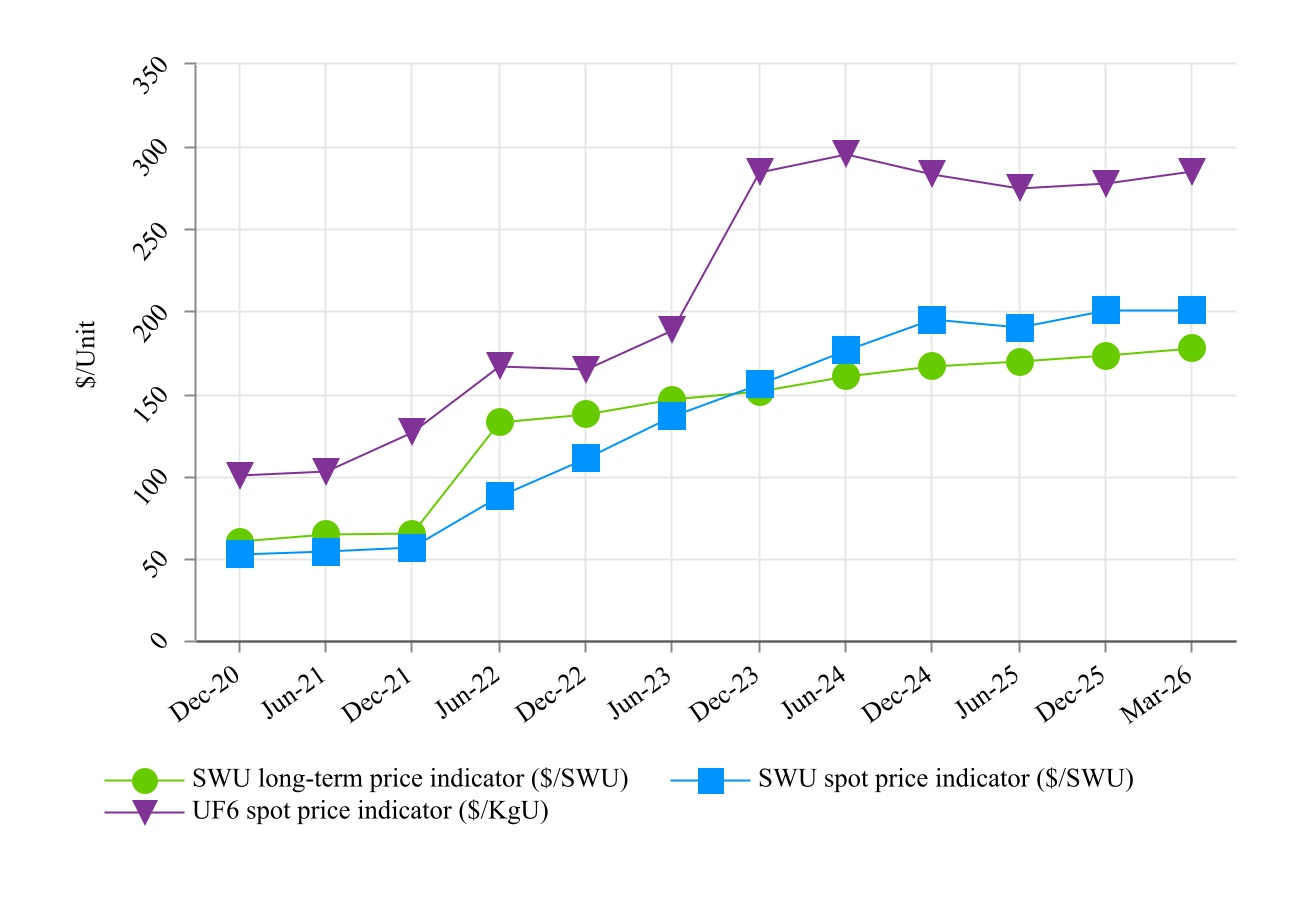
* Source: Nuclear Market Review, a TradeTech publication, www.uranium.info
Our contracts with customers are denominated primarily in U.S. dollars, and, although revenue has not been materially affected by changes in the foreign exchange rate of the U.S. dollar, we may have a competitive price advantage or disadvantage in obtaining new contracts in a competitive bidding process depending upon the weakness or strength of the U.S. dollar. Under customer contracts with deliveries from 2023 to 2025 and 2026 to 2030, respectively, payments are denominated in euros, and subject to exchange rate risk. Costs of our primary competitors are denominated in other currencies. Our contracts with suppliers are primarily denominated in U.S. dollars. We have a SWU supply agreement, that commenced in 2023, with prices payable in a combination of U.S. dollars and euros but with a contract-defined exchange rate.
On occasion, we accept payment for SWU in the form of natural uranium hexafluoride. Revenue from the sale of SWU under such contracts is recognized at the time LEU is delivered and is based on the fair value of the natural uranium hexafluoride at contract inception, or as the quantity of natural uranium hexafluoride is finalized, if variable.
43
Cost of sales for SWU and uranium is based on the amount of SWU, natural uranium hexafluoride and uranium concentrate sales delivered during the period and unit inventory costs, which are determined using the average cost method. Changes in purchase costs have an effect on inventory costs and cost of sales. Cost of sales includes costs for inventory management at off-site licensed locations as well as certain legacy costs related to former employees of the Portsmouth GDP and Paducah GDP.
Technical Solutions
Our Technical Solutions segment reflects our technical, manufacturing, engineering, and operations services offered to public and private sector customers, including the American Centrifuge engineering, procurement, construction, manufacturing, and operations services being performed under the HALEU Operation Contract. Subject to the availability of sufficient funding and offtake commitments, our goal is to expand our uranium enrichment capacity to meet the full range of U.S. government and commercial requirements for enriched uranium. With our government and private sector customers, we seek to leverage our domestic enrichment experience as well as our engineering know-how and precision manufacturing facility to assist customers with a range of engineering, design, and advanced manufacturing projects, including the production of fuel-related components for next-generation nuclear reactors and the development of related facilities. We continue to invest in advanced technology because of the potential for future growth into new areas of business for the Company, while also preserving our unique workforce at our Technology and Manufacturing Center in Oak Ridge, Tennessee, and our production facility near Piketon, Ohio.
44
Results of Operations
Segment Information
The following tables present elements of the accompanying Condensed Consolidated Statements of Operations and Comprehensive Income that are categorized by segment (dollar amounts in millions):
Three Months Ended March 31, 2026 Compared with Three Months Ended March 31, 2025
| Three Months Ended March 31, | |||||||||||||||||||||||
| 2026 | 2025 | $ Change | % Change | ||||||||||||||||||||
| LEU segment | |||||||||||||||||||||||
| Revenue: | |||||||||||||||||||||||
| SWU revenue | $ | 41.6 | $ | 51.3 | $ | (9.7) | (19) | % | |||||||||||||||
| Uranium revenue | 3.0 | — | 3.0 | n/a | |||||||||||||||||||
| Total | 44.6 | 51.3 | (6.7) | (13) | % | ||||||||||||||||||
| Cost of sales | 16.7 | 20.1 | (3.4) | (17) | % | ||||||||||||||||||
Gross profit | $ | 27.9 | $ | 31.2 | $ | (3.3) | (11) | % | |||||||||||||||
| Technical Solutions segment | |||||||||||||||||||||||
| Revenue | $ | 32.1 | $ | 21.8 | $ | 10.3 | 47 | % | |||||||||||||||
| Cost of sales | 28.5 | 20.1 | 8.4 | 42 | % | ||||||||||||||||||
Gross profit | $ | 3.6 | $ | 1.7 | $ | 1.9 | 112 | % | |||||||||||||||
| Total | |||||||||||||||||||||||
| Revenue | $ | 76.7 | $ | 73.1 | $ | 3.6 | 5 | % | |||||||||||||||
| Cost of sales | 45.2 | 40.2 | 5.0 | 12 | % | ||||||||||||||||||
Gross profit | $ | 31.5 | $ | 32.9 | $ | (1.4) | (4) | % | |||||||||||||||
Revenue
Revenue from the LEU segment was $44.6 million and $51.3 million for the three months ended March 31, 2026 and 2025, respectively, a decrease of $6.7 million (or 13%). SWU revenue decreased by $9.7 million as a result of a 47% decrease in the volume of SWU sold, partially offset by a 52% increase in the average price of SWU sold. The Company had uranium revenue of $3.0 million for the three months ended March 31, 2026.
Revenue from the Technical Solutions segment was $32.1 million and $21.8 million for the three months ended March 31, 2026 and 2025, respectively, an increase of $10.3 million (or 47%). The increase in revenue is primarily attributable to a $9.8 million increase in revenue generated by the HALEU Operation Contract, while the remaining change is related to other contracts. Revenue from the HALEU Operation Contract is recorded on a cost-plus-incentive-fee basis and includes a target fee for Phases 2 and 3 of the contract.
Cost of Sales
Cost of sales for the LEU segment was $16.7 million and $20.1 million for the three months ended March 31, 2026 and 2025, respectively, a decrease of $3.4 million (or 17%). SWU costs decreased as a result of a 47% decrease in the volume of SWU sold, partially offset by a 45% increase in the average unit cost of SWU sold. Uranium costs increased primarily as a result of an increase in the volume of uranium sold.
45
Cost of sales for the Technical Solutions segment was $28.5 million and $20.1 million for the three months ended March 31, 2026 and 2025, respectively, an increase of $8.4 million (or 42%). The increase is primarily attributable to an $8.2 million increase in costs incurred under the HALEU Operation Contract, while the remaining change is attributable to other contracts.
Gross Profit
Gross profit for the LEU segment was $27.9 million and $31.2 million for the three months ended March 31, 2026 and 2025, respectively, a decrease of $3.3 million (or 11%). LEU customers generally have multi-year contracts that carry annual purchase commitments, not quarterly commitments. The gross profit in our LEU business varies based upon the timing of those contracts. The pricing applied to deliveries varies depending upon the market conditions at the time the contract was signed. The decrease for the three months ended March 31, 2026 was primarily due to the composition of contracts in the current quarter, compared to the prior quarter.
Gross profit for the Technical Solutions segment was $3.6 million and $1.7 million for the three months ended March 31, 2026 and 2025, respectively, an increase of $1.9 million (or 112%). The increase was primarily attributable to the factors discussed above. Because of the delay in completing Phase 2 of the HALEU Operation Contract, DOE extended the Phase 2 period of performance through January 31, 2026. Costs incurred subsequent to November 2024 have not yet been subject to a fee as this portion of Phase 2 remains undefinitized and is subject to negotiation.
46
Non-Segment Information
The following tables present elements of the accompanying Condensed Consolidated Statements of Operations and Comprehensive Income that are not categorized by segment (dollar amounts in millions):
Three Months Ended March 31, 2026 Compared with Three Months Ended March 31, 2025
| Three Months Ended March 31, | |||||||||||||||||||||||
| 2026 | 2025 | $ Change | % Change | ||||||||||||||||||||
Gross profit | $ | 31.5 | $ | 32.9 | $ | (1.4) | (4) | % | |||||||||||||||
| Advanced technology costs | 18.9 | 3.0 | 15.9 | 530 | % | ||||||||||||||||||
| Selling, general and administrative | 10.0 | 8.3 | 1.7 | 20 | % | ||||||||||||||||||
| Amortization of intangible assets | 1.8 | 1.1 | 0.7 | 64 | % | ||||||||||||||||||
Operating income | 0.8 | 20.5 | (19.7) | (96) | % | ||||||||||||||||||
Nonoperating components of net periodic benefit loss | 1.0 | 0.9 | 0.1 | 11 | % | ||||||||||||||||||
| Interest expense | 4.0 | 3.4 | 0.6 | 18 | % | ||||||||||||||||||
| Investment income | (17.0) | (7.3) | (9.7) | (133) | % | ||||||||||||||||||
| Extinguishment of long-term debt | — | (11.8) | 11.8 | 100 | % | ||||||||||||||||||
| Other expense, net | 0.3 | 0.1 | 0.2 | 200 | % | ||||||||||||||||||
Income before income taxes | 12.5 | 35.2 | (22.7) | (64) | % | ||||||||||||||||||
Income tax expense | 2.5 | 8.0 | (5.5) | (69) | % | ||||||||||||||||||
Net income and comprehensive income | $ | 10.0 | $ | 27.2 | $ | (17.2) | (63) | % | |||||||||||||||
Advanced Technology Costs
Advanced technology costs were $18.9 million and $3.0 million for the three months ended March 31, 2026 and 2025, respectively, an increase of $15.9 million (or 530%). Advanced technology costs consist of American Centrifuge work and related expenses that are outside of our customer contracts in the Technical Solutions segment, including bid and proposal activities and work to improve our enrichment capability. The increase is due to costs associated with our previously announced expansion projects at Oak Ridge and Piketon.
Investment Income
Investment income was $17.0 million and $7.3 million for the three months ended March 31, 2026 and 2025, respectively, an increase of $9.7 million (or 133%). The Company’s investment income represents interest earned on operating cash, which is primarily held in money market accounts. The increase was due primarily to a higher cash balance driven by the proceeds from the issuance of the 0% Convertible Notes in August 2025 and proceeds from the issuance of Class A Common Stock under our ATM program in the second and fourth quarters of 2025.
Extinguishment of Long-Term Debt
Pursuant to a redemption notice, on March 26, 2025, the Company redeemed all of the outstanding 8.25% Notes at a redemption price equal to 100% of the principal amount, together with any accrued and unpaid interest. The Company recorded a gain of $11.8 million related to the extinguishment of the 8.25% Notes in the year ended December 31, 2025.
47
Income Tax Expense
Income tax expense was $2.5 million and $8.0 million in the three months ended March 31, 2026 and 2025, respectively, a decrease of $5.5 million (or 69%). Income tax expense for both periods resulted from applying the annual effective tax rate to the quarterly income from continuing operations adjusted for discrete items. For more information about the valuation allowance, see Note 14, Income Taxes, in our Consolidated Financial Statements on Form 10-K for the year ended December 31, 2025.
Net Income and Comprehensive Income
Net income was $10.0 million and $27.2 million for the three months ended March 31, 2026 and 2025, respectively, a decrease of $17.2 million (or 63%). The decrease was primarily attributable to an increase in advanced technology costs of $15.9 million and a decrease in extinguishment of long-term debt of $11.8 million. This was partially offset by an increase of $9.7 million in investment income and a decrease of $5.5 million in income tax expense, as discussed above.
48
Non-GAAP Results of Operations
The Company measures Operating Income, Net Income and Net Income per Share both on a GAAP basis and on an adjusted basis (“Adjusted Operating Income”, “Adjusted Net Income” and “Adjusted Net Income per Share”) to exclude short-term, non-capitalizable costs related to the expansion of our operations in Piketon, Ohio and Oak Ridge, Tennessee to scale up uranium enrichment operations (“Growth Costs”) and stock-based compensation. Growth Costs relate to the initial phase of our expansion projects (e.g. manufacturing readiness and the training and onboarding of new employees) and are included as Advanced Technology Costs on the Condensed Consolidated Statements of Operations and Comprehensive Income. The Company expects to stop expensing Growth Costs as costs related to our expansion projects become capitalizable. We incur expense related to stock-based compensation which are included as Selling, General and Administrative expense on the Condensed Consolidated Statements of Operations and Comprehensive Income.
We believe Adjusted Operating Income, Adjusted Net Income and Adjusted Net Income per Share, which are non-GAAP financial measures, provide investors with additional understanding of the Company’s overall financial performance as well as its strategic financial planning analysis and period-to-period comparability. These metrics are useful to investors because they reflect how management evaluates the Company’s ongoing operating performance from period-to-period after removing certain transactions and activities that affect comparability of the metrics and are not reflective of the Company’s core operations.
Our calculation of Adjusted Operating Income, Adjusted Net Income, and Adjusted Net Income per Share may not be comparable to similarly named measures reported by other companies.
| Three Months Ended March 31, 2026 | Three Months Ended March 31, 2025 | ||||||||||||||||||||||||||||||||||||||||||||||
GAAP | Growth Costs | Stock-Based Compensation | Adjusted (Non-GAAP) | GAAP | Growth Costs | Stock-Based Compensation | Adjusted (Non-GAAP) | ||||||||||||||||||||||||||||||||||||||||
Gross profit | 31.5 | — | — | 31.5 | 32.9 | — | — | 32.9 | |||||||||||||||||||||||||||||||||||||||
| Advanced technology costs | 18.9 | (17.0) | — | 1.9 | 3.0 | (1.3) | — | 1.7 | |||||||||||||||||||||||||||||||||||||||
| Selling, general and administrative | 10.0 | — | (0.4) | 9.6 | 8.3 | — | (0.5) | 7.8 | |||||||||||||||||||||||||||||||||||||||
| Amortization of intangible assets | 1.8 | — | — | 1.8 | 1.1 | — | — | 1.1 | |||||||||||||||||||||||||||||||||||||||
Operating income | 0.8 | 17.0 | 0.4 | 18.2 | 20.5 | 1.3 | 0.5 | 22.3 | |||||||||||||||||||||||||||||||||||||||
Nonoperating components of net periodic benefit loss | 1.0 | — | — | 1.0 | 0.9 | — | — | 0.9 | |||||||||||||||||||||||||||||||||||||||
| Interest expense | 4.0 | — | — | 4.0 | 3.4 | — | — | 3.4 | |||||||||||||||||||||||||||||||||||||||
| Investment income | (17.0) | — | — | (17.0) | (7.3) | — | — | (7.3) | |||||||||||||||||||||||||||||||||||||||
Extinguishment of long-term debt | — | — | — | — | (11.8) | — | — | (11.8) | |||||||||||||||||||||||||||||||||||||||
Other expense, net | 0.3 | — | — | 0.3 | 0.1 | — | — | 0.1 | |||||||||||||||||||||||||||||||||||||||
Income before income taxes | 12.5 | 17.0 | 0.4 | 29.9 | 35.2 | 1.3 | 0.5 | 37.0 | |||||||||||||||||||||||||||||||||||||||
Income tax expense | 2.5 | 3.8 | 0.1 | 6.4 | 8.0 | 0.3 | 0.1 | 8.4 | |||||||||||||||||||||||||||||||||||||||
Net income and comprehensive income | $ | 10.0 | $ | 13.2 | $ | 0.3 | $ | 23.5 | $ | 27.2 | $ | 1.0 | $ | 0.4 | $ | 28.6 | |||||||||||||||||||||||||||||||
Net income per share: | |||||||||||||||||||||||||||||||||||||||||||||||
| Basic | $ | 0.51 | $ | 0.67 | $ | 0.01 | $ | 1.19 | $ | 1.60 | $ | 0.06 | $ | 0.02 | $ | 1.68 | |||||||||||||||||||||||||||||||
| Diluted | $ | 0.45 | $ | 0.59 | $ | 0.01 | $ | 1.05 | $ | 1.60 | $ | 0.06 | $ | 0.02 | $ | 1.68 | |||||||||||||||||||||||||||||||
| Average number of common shares outstanding (in thousands): | |||||||||||||||||||||||||||||||||||||||||||||||
| Basic | 19,773 | — | — | 19,773 | 16,982 | — | — | 16,982 | |||||||||||||||||||||||||||||||||||||||
| Diluted | 22,446 | — | — | 22,446 | 17,048 | — | — | 17,048 | |||||||||||||||||||||||||||||||||||||||
49
Liquidity and Capital Resources
As of March 31, 2026, the Company had a consolidated cash and cash equivalents balance of $1.9 billion. The Company anticipates having adequate liquidity to support our business operations for at least the next 12 months from the date of this Quarterly Report on Form 10-Q. Our view of liquidity is dependent on, among other things, conditions affecting our operations, including market, international trade restrictions, sanctions and other conditions, the impact of the Import Ban Act and our ability to obtain additional waivers thereunder, the impact of the Russian Decree and the ability of TENEX to secure export licenses thereunder, the level of expenditures and government funding for our services contracts, and the timing of customer payments. Liquidity requirements for our existing operations are affected primarily by the timing and amount of customer sales and our inventory purchases.
Cash resources and net sales proceeds from our LEU segment fund technology costs that are outside of our customer contracts in the Technical Solutions segment and general corporate expenses, including cash interest payments on our debt. We believe our investment in advanced U.S. uranium enrichment technology will position the Company to meet the needs of our customers as they deploy advanced reactors and require next generation fuels.
In November 2022, the DOE awarded the HALEU Operation Contract to the Company with an initial base contract value of approximately $150.0 million in two phases through 2024, with three optional periods for up to nine additional years of production beyond the base contract. Those options are at the DOE’s sole discretion and subject to the availability of Congressional appropriations.
In November 2023, the Company announced that it made its first contractual delivery of HALEU UF6 to the DOE, completing Phase 1. During November 2023, the Company transitioned to Phase 2 of the HALEU Operation Contract, which included production of 900 kilograms of HALEU UF6 for one production year, as well as continued operations and maintenance of the cascade. Phase 2 included an initial contract value of approximately $90.0 million and compensation on a cost-plus-incentive-fee-basis. The DOE owns the HALEU produced from the demonstration cascade. The DOE extended the HALEU Operation Contract Phase 2 period of performance through January 31, 2026 to allow the Company to complete outstanding change orders. As of March 31, 2026, the Phase 2 contract value and related funding is approximately $170.1 million. The Company also is performing additional work on infrastructure and facility repairs and costs associated with 5B Cylinder refurbishment under contract modifications.
The HALEU Operation Contract also gives DOE the ability to exercise three optional periods to contract for up to nine additional years of production from the cascade beyond the base contract; those options are at the DOE’s sole discretion and subject to the availability of Congressional appropriations. On June 17, 2025, the DOE exercised Option 1a of Phase 3 of the HALEU Operation Contract with a period of performance extending through June 30, 2026. Option 1a of Phase 3 of the HALEU Operation Contract has a contract value and related funding of $108.2 million.
On January 5, 2026, the DOE announced that Centrus subsidiary, ACO, was awarded a $900.0 million task order to expand its uranium enrichment facility in Piketon, Ohio, to include commercial-scale production of HALEU. The award also includes options, at the DOE’s discretion, for up to an additional $170.0 million to produce and deliver HALEU to the DOE. The task order is subject to negotiation of a definitive agreement and there are no guarantees about whether or when funding by the DOE for such expansion would be awarded.
Although the Company believes demand for HALEU will emerge over the next several years, there are no guarantees about whether or when government or commercial demand for HALEU will materialize, and there are a number of technical, regulatory, and economic hurdles that must be overcome for these fuels and the reactors that will use these fuels to come to market. For further discussion, refer to Part I, Item 1A, Risk Factors, in our Annual Report on Form 10-K for the year ended December 31, 2025 and under Part II, Item 1A, Risk Factors of this Quarterly Report on Form 10-Q.
50
If funding of gas centrifuge technology by the U.S. government is reduced or discontinued, or we are not awarded the option to continue to operate the cascade or expand it, such actions may have a material adverse impact on our ability to deploy the American Centrifuge technology and on our liquidity. If funding under U.S. federal government programs or contracts and subcontracts, including under the HALEU Operation Contract, HALEU Deconversion Contract, or HALEU Production Contract, is delayed, reduced or terminated, as a result of the changes in the prevailing policies and budgetary priorities of the incumbent administration or otherwise, it could have a material adverse impact on our operations, including our ability to deploy the American Centrifuge technology.
Further, any sanctions or other restrictions, including the Import Ban Act banning LEU imports from Russia and the Russian Decree prohibiting LEU exports out of Russia in the absence of a license, represent a significant risk to our business as we rely on the TENEX Supply Contract as a significant supply source to meet our delivery obligations. Such restrictions on LEU imports to the U.S. or exports from Russia could have a material impact on our operations and liquidity. For further discussion, please refer to Part I, Item 1A, Risk Factors, in our Annual Report on Form 10-K for the year ended December 31, 2025 and under Part II, Item 1A, Risk Factors of this Quarterly Report on Form 10-Q.
We expect to increase our capital expenditures by approximately several hundred million, driven by ongoing investments and a strategic shift towards our manufacturing readiness plan and Ohio expansion. We expect that our strong liquidity position will support our capital expenditures, although we are monitoring inflationary pressures that may affect the cost of materials and equipment.
Expansion of Manufacturing Capacity in Oak Ridge, Tennessee
On November 20, 2024, the Company announced the resumption of centrifuge manufacturing activities and expanding its manufacturing capacity at our facility in Oak Ridge, Tennessee. The Company is investing $60.0 million over an 18 month period which lays the groundwork to support a potential large-scale expansion of uranium enrichment in Piketon, Ohio. This was followed with an announcement on January 23, 2026 that the Company plans to invest more than $560.0 million over the next several years to transition the facility to a high-rate manufacturing plant and support the production of thousands of advanced centrifuges in Oak Ridge, Tennessee. The first new centrifuges produced in Oak Ridge are expected to come online in Ohio in 2029.
Expansion of Uranium Enrichment Capacity in Piketon, Ohio
On September 25, 2025, Centrus announced plans for a major expansion of its uranium capacity in Piketon, Ohio, including plans for large-scale production of both LEU and HALEU to meet commercial and government requirements.
In December 2025, the Company initiated design work on a 150,000 square foot training, operations and maintenance facility in Piketon, Ohio – a critical piece of site infrastructure necessary to support the Company's plans for a major expansion of its uranium enrichment capacity in Piketon. The project involves a significant renovation and rehabilitation of an existing, largely vacant building on the site of the American Centrifuge Plant in Piketon, Ohio. Construction activities began in early 2026. The facility is expected to include a mix of office space, training facilities, and maintenance bays to support plant operations. Also in December 2025, the Company began domestic centrifuge manufacturing to support commercial LEU enrichment activities at the Piketon, Ohio, facility. This strategic move enables the Company to capitalize on its many first-mover advantages in U.S.-owned domestic uranium enrichment, and marks one of the most consequential transformations in the Company's and the United States' uranium enrichment history. Centrus plans to leverage its multi-billion-dollar uranium enrichment expansion to meet its growing backlog of $2.4 billion in contingent LEU sales to U.S. and international customer contracts, and targets future commercial-scale production of HALEU, as well.
51
In March 2026, Centrus announced a partnership with Palantir to apply Palantir’s artificial intelligence (“AI”)-driven software tools in support of the American Centrifuge Plant expansion. Through this partnership, Centrus is leveraging Palantir’s Foundry and Artificial Intelligence Platform to integrate disparate systems across classified and unclassified environments and utilize AI to optimize project controls, engineering, manufacturing execution, supply chain management, and regulatory compliance.
Clean Energy Credit
The Qualifying Advanced Energy Project Credit (“§48C”) was established by the American Recovery and Reinvestment Act of 2009 and renewed and expanded under the IRA. The §48C program aims to strengthen U.S. industrial competitiveness and clean energy supply chains. As the nation builds a net-zero economy, the §48C tax credit program aims to play a critical role to create high-quality jobs, reduce industrial emissions, and increase domestic production of critical clean energy products and materials. The IRA provided $10.0 billion in new funding under §48C(e), with at least $4.0 billion reserved for projects in certain energy communities with closed coal mines or retired coal-fired power plants, to allocate credits to projects in three categories: (1) clean energy manufacturing and recycling, (2) industrial decarbonization, and (3) critical materials refining, processing, and recycling.
On October 18, 2024, the Company submitted an application for a clean energy manufacturing and recycling project associated with re-equipping our manufacturing property at our manufacturing facility in Oak Ridge. This would recreate a viable enrichment supply chain and allow ACO to manufacture centrifuge parts to be used in centrifuge machines to enrich uranium. Our application requested an allocation of $62.4 million based on a qualified investment in eligible property of $208.0 million made by Centrus. On January 10, 2025, the Company was informed that the IRS granted our request for a $62.4 million credit allocation for this facility. Centrus now has two years from that date to provide evidence that the requirements of the credit have been met thus certifying our credit allocation. Upon certification of our credit allocation, the Company then has two years from that date to notify the DOE that the qualified investment in eligible property is placed in service to receive the credit allocation.
Section 6418 was added to the Internal Revenue Code as part of the IRA and allows certain eligible taxpayers to elect to transfer certain clean energy tax credits to unrelated taxpayers for cash rather than use the credits to offset their U.S. federal income tax liability. The Company expects that we will be able to monetize all credit allocations received from §48C by transferring them to unrelated taxpayers for cash. It is unclear how the January 20, 2025 Executive Order 14154, “Unleashing American Energy,” will impact the IRS determination regarding our application request.
Potential Transactions
We are also actively considering and expect to consider potential strategic transactions from time to time, which at any given time may be in various stages of discussion, diligence, or negotiation. These could involve, without limitation, acquisitions and/or dispositions of businesses or assets, joint ventures or investments in businesses, products or technologies, or changes to our capital structure. In connection with any such transaction, we would seek to satisfy these needs through a combination of working capital, cash generated from operations, or additional debt or equity financing.
52
Cash Flow
The change in cash, cash equivalents and restricted cash from our Condensed Consolidated Statements of Cash Flows are as follows on a summarized basis (in millions):
| Three Months Ended March 31, | |||||||||||
| 2026 | 2025 | ||||||||||
| Cash (used in) provided by operating activities | $ | (35.1) | $ | 36.5 | |||||||
| Cash used in investing activities | (23.2) | (2.1) | |||||||||
| Cash used in financing activities | (0.3) | (52.6) | |||||||||
| Effect of exchange rate changes on cash, cash equivalents and restricted cash | (0.3) | (0.1) | |||||||||
| Decrease in cash, cash equivalents and restricted cash | $ | (58.9) | $ | (18.3) | |||||||
Operating Activities
For the three months ended March 31, 2026, net cash used by operating activities was $35.1 million. The net decrease was primarily due to approximately $76.2 million of disbursements for operations, of which approximately $63.7 million relates to both payments for LEU inventory deliveries and cash outflows for the Technical Solutions segment, with the remaining disbursements being for corporate administration, benefits claims, and advanced technology costs. These cash outflows were partially offset by approximately $48.4 million in cash collected from customers and investment income.
For the three months ended March 31, 2025, net cash provided by operating activities was $36.5 million. The net increase was primarily due to approximately $123.0 million in cash collected from customers and investment income. These cash inflows were partially offset by approximately $87.0 million of disbursements for operations, of which approximately $59.0 million relates to both payments for LEU inventory deliveries and cash outflows for the Technical Solutions segment, with the remaining disbursements being for corporate administration, benefits claims, and advanced technology costs.
Investing Activities
Capital expenditures were $23.2 million and $2.1 million for the three months ended March 31, 2026 and 2025, respectively.
Financing Activities
For the three months ended March 31, 2025, cash of $25.2 million was provided from the net proceeds related to the issuance of 258,197 shares of Class A Common Stock under ATM offerings.
Pursuant to a redemption notice, on March 26, 2025, the Company redeemed all 8.25% Notes at a redemption price equal to 100% of the principal amount of $74.3 million, together with any accrued and unpaid interest. Refer to Note 6, Debt, of the Financial Statements regarding the accounting for the 8.25% Notes.
53
Working Capital
The following table summarizes the Company’s working capital (in millions):
| March 31, 2026 | December 31, 2025 | ||||||||||
| Cash and cash equivalents | $ | 1,868.2 | $ | 1,957.2 | |||||||
| Accounts receivable | 41.8 | 30.7 | |||||||||
| Inventories, net | 165.2 | 130.2 | |||||||||
| Deferred revenue and advances from customers, net of deferred costs | (75.8) | (90.2) | |||||||||
| Other current assets and liabilities, net | (105.3) | (87.1) | |||||||||
| Working capital | $ | 1,894.1 | $ | 1,940.8 | |||||||
We are managing our working capital to seek to improve the long-term value of our LEU and Technical Solutions segments because we believe these uses of working capital are in the best interest of all stakeholders. We expect that any other uses of working capital will be undertaken in light of these strategic priorities and will be based on the Company’s determination as to the relative strength of its operating performance and prospects, financial position, and expected liquidity requirements. In addition, we expect that any such other uses of working capital will be subject to compliance with contractual restrictions to which the Company and its subsidiaries are subject. We continually evaluate alternatives to manage our capital structure and may opportunistically repurchase, exchange, or redeem Company securities from time to time.
Convertible Notes
On November 7, 2024, the Company issued 2.25% Convertible Notes with an aggregate principal amount of $402.5 million, due November 1, 2030, unless earlier repurchased, redeemed or converted. The 2.25% Convertible Notes bear interest at an annual rate of 2.25%, payable semi-annually in arrears on May 1 and November 1 of each year, beginning on May 1, 2025. The Company incurred approximately $13.8 million in issuance costs for the issuance of the 2.25% Convertible Notes.
On August 18, 2025, the Company issued 0% Convertible Notes with an aggregate principal amount of $805.0 million, due August 15, 2032, unless earlier repurchased, redeemed or converted. The 0% Convertible Notes do not bear regular interest, and the principal amount of the notes will not accrete. The Company incurred approximately $22.5 million in issuance costs for the issuance of the 0% Convertible Notes.
There are no required principal payments prior to the maturity of the 2.25% Convertible Notes or 0% Convertible Notes. The proceeds from the 2.25% Convertible Notes and the 0% Convertible Notes have been or will be used for general working capital and corporate purposes, which may include investment in technology development or deployment, repayment or repurchase of outstanding debt, capital expenditures, potential acquisitions and other business opportunities and purposes. Additional terms and conditions of the 0% Convertible Notes are described in Note 6, Debt, of the Financial Statements.
For calendar quarters in which the Convertible Notes became convertible at the option of the holders, the Company provided notice to the holders of the Convertible Notes that the notes became convertible beginning on the first day of the respective subsequent quarter, and ending at the close of business on the last day of said quarter. As of April 30, 2026, no notes were converted during those periods.
54
8.25% Notes
Pursuant to a notice of redemption issued on February 24, 2025, on March 26, 2025, the Company redeemed all 8.25% Notes at a redemption price equal to 100% of the $74.3 million aggregate principal amount, together with any accrued and unpaid interest. The Company recorded a gain of $11.8 million to Extinguishment of Long-Term Debt in the Condensed Consolidated Statements of Operations.
2025 Shelf Registration
The Company filed an automatic shelf registration statement on Form S-3 (File No. 333-291305) with the SEC on November 6, 2025, which became effective on November 6, 2025, and was supplemented by a prospectus supplement dated November 6, 2025. Pursuant to this shelf registration statement, the Company may offer and sell up to $1.0 billion in securities, in aggregate. The Company retains broad discretion over the use of the net proceeds from the sale of the securities offered.
Common Stock Issuance
Pursuant to a sales agreement with its agents, the Company sold an aggregate of 258,197 shares of its Class A Common Stock at the market price in the three months ended March 31, 2025 for a total of $26.1 million. After expenses and commissions paid to the agents, the Company’s proceeds totaled $25.4 million in the three months ended March 31, 2025. Additionally, the Company recorded direct costs of $0.1 million in the three months ended March 31, 2025 related to the issuance. The Company did not issue any shares of its Class A Common Stock under an ATM offering in the three months ended March 31, 2026.
The shares of Class A Common Stock were issued pursuant to the Company’s 2023 shelf registration statement on Form S-3 (File No. 333-272984), which was filed with the SEC on June 28, 2023 and became effective on July 10, 2023. This filing was supplemented by prospectus supplements dated February 9, 2024 and May 9, 2025, respectively. Pursuant to this shelf registration statement, the Company may offer and sell up to an aggregate of $200.0 million in securities.
Unless otherwise specified in any prospectus supplement, the Company has used and/or intends to use the net proceeds from the sale of its securities offered under these prospectuses for working capital and general corporate purposes including, but not limited to, capital expenditures, investment in technology development and deployment, repayment of indebtedness, potential acquisitions and other business opportunities. Pending any specific application, the Company may initially invest funds in short-term marketable securities or apply them to the reduction of indebtedness.
Contractual Commitments
There have been no material changes to our contractual commitments from those discussed in our Annual Report on Form 10-K for the year ended December 31, 2025.
DOE Technology License
We have a non-exclusive license in DOE inventions that pertain to enriching uranium using gas centrifuge technology. The license agreement with DOE provides for annual royalty payments based on a varying percentage (1% up to 2%) of our annual revenues from sales of the SWU component of LEU produced by us using DOE centrifuge technology. There is a minimum annual royalty payment of $100,000 and the maximum cumulative royalty over the life of the license is $100.0 million. There is currently no commercial enrichment facility producing LEU using DOE centrifuge technology. We are continuing to advance our U.S. centrifuge technology that has evolved from DOE inventions at specialized facilities in Oak Ridge, Tennessee with a view to deploying a commercial enrichment facility over the long term.
55
Off-Balance Sheet Arrangements
Other than our SWU purchase commitments and the license agreement with DOE relating to the American Centrifuge technology, there were no material off-balance sheet arrangements at March 31, 2026.
Critical Accounting Policies and Estimates
There have been no significant changes to the critical accounting estimates disclosed in Part II, Item 7, Management’s Discussion and Analysis of Financial Condition and Results of Operations, in our Annual Report on Form 10-K for the year ended December 31, 2025.
Item 3. Quantitative and Qualitative Disclosures About Market Risk
There have been no material changes to our market risks from those discussed in our Annual Report on Form 10-K for the year ended December 31, 2025.
Item 4. Controls and Procedures
Evaluation of Disclosure Controls and Procedures
Centrus maintains disclosure controls and procedures that are designed to ensure that information required to be disclosed by Centrus in reports it files or submits under the Exchange Act is recorded, processed, summarized and reported in the time periods specified in the SEC’s rules and forms and that such information is accumulated and communicated to management, including the Chief Executive Officer and the Chief Financial Officer, as appropriate to allow for timely decisions regarding required disclosures.
As of March 31, 2026, the end of the period covered by this Quarterly Report on Form 10-Q, our management performed an evaluation, under the supervision and with the participation of the Chief Executive Officer and the Chief Financial Officer, of the effectiveness of our disclosure controls and procedures (as defined in Rule 13a-15(e) under the Exchange Act). Based on this evaluation, the Chief Executive Officer and the Chief Financial Officer concluded that the Company’s disclosure controls and procedures were effective.
Changes in Internal Control Over Financial Reporting
There were no changes in our internal control over financial reporting during the quarter ended March 31, 2026, that have materially affected, or are reasonably likely to materially affect, our internal control over financial reporting.
56
PART II
Item 1. Legal Proceedings
Refer to Note 11, Commitments and Contingencies — Legal Matters, of our Financial Statements in Part I of this Quarterly Report on Form 10-Q.
Item 1A. Risk Factors
Except as set forth below, there have been no material changes to the Risk Factors described in Part I, Item 1A, Risk Factors, in our Annual Report on Form 10-K for the year ended December 31, 2025.
General Risk Factors
We are integrating AI technologies into our operations, including through strategic partnerships, which may present business, compliance, regulatory and reputational risks.
We and our business partners are increasingly incorporating AI-driven software tools across various aspects of the Company's operations and business functions, including to streamline workflows and optimize key business processes. While we believe the adoption of AI-driven technologies will enhance our operational efficiency and competitive positioning, these technologies involve significant risks and uncertainties that may not yield corresponding benefits, and may exacerbate other risks. Flaws, biases, errors, misconfigurations or malfunctions in AI-driven systems could result in operational disruptions or could result in unintended, unexpected, or otherwise unforeseen adverse consequences, including data loss, corruption or the generation of outputs that appear correct but are inaccurate or misleading. Such failures could include potential breaches of contracts, security protocols, unauthorized disclosure of sensitive or classified information and noncompliance with applicable governmental and defense-related or third party requirements.
In addition, AI technologies could be improperly utilized by our employees or by personnel of our business partners, potentially leading to the unauthorized use or disclosure of confidential, proprietary or classified information or unintended, unexpected, or otherwise unforeseen adverse consequences, which could harm our reputation and expose us to significant legal, regulatory and contractual liability. AI also presents a new attack surface that cyber threat actors may exploit to scale and automate targeted cyberattacks. The regulatory environment governing AI technologies remains uncertain and developments in regulatory frameworks may adversely affect our ability to use AI technologies, subject us to enhanced governmental or regulatory scrutiny, litigation or enforcement actions or require us to make significant changes to our operations. Our reliance on business partners also subjects us to risks associated with each partner’s ability to comply with applicable legal and regulatory requirements and maintain the security and integrity of its systems.
If we fail to successfully integrate AI into our business processes or fail to keep pace with rapidly evolving AI technological developments, we may face competitive disadvantages or experience disruptions to our operations or other unintended, unexpected, or otherwise unforeseen adverse consequences. Any of the foregoing risks could have a material adverse effect on our business, reputation, financial condition, results of operations and prospects.
Item 5. Other Information
None of our directors or executive officers adopted terminated
57
Item 6. Exhibits
| Exhibit No. | Description | ||||
3.1 | |||||
10.1 | |||||
10.2 | Agreement for Engineering, Procurement, and Construction Services between American Centrifuge Operating, LLC and Fluor Federal Services, Inc. (certain information has been omitted because the identified confidential portions (i) are not material and (ii) would be competitively harmful if publicly disclosed). (a)(c) | ||||
| 31.1 | |||||
| 31.2 | |||||
| 32.1 | |||||
| 101 | Unaudited Condensed Consolidated Financial Statements from the Quarterly Report on Form 10-Q for the quarter ended March 31, 2026, filed in interactive data file (formatted as Inline XBRL). | ||||
104 | Cover Page Interactive Data File (formatted as Inline XBRL and contained in Exhibit 101). | ||||
(a)Filed herewith.
(b)Management contracts and compensatory plans and arrangements required to be filed as exhibits pursuant to Item 15(b) of this report.
(c)Schedules have been omitted pursuant to Regulation S-K Item 601(b)(2). The Company agrees to furnish to the SEC a copy of any omitted schedule upon request.
58
SIGNATURES
Pursuant to the requirements of Section 13 or 15(d) of the Securities Exchange Act of 1934, the registrant has duly caused this report to be signed on its behalf by the undersigned, thereunto duly authorized.
| Centrus Energy Corp. | |||||
| May 6, 2026 | /s/ Todd M. Tinelli | ||||
Todd M. Tinelli | |||||
| Senior Vice President, Chief Financial Officer, and Treasurer | |||||
(Principal Financial Officer and Principal Accounting Officer) | |||||
59
Confidential 1 AGREEMENT for Engineering, Procurement, and Construction Services Between American Centrifuge Operating, LLC and Fluor Federal Services, Inc. Contract Number #_________________________________ Modification Number __0___________________________ Effective Date: ____________________________________ Period of Performance: From: _________________ To: ___________________ Contract Value $________________________ Total Funding $_________________ NOTICE: THIS AGREEMENT CONTAINS PROVISIONS WHEREBY ONE PARTY ASSUMES THE LIABILITY OF THE OTHER PARTY OR WAIVES OR RELEASES THE OTHER PARTY FROM DAMAGES OR LIABILITY THAT MAY ARISE OUT OF THE OTHER PARTY’S NEGLIGENCE. EACH PARTY HAS CAREFULLY REVIEWED THESE PROVISIONS AND AGREES THAT THESE PROVISIONS ARE CONSPICUOUS AND THAT EACH PARTY HAS FAIR NOTICE OF THESE PROVISIONS. THE SYMBOL “[*****]” DENOTES PLACES WHERE CERTAIN IDENTIFIED INFORMATION HAS BEEN EXCLUDED FROM THE EXHIBIT BECAUSE IT IS BOTH (i) NOT MATERIAL AND (ii) THE TYPE OF INFORMATION THAT THE COMPANY TREATS AS PRIVATE OR CONFIDENTIAL
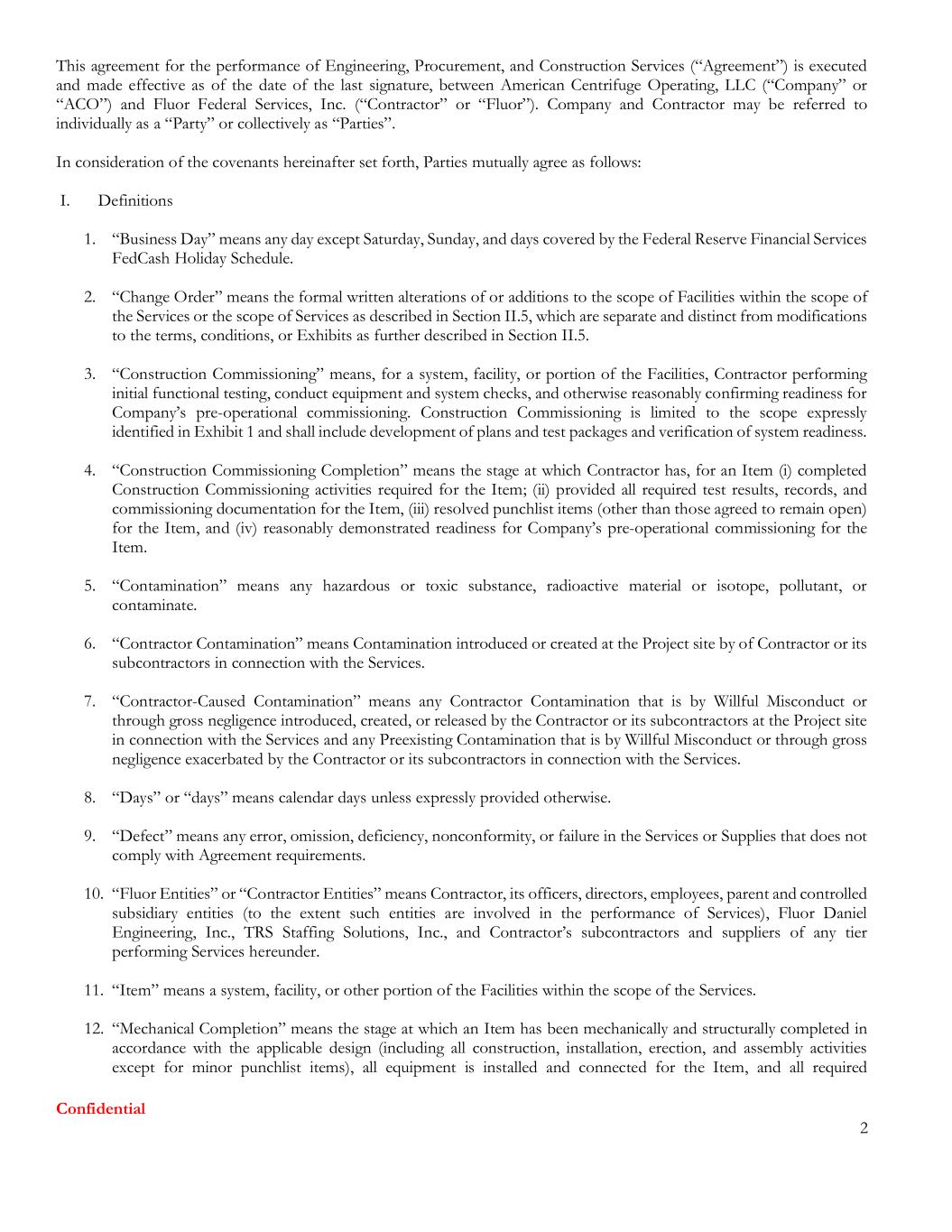
Confidential 2 This agreement for the performance of Engineering, Procurement, and Construction Services (“Agreement”) is executed and made effective as of the date of the last signature, between American Centrifuge Operating, LLC (“Company” or “ACO”) and Fluor Federal Services, Inc. (“Contractor” or “Fluor”). Company and Contractor may be referred to individually as a “Party” or collectively as “Parties”. In consideration of the covenants hereinafter set forth, Parties mutually agree as follows: I. Definitions 1. “Business Day” means any day except Saturday, Sunday, and days covered by the Federal Reserve Financial Services FedCash Holiday Schedule. 2. “Change Order” means the formal written alterations of or additions to the scope of Facilities within the scope of the Services or the scope of Services as described in Section II.5, which are separate and distinct from modifications to the terms, conditions, or Exhibits as further described in Section II.5. 3. “Construction Commissioning” means, for a system, facility, or portion of the Facilities, Contractor performing initial functional testing, conduct equipment and system checks, and otherwise reasonably confirming readiness for Company’s pre-operational commissioning. Construction Commissioning is limited to the scope expressly identified in Exhibit 1 and shall include development of plans and test packages and verification of system readiness. 4. “Construction Commissioning Completion” means the stage at which Contractor has, for an Item (i) completed Construction Commissioning activities required for the Item; (ii) provided all required test results, records, and commissioning documentation for the Item, (iii) resolved punchlist items (other than those agreed to remain open) for the Item, and (iv) reasonably demonstrated readiness for Company’s pre-operational commissioning for the Item. 5. “Contamination” means any hazardous or toxic substance, radioactive material or isotope, pollutant, or contaminate. 6. “Contractor Contamination” means Contamination introduced or created at the Project site by of Contractor or its subcontractors in connection with the Services. 7. “Contractor-Caused Contamination” means any Contractor Contamination that is by Willful Misconduct or through gross negligence introduced, created, or released by the Contractor or its subcontractors at the Project site in connection with the Services and any Preexisting Contamination that is by Willful Misconduct or through gross negligence exacerbated by the Contractor or its subcontractors in connection with the Services. 8. “Days” or “days” means calendar days unless expressly provided otherwise. 9. “Defect” means any error, omission, deficiency, nonconformity, or failure in the Services or Supplies that does not comply with Agreement requirements. 10. “Fluor Entities” or “Contractor Entities” means Contractor, its officers, directors, employees, parent and controlled subsidiary entities (to the extent such entities are involved in the performance of Services), Fluor Daniel Engineering, Inc., TRS Staffing Solutions, Inc., and Contractor’s subcontractors and suppliers of any tier performing Services hereunder. 11. “Item” means a system, facility, or other portion of the Facilities within the scope of the Services. 12. “Mechanical Completion” means the stage at which an Item has been mechanically and structurally completed in accordance with the applicable design (including all construction, installation, erection, and assembly activities except for minor punchlist items), all equipment is installed and connected for the Item, and all required
Confidential 3 construction and static tests have been satisfactorily performed for the Item, all required QA/QC documentation has been delivered to Company for the Item, and such Item is ready to begin Construction Commissioning. 13. “Preexisting Contamination” means any Contamination present at the Project site that existed at the Project site prior to Contractor’s commencement of physical work. 14. “Refurbishment” means any Services to restore or repair specific Company-identified Company or Government owned or furnished Supplies on site at the Facilities into good working condition. 15. “Reimbursable Costs” means all Contractor costs, incurred or paid by Contractor, for which Contractor shall be compensated under this Agreement by Company in accordance with Article III, with the exception of any cost expressly stated in the Agreement to be a Contractor cost. 16. “Standard of Care” means the degree of skill, care, and diligence ordinarily exercised by reputable engineering, procurement, and construction firms performing services of similar type, size, complexity, and location under similar circumstances. 17. “Supplies” means all tangible property except land or interest in land that Contractor procures, or Contractor’s subcontractors and suppliers procure, under this Agreement as part of the Services. Supplies include without limitation buildings, facilities, equipment, machine tools, and the alteration of the foregoing. Unless otherwise agreed, Supplies shall not include Contractor’s temporary facilities or consumables, all of which shall remain the property of Contractor; generally, Supplies shall include those items purchased, not rented, for the Project. 18. “Turnover” means the stage at which (i) an Item has achieved Construction Commissioning Completion, (ii) Contractor has delivered all turnover documentation required hereunder for such Item, and (iii) Company accepts such turnover for such Item in writing. 19. “Management Employee” or “Management Employees” means a Senior Vice President of Contractor performing Services under Agreement or a Contractor employee holding one of the positions listed on Contractor’s Centrus Project Management Organization Chart, Exhibit 9. 20. “Managed Party” or “Managed Parties” means any other party or individual under the control of Contractor and performing Services under Agreement. 21. “Company Manager” means (i) an employee of Company or another Company contractor or subcontractor at any tier, (ii) holding a job title equal to or more senior than Director, and (iii) having job responsibilities relating to the Project. 22. “Willful Misconduct” means intentional disregard by either a Management Employee, a Managed Party, or a Company Manager of the standard of care that a reasonably prudent person would exercise, with reckless disregard for the consequences thereof. II. Scope of Services 1. Description of Services A. Contractor shall perform engineering, procurement, and construction services and deliver Supplies as set forth in the Exhibit 1 (hereinafter referred to as the “Services”) in connection with Company’s Piketon, Ohio Facilities (the “Facilities”) with respect to the Company’s Low-Enriched Uranium and High-Assay Low Enriched Uranium production expansion project (the “Project”). B. Parties understand that this Agreement and Contractor’s strategies to execute and complete the Services are based on assumptions documented in Exhibit 2.
Confidential 4 C. Contractor shall adhere to and satisfy the quality requirements defined on Exhibit 7 and the data security requirements defined on Exhibit 8. 2. Performance and Information. A. Performance. 1) Contractor shall perform the Services (i) in a commercially reasonable manner, (ii) in accordance with the Standard of Care, (iii) consistently with the work authorization process as set forth in and required by this Agreement, and (iv) in accordance with applicable law and regulation. Notwithstanding any other term in this Agreement, Contractor is not obligated to perform the Services or any particular services for any set price or schedule. 2) The Parties anticipate that Company will authorize funds incrementally to the Agreement. The Parties anticipate that funding will be added to the Agreement by Company in accordance with and based on agreed Project stage gates (e.g., the estimated value of Front-End Engineering and Design (“FEED”) at the commencement of FEED). Contractor shall not continue performance beyond such Company- authorized funding. Contractor will notify the Company Representative in writing whenever it has reason to believe that the costs it expects to incur under this Agreement in the next thirty days, when added to all costs previously incurred, will exceed eighty percent (80%) of the total amount so far allotted by Company to the Agreement. Such Contractor notification will include the estimated amounts of additional funding required to continue Contractor’s performance of the Services for the period specified in the Project schedule (“Funding”) and the estimated date when one hundred percent (100%) of the total amount allotted to the Agreement will be reached to include all amounts due Contractor in accordance with Article III; such Project schedule may, without limitation, include Contractor’s demobilization. Within fifteen (15) days of Contractor’s notification under this Section, Company shall respond in writing indicating whether Company intends to (i) add the Funding (or a different amount of funds) to the Agreement or (ii) terminate the Agreement for convenience as of a specified date or amount of remaining funds. B. Information. 1) In the performance of Services, including the delivery of any related Supplies, Parties understand and agree Contractor will be supplied with certain information and/or data by Company and/or others identified in advance in writing by Company, and Contractor will rely on such information and/or data. It is agreed that the accuracy of such information is not within Contractor’s control, and Contractor shall not be liable for its accuracy, nor for its verification, unless Agreement is modified in writing to provide for verification by Contractor. If, in the performance of Services, Contractor discovers a concern with the accuracy or completeness of provided information, Contractor will make good faith reasonable efforts to promptly notify Company in writing. 2) Any information delivered by Contractor to Company may be used solely by Company for the purpose for which such information is intended. Company may disclose such information for legitimate Project purposes, including as regulatory submissions, in connection with financing, or per design coordination, commissioning, legal, operations, and integration needs with third party contractors, subject to the nondisclosure requirements for Protected Information defined in Exhibit 5. Indemnification for misuse or misapplication of certain information or deliverables shall be per Article V. 3. Contractor’s Responsibilities. As required for the Services, Contractor shall, subject to the terms and conditions of Agreement: A. Furnish supervisors, engineers, designers, draftsmen, and other personnel necessary for the preparation of drawings and specifications;
Confidential 5 B. Furnish buyers, inspectors, expediters, procurement, and other personnel necessary to procure Supplies and services necessary for completion of the Services; C. Furnish procurement personnel, managers, supervisors, engineers, and other personnel necessary to place and administer construction subcontracts and other agreements necessary for completion of the Services. D. Furnish other managers, supervisors, and all other personnel necessary for completion of the Services; E. Prepare and furnish a Project schedule and cost estimate in accordance with Exhibit 1 and in accordance with the Project project control plan to be mutually agreed; F. Procure Supplies and services necessary for completion of the Services, including underground analysis to identify utilities/subsurface conditions per an agreed approach and liability structure to be memorialized as an Exhibit to this Agreement; the Parties agree that all information provided by such subcontractor shall be treated as rely upon information in accordance with Article II.2.B.1; G. Furnish construction management superintendents, craft, and other personnel sufficient for Contractor to self- perform construction and to manage its construction subcontractors; H. Provide HSSE (Health, Safety, Security, and Environmental) management and personnel, systems and work processes to support the planning and execution of safe construction activities and environmental compliance during construction; I. Provide Quality Assurance (QA) and/or Quality Control (QC) personnel as needed to support the Services; J. Implement and maintain a Quality Management System that will satisfy the requirements to be placed on Company’s Approved Suppliers List; K. Place and administer construction subcontracts and other agreements necessary for completion of the Services; L. Provide processes, procedures, software, documentation, and personnel to plan, test, perform the Mechanical Completion and Construction Commissioning, and support Company’s pre-operational commissioning as described on Exhibit 1; M. On a monthly basis on or about the 20th of each month, (a) provide Company the Contractor’s Project procurement schedule, (b) provide Company the Contractor’s current Project schedule, (c) provide Company the Contractor’s forecasted and/or scheduled Project activities, (d) provide Company the Contractor’s Project and procurement forecast, and (e) provide Company Contractor’s Change Order and Change log; N. Appoint one or more individuals who shall be authorized to act on behalf of Contractor and with whom Company may consult at all reasonable times, and whose instructions, requests, and decisions will be binding upon Contractor as to all matters pertaining to this Agreement and the performance of the parties hereunder (“Contractor Representative”). Contractor shall advise Company in writing of the names and contact information of the Contractor Representative(s); O. Contractor shall (i) take steps necessary to enter Company’s Approved Supplier List, and (ii) will achieve such status prior to performing any of the Services that relate to items relied on for safety under NRC regulation and outlined in Company’s license (“Quality-Rated Services”); further, Contractor will confirm with Company Representative or designee in writing that Contractor may proceed with such Quality Rated Services in (ii) prior to performance; P. Support (subject to Contractor’s oversight and control of its personnel) Company’s execution of construction work with other direct contractors. This support consists of request for information responses, engineering
Confidential 6 changes, inspection support, Quality Assurance/Quality Control (QA/QC) support, material management, temporary facilities, and field oversight. Q. Obtain lien waivers (in a form reasonably acceptable to Company) from all Contractor subcontractors and suppliers as Contractor makes payments to its subcontractors and suppliers, and provide copies of such lien waivers to Company at Company’s reasonable request or as otherwise agreed pursuant to Article XIV.2; further, Contractor will provide such lien waivers from Contractor to Company as progress payments are made for Services as paid. R. In accordance with Contractor’s customary practices, provide Company reasonable access to a reading room in Greenville, SC for Company personnel to view relevant proprietary and confidential (i) records and (ii) Project-related Contractor policies and procedures, specifically identified in writing by Company Representative, that Contractor would provide to a Government auditor; access to and access requirements and restrictions for this reading room will be controlled by Contractor and at Contractor’s sole discretion; and S. Furnish material management personnel, inspectors, managers, supervisors, and all other personnel necessary for the completion of transportation, delivery, receiving, storage, and issuance of Supplies necessary for completion of the Services. T. Furnish Company the name of the Contractor employee who is replacing another Contractor employee that holds one of the thirteen positions in Contractor’s Centrus Project Management Organization Chart, Exhibit 9, within 10 days of such replacement. 4. Company’s Responsibilities. Company shall at such times as may be reasonably required by Contractor and as reasonably necessary for the successful and timely completion of Services: A. Provide a Project site for the construction of the Facilities, suitable access thereto, and an adequate area or areas adjoining such site for Contractor’s, and its subcontractors’, office(s) and warehouse(s) and adequate space for craft change rooms, shop buildings, welding facilities, materials storage and lay down areas, employee parking, and furnish necessary construction utilities; provided that Contractor shall remain responsible for the planning and coordinating of its own means of access, logistics and site use per Exhibit 1; B. Obtain any permits and process and other licenses in a timely manner, which are required for Facilities and/or to be taken out in the name of Company, except where such permits and process and other licenses are specifically identified as being the responsibility of Contractor as part of Services; C. Start up and commission the Facilities and provide all personnel, feedstock, and Supplies necessary for commissioning, start-up, operation, and maintenance thereof as described in Exhibit 1; for clarity, Company shall perform all pre-operational, integrated, and nuclear commissioning activities, while Contractor shall perform Mechanical Completion, Construction Commissioning, and commissioning support; D. Pay all taxes assessed against the Facilities; E. Advise Contractor Representative in writing of the existence, potential exposure, spill, escape of product, or release, and undertake the abatement and disposal, of hazardous, toxic, corrosive, flammable or radioactive substance, material, waste, pollution, or contamination as identified in the Comprehensive Environmental Response, Compensation, and Liability Act (42 U.S.C. 9601 et. seq.), Resource Conservation and Recovery Act, as amended (42 U.S.C. 6901 et. seq.), Toxic Substance Control Act, as amended (15 U.S.C. 2601 et. seq.) and their implementing regulations and similar federal, state, and local statutes, and petroleum, radioactive, or other chemical materials, or any fraction thereof, not otherwise specifically listed or designated as a hazardous substance, or other pollutant or regulated substance which are encountered by Contractor at Company’s facilities in the performance of Services;
Confidential 7 F. Omitted; G. Appoint one or more individuals who shall be authorized to act on behalf of Company, with whom Contractor may consult at all reasonable times, and whose instructions, requests, and decisions will be binding upon Company as to all matters pertaining to this Agreement and the performance of the parties hereunder (“Company Representative”); Company shall advise Contractor in writing of the name and contact information of the Company Representative; H. Arrange for the provision or provide relevant Government and Company services, real property, and Supplies identified in Exhibit 1 or otherwise reasonably required to Contractor at no additional cost (e.g., access to appropriate Company information technology systems, on site office space, Project site access and access credentials); provided that Contractor will timely identify in writing its requirements for such Company- furnished items and that Company shall not be obligated to furnish items not identified in Exhibit 1 unless mutually agreed in writing in accordance with commercially reasonable practices; I. Provide Contractor with requested information (e.g., process design, existing as-built information, utility interconnections, equipment, or construction material vendor data) in accordance with Contractor’s Project schedule; J. Supply documentation and specifications, in accordance with the agreed Project schedule, for all existing infrastructure or facilities located on, adjacent to, or under the Project site and all Company and Government, including without limitation all Governmental agency, documents relevant to the Project, upon which documentation and information Contractor may rely in accordance with Article II.2.B.1); K. Omitted; L. Through the Company Representative, on no less than a monthly basis on or about the 25th of each month but no later than the 28th of each month, (a) provide written authorization for Contractor to proceed with procurement activities set forth in Contractor’s procurement schedule, (b) provide written approval of Contractor’s current Project schedule, (c) provide written authorization for Contractor to proceed with forecasted and/or scheduled Project activities, (d) provide written approval of Contractor’s Project and procurement forecast, and (e) provide written approval of Contractor’s change order log; M. Company shall timely provide Contractor with consent and/or approvals identified in Agreement or as otherwise agreed (e.g., in approved or to-be-approved plans such as the Project Change Management Plan); and N. Approve a Project process to accomplish the activities contemplated by Articles II.3.L, II.4.L, and XIV.2 (Subcontracts) and for achieving Mechanical Completion, Construction Commissioning Completion, and Turnover. For clarity, the Parties acknowledge and agree that the scope of Services does not require Contractor to demolish or remove existing utility structures and cooling towers at the Project site. 5. Modifications, Change Orders, and Changes. It is the desire of the Parties to keep modifications, Change Orders, and changes at a minimum, but the Parties recognize that such modifications, Change Orders, and changes may become necessary and agree that they shall be handled as follows: A. Modifications. Modifications to this Agreement are required for all alterations of or additions to the terms and conditions of this Agreement or Exhibits 3, 5, 7, and 8 of this Agreement; Modifications shall be accomplished via negotiated bilateral modification of this Agreement executed by the Contractor Representative and Company Representative.
Confidential 8 B. Change Orders. Change Orders are required for all alterations of or additions to the scope of Facilities or Services; Change Orders shall be accomplished via formal change order as specified below. For the avoidance of doubt, the Parties acknowledge and agree that this Agreement is fully reimbursable, and Contractor shall be paid in accordance with Article III for all Services. Changes Orders and the process set forth herein shall not be applied to require Contractor to complete any particular services for a set price or schedule. 1) Company-Initiated Change Orders. a. Bilateral Change Orders. Company may initiate the bilateral Change Order process by advising Contractor in writing of alterations of or additions to the scope of Facilities or Services believed to be necessary. As soon thereafter as reasonably practicable, Contractor shall prepare and provide to Company a rough order of magnitude (ROM) cost estimate and schedule impact. Contractor shall be compensated for the preparation of such ROM cost estimate and schedule impact in accordance with Article III. After following the process outlined in this Section, Company shall advise Contractor in writing of its approval or disapproval within ten (10) days. If Company approves, Contractor shall perform the Services as altered by or added to by the Change Order. All bilateral Change Orders must be in writing and executed by the Contractor Representative and Company Representative. Under no circumstance is Contractor obligated to perform bilateral Change Order work in advance of a fully executed bilateral Change Order. b. Unilateral Change Orders. Company may issue unilateral Change Orders in writing and executed by the Company Representative provided (1) such unilateral Change Order is within the general scope of the Agreement, (2) the unilateral Change Order would not violate law, regulation, or applicable safety requirements, and (3) the unilateral Change Order does not impact an Item after Turnover of such Item. Notwithstanding any term in Agreement, if a unilateral Change Order is issued after Mechanical Completion as applicable on a per Item basis, Contractor’s warranty obligation for Services performed under such unilateral Change Order for such Item shall be limited to that set forth in Section IV.2. Unless excused, Contractor shall promptly commence performance of such unilateral Change Order work, the impacts of such unilateral Change Order shall be reflected in Contractor’s deliverables specified in Article II.3.M, and Company shall compensate Contractor in accordance with Article III. Contractor shall be excused from performing unilateral Change Order work that (i) is outside the limits of Company’s ability to issue a unilateral Change Order as described in this Article II.5.B.1).b., or (ii) in Contractor’s reasonable good faith belief, is not within the scope of the Company identified nuclear liability protections in Article V.4. Further, if a unilateral Change Order or combination of unilateral Change Orders described above will result in Contractor incurring costs in excess of amounts in the Zero Balance Account described in Exhibit 3 (“ZBA”), but does not violate (i) or (ii) of the foregoing sentence, Contractor shall proceed with performance of such unilateral Change Orders until incurring cumulative costs in excess of at which time it will be able to suspend work on such unilateral Change Orders; provided Company shall be able to fund the ZBA, per Article III, in accordance with or outside the monthly deposit cycle to reduce, reset, or both this exposure amount. If multiple unfunded unilateral Change Orders are issued, Company Representative or another duly authorized representative of Company may direct in writing the priority of Contractor’s performance of unilateral Change Order work under the aforementioned cap. If (ii) is invoked and Contractor incurs based on unilateral Change Orders in two consecutive months, then Company will add a continuing balance, on an indefinite basis and in excess of amounts requested by Contractor in accordance with Exhibit 3, of going forward unless otherwise agreed by the Parties in writing. 2) Contractor Initiated Change Orders. Contractor may initiate the bilateral Change Order process by advising Company in writing that in Contractor’s opinion an alteration of or addition to the scope of Facilities or Services is necessary. Contractor’s notice shall (i) identify the circumstances giving rise to the need for such [*****] [*****][*****] [*****]
Confidential 9 alteration of or addition to the scope of Facilities or Services, and (ii) supporting documentation in a form reasonably requested by Company in conformity with Company’s record keeping and documentation systems. Contractor shall be compensated for the preparation of such Change Order process initiation in accordance with Article III. Company shall advise Contractor in writing of its agreement or disagreement within ten (10) days. If Company agrees, it shall advise Contractor in writing and, thereafter, the Change Order process shall be handled as if initiated by Company. C. Changes. Changes to the then-agreed cost and schedule baseline shall be managed and approved through an agreed Change Management Process. Changes, and an agreed Change Management Process, shall be used solely to address cost and schedule trends, and shall not be applied to require Contractor to complete any particular services for a set price or schedule; Contractor shall be entitled to changes to address increases in Contractor’s costs or the estimated time for completion of the Services. D. Disputed Change Orders or Changes. 1) Disputed Change Orders. If a Party disputes the existence, extent, validity, or effect of a Change Order or Change Order request, then the Party may notify the other Party that it desires to meet and resolve the dispute. If the dispute cannot be resolved to the mutual satisfaction of the Parties within ten (10) days, then the Parties shall proceed to resolve the dispute in accordance with Article XIII. 2) Disputed Changes. If a Party believes a Change is properly a Change Order or disputes the existence, extent, validity, or effect of a Change, then the Party may notify the other Party that it desires to meet and resolve the dispute. If the dispute cannot be resolved to the mutual satisfaction of the Parties within ten (10) days, then the Parties shall proceed to resolve the dispute in accordance with Article XIII. III. Compensation 1. Company shall compensate and pay Contractor for the Services in accordance with this Article III and Exhibit 3 (Compensation and Payment). 2. Notwithstanding anything to the contrary in this Agreement or Exhibit 3, (a) undisputed amounts owed by Contractor to Company, including without limitation for undisputed overpayments and undisputed duplicate payments, or (b) amounts owed by Contractor to Company to satisfy warranty obligations (subject to Section XIV.7.F) shall be, at Contractor’s election, either (i) promptly paid by Contractor to Company, or (ii) offset by Company against amounts due Contractor. 3. Disputed amounts shall be resolved in accordance with Article XIII. If after the resolution of a dispute it is mutually agreed or finally determined that Contractor owes Company an amount, the amount shall be, at Contractor’s election, either (i) promptly paid by Contractor to Company, or (ii) offset by Company against amounts due Contractor. If after the resolution of a dispute it is mutually agreed or finally determined that Company owes Contractor an amount, the amount shall be promptly paid by Company to Contractor. Except as expressly provided otherwise in this Article III, Company shall not withhold or offset amounts pending resolution of a dispute, and Contractor’s right to prompt payment shall be preserved. 4. Nothing in this clause precludes or restricts Company from exercising its audit rights under this Agreement or from questioning or disputing amounts paid to Contractor. Any Company exercise of offset in accordance with the requirements of this Article III shall not be grounds for Contractor to suspend, terminate, or cancel performance. IV. Warranties 1. Contractor represents and warrants that it shall perform the Services (i) in a commercially reasonable manner, (ii) in accordance with the Standard of Care, and (iii) in accordance with applicable law and regulation.
Confidential 10 2. Defects Through Mechanical Completion. If during the performance of the Services by Contractor, exclusive of its subcontractors and suppliers, prior to Mechanical Completion or as provided in Section II.5.B.1).b, of an Item Company notifies Contractor that there is a Defect in the Services for the Item, Contractor shall perform corrective services as may be necessary to bring the Services for the Item into conformance with Agreement requirements to the extent such services are within the original scope of the Services (including any Change Orders). Company shall compensate Contractor for such corrective services in accordance with Exhibit 3, including Fee, as defined in Exhibit 3. 3. Defects From after Mechanical Completion to Completion of Turnover. If during the performance of the Services by Contractor after Mechanical Completion and prior to the completion of Turnover for an Item Company notifies and reasonably demonstrates to Contractor that (i) there is a Defect in the Services for the Item, and (ii) the Defect in the Item was identified by Company after Mechanical Completion, Contractor shall perform corrective services as may be necessary to bring the Services for the Item into conformance with Agreement requirements to the extent such services are within the original scope of the Services (including any Change Orders). Company shall compensate Contractor for such corrective services in accordance with Exhibit 3, except that such compensation shall not include Fee, as defined in Exhibit 3. 4. Defects Following Turnover. If during the following Turnover of an Item, Company notifies and reasonably demonstrates to Contractor in writing that (i) there is a Defect in the Services for the Item, and (ii) the Defect in the Item was identified by Company after Turnover, Contractor shall promptly perform corrective services as may be necessary to bring the Services for the Item into conformance with Agreement requirements to the extent such services are within the original scope of the Services (including any Change Orders). If (a) Contractor is, in Contractor’s commercially reasonable discretion, unable to perform such corrective services, (b) Contractor notifies Company in writing that Contractor is unwilling or elects not to perform such corrective services, or (c) Contractor is, in Company’s commercially reasonable discretion, practically precluded from providing corrective services (including, without limitation, owing to introduced nuclear material or union labor restrictions as may be applicable), then Contractor shall reimburse Company for reasonable costs of corrective services necessary to bring the Services for the Item into compliance with Agreement requirements to the extent such services are within the original scope of the Services (including any Change Orders); Contractor’s cumulative obligation under this Section IV.4 is provided in Section XIV.7.F. 5. Third Party Supplies and Services Warranties. Contractor shall, for the protection of Company, demand and obtain from all suppliers and subcontractors from which Contractor procures services or Supplies warranties and guarantees with respect to such services and Supplies which shall be made available to Company to the full extent of the terms thereof and such warranties shall be in accordance with Company requirements specified per the procurement process set forth in Section XIV.2 or as may be agreed to by Company in writing. PRIOR TO TURNOVER OF AN ITEM OR AS PROVIDED IN SECTION II.5.B.1).b, CONTRACTOR’S LIABILITY WITH RESPECT TO SUPPLIES OR SERVICES OBTAINED FROM SUPPLIERS OR SUBCONTRACTORS FOR SUCH ITEM SHALL BE LIMITED TO PROCURING WARRANTIES ANDGUARANTEES FROM SUCH SUPPLIERSOR SUBCONTRACTORS AND RENDERING ALL REASONABLE ASSISTANCE TO COMPANY TO ENFORCE SUCHWARRANTIES. Contractor shall be compensated for performing the foregoing services in accordance with Article III and Exhibit 3, including Fee as defined in Exhibit 3. 6. Additional Representations and Warranties. Contractor hereby expressly represents and warrants the following: A. Liens. Provided Company is not in breach of its payment obligations under this Agreement, (i) Contractor shall use reasonable efforts to ensure no liens, claims, or encumbrances arise against the Facilities, the Project Site, Supplies, or Company property as a result of Contractor’s performance of the Services, and (ii) Contractor shall obtain conditional and/or unconditional lien waivers (in a form reasonably acceptable to Company) as payments from Contractor to its suppliers and subcontractors are made. [*****]
Confidential 11 B. Qualified Subcontractors. Contractor shall use reasonable efforts to engage subcontractors that are duly licensed and authorized to perform the subcontracted portion of the Services and in keeping with the standard of care applicable to such subcontractors. C. Authority and Conflicts. Contractor has full authority to enter into and perform this Agreement, and such performance does not violate any agreement or legal obligation binding on Contractor. D. No Debarment. Contractor is not debarred, suspended, or otherwise ineligible to contract with US government entities. E. Non-Waiver; Supplemental. The warranties in this Article IV supplement and do not limit Contractor’s other obligations under this Agreement. 7. EXCLUSIONS AND LIMITATIONS OF WARRANTY A. Excluded from Contractor’s warranty obligations specified in this Article IV are (i) any services that would involve Contamination, (ii) any Services involving or relating to Refurbishment, and (iii) circumstances where the Defect was caused by Company, a party under Company’s direction or control including without limitation other contractors of Company, or by conditions for which Company is expressly responsible for hereunder. The Parties agree that the mere presence of an item on any punchlist does not trigger Contractor warranty obligations under this Article IV. B. Contractor’s warranty obligations specified in this Article IV apply only to the extent that a Defect is not caused by (i) Company’s failure to properly operate or maintain the Facilities, (ii) misuse of or unauthorized alterations to the Services or Facilities by Company or a party under Company’s direction or control including without limitation other contractors of Company, (iii) normal wear and tear, (iv) Company’s failure to provide Contractor reasonable access to perform corrective work, provided that Contractor’s practical preclusion (including, without limitation, owing to introduced nuclear material or union labor restrictions) to perform corrective work post-Turnover shall not be interpreted as Company failing to provide reasonable access, or (v) Contamination. C. Company acknowledges and agrees that Contractor’s post-Turnover warranty obligations are not associated with final Turnover as contemplated by Article VIII.2. D. EXCEPT AS EXPRESSLY SET FORTH IN THIS ARTICLE IV, CONTRACTOR DOES NOT MAKE ANY ADDITIONAL WARRANTIES WITH RESPECT TO THE SERVICES, AND, TO THE EXTENT PERMITTED BY APPLICABLE LAW, CONTRACTOR DISCLAIMS ALL IMPLIED WARRANTIES, INCLUDING WITHOUT LIMITATION ANY IMPLIED WARRANTIES OF MERCHANTABILITY OR FITNESS FOR A PARTICULAR PURPOSE. FOR CONTRACTOR’S OBLIGATIONS UNDER SECTIONS IV.3 AND IV.4 AND CONTRACTOR’S POST-MECHANICAL COMPLETION UNILATERAL CHANGE ORDER OBLIGATIONS UNDER SECTION IV.2, THIS ARTICLE IV GOVERNS AND SUPERSEDES ANY OTHER TERMS OF THIS AGREEMENT WHICH ADDRESS WARRANTIES AND ARE CONTRACTOR’S SOLE WARRANTY OBLIGATIONS AND ARE COMPANY’S EXCLUSIVE REMEDIES WITH RESPECT THERETO. ASIDE FROM THE FOREGOING SENTENCE, NOTHING IN THIS ARTICLE IV SHALL BE CONSTRUED TO LIMIT, WAIVE, OR SUPERSEDE CONTRACTOR’S OBLIGATIONS ELSEWHERE IN THIS AGREEMENT. CONTRACTOR’S LIABILITY, IF ANY, FOR WARRANTY OBLIGATIONS EXPRESSLY SET FORTH IN THIS ARTICLE IV SHALL BE SUBJECT TO THE APPLICABLE LIMITATIONS OF LIABILITY SET FORTH IN ARTICLE XIV.7.F. V. Indemnities. All indemnification obligations of Company and Contractor set forth in this Article V are subject to the express provisions of Article XIV.7.
Confidential 12 1. Bodily Injury and Property Damage FOR THE DURATION OF AGREEMENT, CONTRACTOR SHALL INDEMNIFY, DEFEND, RELEASE, AND HOLD HARMLESS COMPANY AND ITS DIRECTORS, OFFICERS, EMPLOYEES, AGENTS, PARENT AND CONTROLLED SUBSIDIARY ENTITIES (TO THE EXTENT SUCH ENTITIES ARE INVOLVED IN THE PROJECT) FROM ALL THIRD-PARTY CLAIMS, LIABILITIES, AND CAUSES OF ACTION FOR BODILY INJURY TO OR DEATH OF ANY PERSON OR DESTRUCTION OF THIRD PARTY PROPERTY TO THE EXTENT CAUSED BY THE NEGLIGENCE OR WILLFUL MISCONDUCT OF CONTRACTOR OR ITS SUBCONTRACTORS IN THE PERFORMANCE OF THE SERVICES; EXCLUDED FROM THE FOREGOING CONTRACTOR OBLIGATIONS ARE CLAIMS BY THE UNITED STATES GOVERNMENT, INCLUDING WITHOUT LIMTIATION THE DEPARTMENT OF ENERGY (“DOE”), FOR DAMAGE TO GOVERNMENT- OWNED PROPERTY TO THE EXTENT CAUSED BY THE NEGLIGENCE OF CONTRACTOR OR ITS SUBCONTRACTORS IN PERFORMANCE OF THE SERVICES. FOR THE DURATION OF THE AGREEMENT, COMPANY SHALL INDEMNIFY, DEFEND, RELEASE, AND HOLD HARMLESS CONTRACTOR AND THE CONTRACTOR ENTITIES FROM ALL THIRD-PARTY CLAIMS, LIABILITIES, AND CAUSES OF ACTION FOR BODILY INJURY TO OR DEATH OF ANY PERSON OR DESTRUCTION OF THIRD PARTY PROPERTY TO THE EXTENT CAUSED BY THE NEGLIGENCE OR WILLFUL MISCONDUCT OF COMPANY OR ITS CONTRACTORS (OTHER THAN CONTRACTOR) IN CONNECTION WITH THE PROJECT. 2. Damages to Company Property; Repair of Facilities EXCEPT TO THE EXTENT EXPRESSLY SPECIFIED OTHERWISE IN THIS SECTION V.2, CONTRACTOR SHALL BE COMPENSATED IN ACCORDANCE WITH ARTICLE III TO REPLACE, REPAIR, OR RECONSTRUCT, OR FURNISH ANY REAL PROPERTY (OR REAL PROPERTY IMPROVEMENTS) OR SUPPLIES OWNED OR FURNISHED BY COMPANY OR GOVERNMENT (INCLUDING LEASED PROPERTY FROM DOE TO COMPANY) WHICH ARE LOST, DAMAGED, OR DESTROYED IN CONNECTION WITH CONTRACTOR’S PERFORMANCE OF THE SERVICES; PROVIDED, HOWEVER, NOTWITHSTANDING ANY OTHER TERM IN THIS AGREEMENT THAT TO THE EXTENT SUCH LOSS, DAMAGE, OR DESTRUCTION IS CAUSED BY THE NEGLIGENCE OR WILLFUL MISCONDUCT OF CONTRACTOR OR ITS SUBCONTRACTORS OR SUPPLIERS, AND SUCH LOSS, DAMAGE, OR DESTRUCTION IS A RECOVERABLE CLAIM UNDER THE BUILDER’S ALL RISK POLICY, CONTRACTOR SHALL, SUBJECT TO THE LIMITATION OF LIABILITY PROVISIONS OF ARTICLE XIV.7, BE LIABLE TO COMPANY UP TO THE LESSER OF AND COMPANY SHALL BE RESPONSIBLE FOR ANY DAMAGE OR LOSS ABOVE THE FOREGOING PER OCCURRENCE AMOUNT. CONTRACTOR’S FOREGOING PER OCCURRENCE LIABILITY OBLIGATION OF UP TO THE LESSER OF . FOR ALL OTHER LOSS, DAMAGE, OR DESTRUCTION OF SUCH REAL PROPERTY OR SUPPLIES COMPANY SHALL BEAR SUCH RISK OF LOSS, DAMAGE, OR DESTRUCTION. 3. Deliverables Misuse. COMPANY SHALL INDEMNIFY, DEFEND, RELEASE, AND HOLD HARMLESS CONTRACTOR ENTITIES FROM THIRD-PARTY CLAIMS TO THE EXTENT ARISING OUT OF (I) COMPANY’S MODIFICATION OF CONTRACTOR DELIVERABLES WITHOUT CONTRACTOR’S OR SUCH THIRD-PARTY’S WRITTEN APPROVAL, (II) COMPANY’S UNAUTHORIZED DISCLOSURE OF CONTRACTOR DELIVERABLES, OR (III) COMPANY’S USE OR REUSE OF CONTRACTOR’S DELIVERABLES FOR PURPOSES OUTSIDE THE SCOPE OF THIS AGREEMENT. NOTHING IN THIS SECTION SHALL LIMIT CONTRACTOR’S WARRANTY OBLIGATIONS. 4. Nuclear Risks and Price Anderson Nuclear Hazards Indemnification by the Department of Energy [*****] [*****]
Confidential 13 A. Company warrants and represents that (i) any of Company’s activities that have the potential to result in public liability arising out of or in connection with Contractor’s Services and the Project and (ii) Contractor’s activities that have the potential to result in public liability which may be imputed to Contractor and for which Contractor could be held liable, will be conducted within the scope of activities under the Lease Agreement between the United States Department of Energy (“DOE”) and the United States Enrichment Corporation and/or other agreements that provide equivalent public liability protections, and represents that the Lease Agreement between the DOE and the United States Enrichment Corporation, including Supplemental Agreement No. 1 to include the agreement for indemnification between DOE and Company, is still in effect. B. Lease Term Negotiation, Renewal, or Replacement. Notwithstanding the representations and warranties of Section V.4.A above, which are not modified by the following, the Parties acknowledge and agree that Company may freely renegotiate, renew, or replace the existing Lease Agreement or enter into alternative risk-bearing contracts and that such renegotiation, renewal, or replacement shall not trigger a breach by Company under this Agreement. If the protection scheme contemplated by this Section V.4 may be modified in any way (e.g., changes in the scope of Company activities contemplated under the Lease Agreement) or replaced, Company shall provide Contractor reasonable advance notice thereof together with the details of such modification or replacement. C. Pursuant to Section 10.1(i) of the Supplemental Agreement No. 1 and subject to Section X.2.A of this Agreement, the Parties include by reference and acknowledge the inclusion of those supplemental lease terms to the Project and their protective applicability to Company and, by extension, Contractor. 5. Intellectual Property Indemnity A. WITH THE EXCEPTION OF THIRD PARTY CLAIMS RELATED TO SUPPLIERS AND SERVICES PERFORMED BY CONTRACTOR’S SUBCONTRACTORS AND SUPPLIERS, CONTRACTOR SHALL INDEMNIFY, DEFEND, RELEASE, AND HOLD HARMLESS COMPANY AND ITS DIRECTORS, OFFICERS, EMPLOYEES, AGENTS, PARENT AND CONTROLLED SUBSIDIARY ENTITIES (TO THE EXTENT SUCH ENTITIES ARE INVOLVED IN THE PROJECT) FROM THIRD-PARTY CLAIMS ALLEGING THAT SERVICES, CONTRACTOR DELIVERABLES, OR SUPPLIES FURNISHED BY CONTRACTOR UNDER THIS AGREEMENT INFRINGE OR MISAPPROPRIATE ANY PATENT, COPYRIGHT, TRADEMARK, TRADE SECRET, OR OTHER INTELLECTUAL PROPERTY RIGHT, AND FROM ANY ASSOCIATED DAMAGES, COSTS, AND REASONABLE ATTORNEYS’ FEES, EXCEPT TO THE EXTENT SUCH CLAIMS ARISE FROM: (A) DESIGNS, SPECIFICATIONS, OR OTHER WRITTEN INSTRUCTIONS FURNISHED BY COMPANY THAT CONTRACTOR WAS REQUIRED TO FOLLOW, (B) INFORMATION PROVIDED TO CONTRACTOR IN ACCORDANCE WITH ARTICLE II.2.B.1), (C) COMPANY’S UNAUTHORIZED MODIFICATION OR DISCLOSURE OF SUCH CONTRACTOR DELIVERABLES, (D) COMPANY’S USE OF SUCH CONTRACTOR DELIVERABLES IN A MANNER NOT CONTEMPLATED BY THIS AGREEMENT, (E) COMPANY’S COMBINATION OF SUCH CONTRACTOR DELIVERABLES OR SUPPLIES WITH PROCESSES, PROCEDURES, DELIVERABLES, SUPPLIES, ETC. PROVIDED BY COMPANY OR ANOTHER CONTRACTOR OF COMPANY, (F) COMPANY’S PROCESSES TO OPERATE THE FACILITIES, OR (G) WILLFUL MISCONDUCT OF COMPANY, ITS DIRECTORS, OFFICERS, EMPLOYEES, AGENTS, OR PARENT AND CONTROLLED SUBSIDIARY ENTITIES (TO THE EXTENT SUCH ENTITIES ARE INVOLVED IN THE PROJECT). B. WITH THE EXCEPTION OF THIRD PARTY CLAIMS RELATED TO SUPPLIERS AND SERVICES PERFORMED BY CONTRACTOR’S SUBCONTRACTORS AND SUPPLIERS, IF A CLAIM IS FILED (OR IS REASONABLY THREATENED TO BE FILED SUBJECT TO THE LAST SENTENCE OF THIS SECTION) WITH AN ADJUDICATIVE BODY OF INFRINGEMENT OR MISAPPROPRIATION SPECIFIED IN ARTICLE V.5.A AND NOT FALLING WITHIN AN EXCEPTION THEREIN IS MADE AGAINST COMPANY, CONTRACTOR SHALL AT ITS SOLE DISCRETION, SOLE EXPENSE, AND IN CONSULTATION WITH COMPANY, (I) PROCURE FOR COMPANY THE
Confidential 14 RIGHT TO CONTINUE USING THE AFFECTED DELIVERABLE, (II) MODIFY THE DELIVERABLE SO THAT IT IS NON-INFRINGING WHILE MEETING THE REQUIREMENTS OF THIS AGREEMENT, OR (III) REPLACE THE DELIVERABLE WITH A NON-INFRINGING EQUIVALENT THAT MEETS THE REQUIREMENTS OF THIS AGREEMENT. CONTRACTOR MAY AT ANY TIME PRIOR TO SUCH FINAL JUDGEMENT, IN ITS SOLE DISCRETION, AT ITS SOLE EXPENSE, AND IN CONSULTATION WITH COMPANY, (I) PROCURE FOR COMPANY THE RIGHT TO CONTINUE USING THE AFFECTED DELIVERABLE, (II) MODIFY THE DELIVERABLE SO THAT IT IS NON-INFRINGING WHILE MEETING THE REQUIREMENTS OF THIS AGREEMENT, OR (III) REPLACE THE DELIVERABLE WITH A NON-INFRINGING EQUIVALENT THAT MEETS THE REQUIREMENTS OF THIS AGREEMENT. IF COMPANY NOTIFIES CONTRACTOR OF A RECEIVED CLAIM AND SEEKS REMEDY PER THIS SECTION BECAUSE IT BELIEVES, IN GOOD FAITH, THAT A CLAIM IS REASONABLY THREATENED AND CONTRACTOR REASONABLY DISAGREES, THE PARTIES SHALL WITHIN TEN (10) DAYS SUBMIT TO A BINDING MEDIATION (WITH A MEDIATOR TO BE MUTUALLY AGREED) TO RESOLVE THE DISPUTE, WITH THE NON-PREVAILING PARTY TO PAY THE COSTS. C. SUBJECT TO THE LIMITATION OF LIABILITY PROVISIONS OF ARTICLE XIV.7, COMPANY SHALL INDEMNIFY, DEFEND, RELEASE, AND HOLD HARMLESS THE CONTRACTOR ENTITIES FROM ANY THIRD-PARTY CLAIM TO THE EXTENT SUCH CLAIM ARISES OUT OF (A) DESIGNS, SPECIFICATIONS, OR OTHER WRITTEN INSTRUCTIONS FURNISHED BY COMPANY THAT CONTRACTOR WAS REQUIRED TO FOLLOW, (B) INFORMATION PROVIDED TO CONTRACTOR IN ACCORDANCE WITH ARTICLE II.2.B.1), (C) COMPANY’S UNAUTHORIZED MODIFICATION OR DISCLOSURE OF SUCH CONTRACTOR DELIVERABLES; (D) COMPANY’S USE OF SUCH CONTRACTOR DELIVERABLES IN A MANNER NOT CONTEMPLATED BY THIS AGREEMENT, (D) COMPANY’S COMBINATION OF CONTRACTOR DELIVERABLES OR SUPPLIES WITH PROCESSES, PROCEDURES, DELIVERABLES, SUPPLIES, ETC. PROVIDED BY COMPANY OR ANOTHER CONTRACTOR OF COMPANY, (E) COMPANY’S PROCESSES TO OPERATE THE FACILITIES, OR (F) ALLEGES INFRINGEMENT OR MISAPPROPRIATION OF ANY PATENT, COPYRIGHT, TRADEMARK, TRADE SECRET, OR OTHER INTELLECTUAL PROPERTY RIGHT THROUGH THE WILLFUL MISCONDUCT OF COMPANY, ITS DIRECTORS, OFFICERS, EMPLOYEES, AGENTS, OR PARENT AND CONTROLLED SUBSIDIARY ENTITIES (TO THE EXTENT SUCH ENTITIES ARE INVOLVED IN THE PROJECT). D. Intellectual property indemnification for third party claims related to Supplies and services performed by Contractor’s subcontractors and suppliers is addressed in Article XII.3. 6. Fines and Penalties A. CONTRACTOR INDEMNIFIES COMPANY AGAINST FINES AND PENALTIES FROM A GOVERNMENT OR GOVERNMENTAL ENTITY (E.G., AGENCY) TO THE EXTENT OF CONTRACTOR’S VIOLATION OF LAW AND PROVIDED SUCH CONTRACTOR VIOLATION OF LAW IS NOT THE RESULT OF CONTRACTOR’S COMPLIANCE WITH THE TERMS OF THE AGREEMENT OR WRITTEN DIRECTION OR INSTRUCTIONS FROM COMPANY REPRESENTATIVE. B. COMPANY INDEMNIFIES FLUOR AGAINST FINES AND PENALTIES FROM A GOVERNMENT OR GOVERNMENTAL ENTITY (E.G., AGENCY) (I) TO THE EXTENT OF COMPANY’S VIOLATION OF LAW, AND/OR (II) IF ANY SUCH FINES AND PENALTIES AGAINST CONTRACTOR ARE BASED ON CONTRACTOR’S COMPLIANCE WITH THE TERMS OF THE AGREEMENT AND/OR WRITTEN DIRECTION OR INSTRUCTIONS FROM THE COMPANY REPRESENTATIVE.
Confidential 15 C. THE PARTIES EXPRESSLY ACKNOWLEDGE AND AGREE THAT THE FINES AND PENALTIES INDEMNITY DESCRIBED IN SECTIONS V.6.A AND V.6.B IS ENFORCEABLE AND SUCH FINES AND PENALTIES ARE TO BE PAID BY THE APPLICABLE PARTY AND THAT THE WAIVER OF DAMAGES IN SECTION XIV.7.C SHALL NOT OVERCOME THE OBLIGATION TO PAY SUCH AMOUNTS ASSESSED BY A GOVERNMENT OR GOVERNMENTAL ENTITY REGARDLESS OF THE NATURE OR DAMAGE CATEGORY APPLICABLE TO SUCH FINES AND PENALTIES, AND THAT THE WAIVER OF DAMAGES IN XIV.7.C SHALL NOT OVERCOME THE OBLIGATION OF THIS SECTION V.6 REGARDLESS OF HOW THE FINE OR PENALTY IS LABELED OR ITS NATURE (E.G., THE FINES AND PENALTIES INDEMNITY WILL APPLY EVEN IF THE UNDERLYING FINE OR PENALTY IS A DIRECT, CONSEQUENTIAL, INCIDENTAL, SPECIAL, PUNITIVE, OR INDIRECT DAMAGE); HOWEVER, THE PARTIES FURTHER AGREE THAT AMOUNTS IN EXCESS OF THE FINES AND PENALTIES THEMSELVES ARE NOT PAYABLE AND THAT THE WAIVER OF DAMAGES IN SECTION XIV.7.C SHALL CONTINUE TO APPLY TO ANY AMOUNTS IN EXCESS OF THE FINES AND PENALTIES THEMSELVES, SUCH AS A PARTY’S RESULTING LOSS OF PROFITS, LOSS OF USE, BUSINESS INTERRUPTION, OR INCREASED OPERATING COSTS AND MAINTENANCE OR STAFFING NEEDS, OR FURTHER CONSEQUENTIAL, INCIDENTAL, SPECIAL, PUNITIVE, OR INDIRECT DAMAGES IN EXCESS OF THE FINES AND PENALTIES. 7. Subcontract Payment and Performance Bond In the event the agreed procurement processes established between Company and Contractor require Contractor to obtain bonding of any type from a Contractor subcontractor or supplier and Company waives such requirement in writing, then notwithstanding any other term in this Agreement, Company shall hold Contractor harmless (i) to the extent of what would have been covered by such ordinally required bond(s), (ii) from any loss incurred by Contractor or Company in the event said Contractor subcontractor or supplier defaults with respect to any of its obligations, and (iii) from defaults in the subcontractor or supplier’s performance of the portion of the Services sublet to it. VI. Insurance and Bonding. All policies described below shall be in place within thirty (30) days of the effective date of this Agreement; all associated certificates of insurance to be delivered shall be so provided within a commercially reasonable time thereafter requested by Company. 1. Contractor-Provided Insurance A. Commencing with the performance of its Services hereunder, continuing until the earlier of Turnover completion or termination of Agreement, and as an indirect allocated cost included in the multipliers set forth in Exhibit 3, Contractor shall maintain insurance policies as follows: 1) Workers’ Compensation and/or all other social insurance in accordance with the statutory requirements of the state, province, or country having jurisdiction over Contractor’s employees who are engaged in the Services, with Employer’s Liability of 2) Commercial General Liability of for bodily injury to or death of persons and/or loss of or damage to property of parties other than Company, which policy shall contain contractual liability coverage; and 3) Automobile Liability coverage in the amount of covering owned, non-owned, and hired vehicles. B. Further, commencing with the performance of its Services hereunder and continuing until the earlier of final Turnover completion or termination of the Agreement Contractor shall be compensated in accordance with Article III for obtaining and maintaining the following insurance policies: [*****] [*****] [*****]
Confidential 16 1) Commercial General Liability of for bodily injury to or death of persons and/or loss of or damage to property of parties other than Company, which policy shall contain contractual liability coverage; and 2) Automobile Liability coverage in the amount of covering owned, non-owned, and hired vehicles. 3) Excess Liability (Umbrella) insurance in the amount of applying excess of the policies specified in Section VI.1.B.1) and VI.1.B.2). Such Excess Liability coverage shall be at least as broad as the underlying coverage and shall follow form over all required underlying policies. C. COMPANY SHALL BE NAMED AS AN ADDITIONAL INSURED ON THE POLICIES REQUIRED UNDER SECTION VI.1.B ON A PRIMARY AND NONCONTRIBUTORY BASIS, PURSUANT TO ISO-EQUIVALENT ENDORSEMENTS SATISFACTORY TO COMPANY. WAIVERS OF SUBROGATION SHALL APPLY IN FAVOR OF COMPANY TO THE EXTENT PERMITTED BY LAW AND CONTRACTOR’S LIABILITY UNDER AGREEMENT. 2. Company-Provided Insurance A. Company shall provide and maintain “Builder’s All Risk” or equivalent insurance protecting the respective interests of Company, the Fluor Entities, and Contractor’s subcontractors and suppliers of all tiers covering physical loss or damage during the course of construction and any Supplies for the Facilities, while in transit (including ocean marine, land, and/or air transit movement), while at the Project site, awaiting, and during erection and the Facilities. Company assumes responsibility for all deductibles as specified in the contract of insurance. SUCH INSURANCE SHALL NAME THE FLUOR ENTITIES AND CONTRACTOR’S SUBCONTRACTORS AND SUPPLIERS OF ALL TIERS AS ADDITIONAL INSUREDS, SOLELY WITH RESPECT TO PROPERTY DAMAGE COVERED UNDER SUCH BUILDER’S RISK POLCIY, AND COMPANY DOES HEREBY WAIVE ITS RIGHT OF RECOVERY AND SHALL CAUSE ITS INSURERS TO WAIVE RIGHTS OF SUBROGATION AGAINST THE FLUOR ENTITIES AND CONTRACTOR’S SUBCONTRACTORS AND SUPPLIERS OF ALL TIERS UNDER SUCH INSURANCE, EVEN IN THE EVENT OF THE FAULT, NEGLIGENCE (WHETHER ACTIVE, PASSIVE, JOINT OR CONCURRENT), STRICT LIABILITY, OR OTHER THEORY OF LEGAL LIABILITY OF THE FLUOR ENTITIES WITH THE EXCEPTION OF ANY LOSS OR DAMAGE CAUSED BY CONTRACTOR’S WILLFUL MISCONDUCT. B. Reserved. 3. Certificates of Insurance. If requested by a Party, the terms of insurance coverage provided by the other Party shall be as evidenced by certificates to be furnished to the requesting Party. Each Party’s certificates of insurance shall provide that thirty days’ written notice shall be given to the other Party prior to cancellation of any policy. Certificates of insurance shall evidence or attach all required endorsements. 4. Bonding. Parties will use commercially reasonable efforts to finalize the penal amounts and Agreement terms and conditions for payment and performance bonds to be provided by Contractor under this Agreement within thirty (30) days of the effective date of this Agreement; this Agreement shall be bilaterally modified accordingly. Parties agree that no parent company guarantee shall be required from Contractor and that the penal amount of any bonds to be provided by Contractor under this Agreement shall not exceed VII. Commencement, Mechanical Completion, and Construction Commissioning [*****] [*****] [*****] [*****]
Confidential 17 1. Commencement of Work. Company shall control the commencement of work through written authorizations to proceed. Following receipt of such authorization, Contractor shall promptly commence such work within the scope of the Services (including any Change Orders) and shall prosecute such services continuously and with due diligence. 2. Mechanical Completion. Once Mechanical Completion of any system, facility, or portion of the Facilities is ready for determination, Contractor shall notify company in writing and request a joint inspection. Within five (5) Business Days of Contractor’s notice, Company and Contractor shall jointly inspect the relevant system, facility, or portion of the Facilities. If Company identifies corrective work necessary prior to issuance of a Mechanical Completion certificate, Contractor shall perform such work promptly and in accordance with its obligations under Section IV.2. Company shall not unreasonably delay, condition, or withhold acknowledgment of Mechanical Completion. A punchlist of minor items shall be prepared and Contractor shall correct such items diligently. Mechanical Completion does not include operational commissioning, integrated testing, or introduction of nuclear material. Upon completion of the joint inspection and confirmation that Mechanical Completion criteria are satisfied, Company shall issue a Mechanical Completion certificate for the applicable system, facility, or portion of the Facilities in a form reasonably acceptable to the Parties within five days. 3. Construction Commissioning. Following Mechanical Completion, Contractor shall perform Construction Commissioning. Company acknowledges that Contractor’s commissioning responsibilities are limited to pre- operational support. Operational commissioning, integrated testing, nuclear material introduction, and facility startup are the sole responsibility of Company. Upon completing Construction Commissioning for a system, facility, or portion of the Facilities, Contractor shall notify Company. VIII. Turnover, Transfer, and Acceptance 1. Care, Custody, and Control. Except as expressly stated otherwise, Contractor shall retain care, custody, and control of the Services, systems, facility, or relevant portion of the Facilities under its responsibility, and all Supplies intended for incorporation into the Facilities until issuance of a Turnover certificate below. Turnover and transfer of care, custody, and control shall not be deemed, but only upon achieving Turnover and the issuance of a Turnover certificate. 2. Turnover A. Turnover. When Contractor determines Construction Commissioning for an Item is complete, Contractor shall notify Company in writing. Within five (5) Business Days, the Parties shall jointly inspect the Item to confirm: (1) Construction Commissioning is complete; (2) punchlist items (other than those agreed to remain open for a mutually agreed time) have been corrected; and (3) required Turnover documentation has been delivered. Upon verification of the Turnover conditions, Company shall issue a Turnover Certificate in a form reasonably acceptable to the Parties within five days. Upon issuance of the Turnover Certificate for an Item (i) care, custody, and control of the Item transfers from Contractor to Company; (ii) the applicable post-Turnover warranty, as defined in Article IV, period commences for the Item; (iii) Contractor’s obligations for that portion of the Item are limited to post-Turnover warranty in accordance with Article IV, punchlist correction (other than those agreed to remain open for a mutually agreed time and for which Contractor shall be compensated in accordance with Exhibit 3 including Fee), and any expressly agreed post-Turnover support (for which Contractor shall be compensated in accordance with Exhibit 3 including Fee); and (iv) Company assumes all risks associated with such Item operation, integrated testing, nuclear material introduction, and startup. B. Final Turnover. Upon completion of all required Turnovers and punchlists (other than those agreed to remain open for a mutually agreed time), Contractor shall notify Company that the Services are complete and shall submit a request for Final Turnover. Such Final Turnover request shall include the Turnover Certificates received by Contractor from Company under Agreement. Company shall issue a Final Turnover Certificate, in a form reasonably acceptable to the Parties within five days of any such written request. Issuance of the Final Turnover Certificate does not relieve Contractor of any surviving obligations under Article IV.
Confidential 18 IX. Force Majeure. Any delays in or failure of performance by Company or Contractor, other than (i) payment, (ii) the deposit of money to or maintenance of the Company Project accounts specified in Exhibit 3, (iii) or the other requirements of Article III, shall not constitute default hereunder if and to the extent such delays or failures of performance are caused by unforeseeable occurrences beyond the control of Company or Contractor, as the case may be, including without limitation: Acts of God or the public enemy; expropriation or confiscation of facilities; compliance with any order or request of any governmental authority; act of war; rebellion, sabotage, or damage resulting therefrom; plagues or pandemics; fires, floods, explosions, accidents; riots, strikes, or other concerted acts of workmen, whether direct or indirect; or any causes, whether or not of the same class or kind as those specifically above named, which are not within the control of Company or Contractor respectively, and, which by the exercise of reasonable diligence, Company or Contractor are unable to prevent (each, a “Force Majeure Event”). A Party affected by a Force Majeure Event shall promptly provide written notice to the other Party describing the Force Majeure Event in accordance with specific requirements of the Modifications, Change Orders, and Changes clause of the Agreement, applicable to the circumstances. For clarity, Contractor’s Force Majeure costs are Reimbursable Costs. Failure to provide written notice to the other Party within ten (10) days shall reduce the affected Party’s relief to the extent the other Party is prejudiced. The affected Party shall use commercially reasonable efforts to avoid, mitigate, and overcome the effects of a Force Majeure Event impacting the affected Party, including implementing reasonable work-around measures. Upon cessation of a Force Majeure Event, the affected Party shall promptly resume performance. X. Termination, Cancellation, and Suspension 1. Termination by Company for Default. Should Contractor (i) become insolvent or file bankruptcy or insolvency proceedings, or make an assignment for the benefit of creditors, or has a receiver or trustee appointed over a substantial portion of its assets (“Become Insolvent”), or (ii) should Contractor commit a breach of a material provision of this Agreement, and should Contractor thereafter fail to remedy such breach within thirty days after written demand by Company (unless such breach cannot reasonably be remedied in such thirty days, in which case Contractor (a) must provide a reasonable timeline for remedy, (b) initiate remedy steps within the original thirty day timeframe, and (c) use all reasonable efforts to continue remedy processes without material interruption per the remedy timeline, with cessation of remedy efforts to be deemed a failure to remedy), Company may terminate Agreement and enter upon the Project site and take possession thereof and at the same time instruct Contractor to remove from the Project site all of its Supplies. Upon any such termination, Contractor shall be compensated for all Services through termination and paid all Fee then earned in accordance with the provisions of Article III. Contractor shall be entitled to compensation in accordance with Article III for demobilization costs, but not other termination-for-convenience types of recovery. 2. Suspension by Contractor; Termination by Contractor A. Contractor may suspend or terminate this Agreement (i) Should Company commit a breach of a material provision of this Agreement, and should Company thereafter fail to remedy such breach within thirty days after written demand by Contractor (unless such breach cannot reasonably be remedied in such thirty days, in which case Company (a) must provide a reasonable timeline for remedy, (b) initiate remedy steps within the original thirty day timeframe, and (c) use all reasonable efforts to continue remedy processes without material interruption per the remedy timeline, with a cessation of remedy efforts to be a deemed failure to remedy), (ii) should Company fail to pay amounts due and owing under this Agreement (except as expressly Company is permitted to offset amounts in this Agreement) or otherwise fail to maintain the accounts specified in Exhibit 3 and in accordance with the requirements of Exhibit 3, and Company does not cure such failure within after written demand from Contractor, (iii) should Company Become Insolvent, or (iv) should Contractor reasonably believe, on advice of outside counsel, [*****] [*****]
Confidential 19 B. Should Contractor so suspend this Agreement, (i) Parties agree Contractor shall have no liability for impacts to the Project cost or schedule based on any such suspension and, if Contractor recommences performance of the Services, the Parties agree to negotiate a Change accounting for suspension-based Project schedule and cost impacts, and (ii) Contractor shall be compensated for all Services performed and paid all Fee earned through and during the suspension in accordance with the provisions of Article III; the Parties expressly contemplate that Contractor’s costs during suspension and after resumption of performance following a suspension include, without limitation, Contractor’s reasonable, documented, and direct standby, demobilization, and remobilization costs. Contractor shall not be entitled to anticipated profits, lost business opportunities, or consequential damages as a result of suspension. C. In the event this Agreement is terminated by Contractor, Contractor shall be compensated for all Services performed and paid all Fee earned through termination in accordance with the provisions of Article III, and the Cancellation Charge as defined in Exhibit 3; the Parties expressly contemplate that Contractor’s costs may include, without limitation, Contractor’s reasonable, documented, and direct demobilization costs and subcontractor cancellation charges disclosed to Company. 3. Cancellation by Company for Convenience. Company reserves the right to cancel some or all Services hereunder upon written notice to Contractor. Contractor shall promptly commence termination efforts, and Company expressly acknowledges termination schedules and costs may be impacted by Contractor’s compliance with the terms and conditions of this Agreement and applicable law or regulation (e.g., WARN act). Should Services be so canceled by Company, Contractor shall be compensated for all Services performed and paid all Fee earned through termination, including without limitation reasonable and direct demobilization in accordance with Article III hereof, and the Cancellation Charge as defined in Exhibit 3. 4. Suspension by Company A. Company reserves the right to suspend Contractor’s performance of Agreement upon ten (10) Days’ written notice, unless Contractor agrees in writing to a shorter notice period. Resumptions of Services, including without limitation remobilization efforts, shall be treated a change in accordance with Article II.5 and include, without limitation, Contractor’s reasonable, documented, and direct demobilization and remobilization costs. B. Should Company suspend the Services, Contractor shall be paid in accordance with the provisions of Article III for Services performed and paid all Fee earned to the date of suspension including without limitation reasonable and direct demobilization. C. For suspensions in excess of , the Parties shall meet in good faith to determine whether continuation of the Agreement is practicable. If the Parties cannot agree on a path forward within , Contractor may elect to terminate the Agreement, in which case Contractor’s recovery shall be limited to amounts payable under Article X.3. XI. Safety and Environmental 1. Compliance with Laws A. Contractor shall make every reasonable effort to perform the Services in accordance with applicable laws, rules, regulations, and orders relating to environmental concerns and/or the safety of Contractor’s employees. If, during the performance of the Services, any questions should arise regarding safety or environmental aspects of the Services, Contractor and Company shall mutually agree upon any changes required in the Services pursuant to Article II.5. B. From and after the transfer of care, custody, and control of the Facilities or any portion thereof at Turnover, Company assumes all responsibility for compliance by the Facilities, or portion thereof, with applicable safety [*****] [*****]
Confidential 20 and/or environmental laws, rules, regulations, and orders; provided, however, that nothing in this Section relieves Contractor of its contractual obligations prior to Turnover under Agreement. 2. Pre-Existing Conditions and Limitations A. Company warrants it has disclosed or it shall immediately disclose (or direct Contractor where publicly located on a document by document or item by item basis, and the Parties expressly agree that such public information shall be treated by Contractor in accordance with Section II.2.B.) as information becomes available (i) any and all reports, test results, public records, and other sources of information known to Company which show areas of Contamination at the Project site relevant to Contractor’s performance of the Services and (ii) all other relevant information regarding preexisting conditions and limitations at the Project site relevant to Contractor’s performance of the Services, including, without limitation, the character, quality, and quantity of surface and substance conditions, materials, and/or obstacles. ANYTHING HEREIN TO THE CONTRARY NOTWITHSTANDING, TITLE TO, OWNERSHIP OF, AND LEGAL RESPONSIBILITY AND LIABILITY FOR ANY AND ALL CONTAMINATION SHALL AT ALL TIMES REMAIN WITH COMPANY, EVEN IN THE EVENT OF THE FAULT, NEGLIGENCE (WHETHER ACTIVE, PASSIVE, JOINTOR CONCURRENT), STRICT LIABILITY, OR OTHERLEGAL THEORY OF LIABILITYOF THE FLUORENTITIES, EXCEPTFORLIABILITIES AS SET FORTH IN AND LIMITED BY SECTIONS XI.3.B AND XIV.7 ARISING SOLELY OUT OF CONTRACTOR- CAUSED CONTAMINATION. B. Should Contractor encounter any utilities, lines, structures, antiquities (e.g., Native American graves or campsites, relics), or unusual materials (e.g., obsidian chips or flakes, bones, darkly stained soils, “arrowheads”) not shown on the drawings or not correctly located thereon, Contractor shall promptly stop all work adjacent thereto. Contractor shall promptly notify Company, and the Parties shall address the matter as a change in accordance with Article II.5. In such circumstances, Contractor shall take reasonable steps to secure and stabilize the area to prevent further disturbance or damage until Company issues direction, which direction shall not be unreasonably withheld, conditioned, or delayed. 3. Contamination A. Company shall, at Company’s sole expense and risk, arrange for mitigation, handling, storage, transportation, treatment, and delivery for disposal of Contamination. Company shall be solely responsible for obtaining a disposal site for Contamination. Company shall look to the disposal facility and/or transporter for any responsibility or liability arising from improper disposal or transportation of Contamination. Contractor shall not have or exert any control over Company in Company’s obligations or responsibilities as a generator in the mitigation, storage, transportation, treatment, or disposal of any Contamination. Company shall complete and execute any required governmental forms relating to regulated activities, including, without limitation, mitigation, generation, storage, handling, treatment, transportation, or disposal of Contamination. If Contractor executes or completes any required governmental forms relating to regulated activities, including, but not limited to, mitigation, storage, generation, treatment, transportation, handling or disposal of hazardous or toxic materials, Contractor shall be and be deemed to have acted as Company’s agent. COMPANY SHALL RELEASE, DEFEND, INDEMNIFY, ANDHOLD THE FLUORENTITIESHARMLESS FROM ALL DAMAGES OR PENALTIES PAID BY COMPANY OR CONTRACTOR RESULTING FROM CONTAMINATION, EVEN IN THE EVENT OF THE FAULT, NEGLIGENCE (WHETHER ACTIVE, PASSIVE, JOINT, OR CONCURRENT), STRICT LIABILITY, OR ANY OTHER THEORY OF LIABILITY EXCEPT TO THE EXTENT SPECIFIED IN SECTION XI.3.B. AND SUCH CLAIMS ARISE SOLELY OUT OF CONTRACTOR-CAUSED CONTAMINATION AND CONTRACTOR’S OR ITS SUBCONTRACTOR’S ACTIONS OR OMISSIONS. B. If Contractor creates Contractor-Caused Contamination or discovers Contamination in course of performing Services, Contractor shall immediately (i) secure the affected area, (ii) commence reasonable efforts to mitigate
Confidential 21 against further release, (iii) notify Company, and (iv) cooperate in determining the extent of the condition. For Contractor-Caused Contamination, subject to the limitation of liability specified in Article XIV.7, Contractor shall be responsible for its costs associated with (i) and (ii) in the previous sentence. Once notified by Contractor in accordance with this Section XI.3.B, Company shall immediately take over efforts to mitigate against further release of Contamination and otherwise perform its obligations under Section XI.3.A. 4. Additional Safety and Environmental Requirements A. Health Safety Security, and Environmental (“HSSE”) Program Requirements. Contractor shall establish, maintain, and enforce a HSSE program consistent with (i) applicable laws and regulations, and (ii) Contractor’s standard corporate HSSE practices. Contractor shall require that all subcontractors adopt and comply with applicable HSSE requirements. Contractor’s HSSE program will include requirements that (a) Contractor conduct required safety training, toolbox/tailgate meetings, and job hazard analyses appropriate to the Services, (b) Contractor comply with Company’s site HSSE policies, procedures, and requirements, including any site- specific security, industrial safety, and environmental protection requirements applicable to the areas where Contractor performs the Services. Company shall provide Contractor reasonable access to such Company policies and requirements; modifications to Company’s HSSE policies, procedures, and requirements will be addressed in accordance with Article II.5. Where Company’s site requirements conflict with applicable law or materially exceed Contractor’s standard HSSE practices, Contractor shall notify Company, and the Parties shall determine any required adjustments in accordance with Article II.5. B. Incident Notification. In performing the Services, Contractor shall promptly notify Company of any (i) safety incident involving medical treatment or recordable injury, (ii) environmental spill, release, or non-compliance event, (iii) near-miss with high potential consequence, or (iv) violation of applicable HSSE law by Contractor or its subcontractors. Contractor shall use all reasonable efforts to provide a written incident report within twenty-four (24) hours (or such shorter period as required by applicable law) and shall participate in incident investigations, root-cause analyses, and corrective-action development. C. Stop Work Authority. Both Company and Contractor shall have the authority to stop work if either Party reasonably determines that an imminent danger to personnel, the environment, or property exists. Following issuance of a stop work order in its Project site areas of responsibility as set forth in Exhibit 1, Contractor shall take all reasonable efforts to make the area safe in a safe and timely manner. Work shall resume only after the unsafe condition is corrected or as otherwise directed by the Company Representative. Any bona fide stop- work order issued by Contractor shall constitute a Change and any stop-work order issued by Company shall constitute a Change. D. Removal of Personnel. Contractor will maintain control over staffing, onboarding, and personnel changes of its direct resources required to perform the Services; Company, however, may bring to the attention of Contractor Company’s concerns about the capability and/or performance of Contractor’s Project personnel; Company may require Contractor to remove personnel from the Project if (i) the individual no longer able to meet applicable Site or Project access requirements, (ii) the individual violates Contractor’s Safety Procedures or is otherwise a danger to persons and property on the Project or (iii) any other good faith, commercially reasonable grounds impacting practically the performance of Services. Company approval is not required for onboarding, reassignment, or replacement of personnel, provided all individuals meet applicable qualification and clearance requirements. Company will identify such applicable qualification and clearance requirements within fifteen days of the effective date of Agreement; changes to such qualification and clearance requirements shall be handled in accordance with the Article II.5. Contractor will use reasonable efforts to retain staffing for the duration of their assigned work to maintain continuity. E. Environmental Protection and Management. Contractor shall perform the Services in a manner that complies with applicable environmental laws. Contractor shall be responsible for the handling, storage, transportation, and disposal of all waste, debris, and materials generated by Contractor or its subcontractors in the performance
Confidential 22 of the Services, excluding Contamination which is addressed elsewhere in this Agreement. Contractor shall implement spill prevention and response procedures appropriate to the Project. XII. Intellectual Property, Rights in Data 1. Plans and Specifications A. Title to and Requirements for Plans and Specification. Unless otherwise provided in Agreement, drawings and specifications prepared by Contractor pursuant to this Agreement, which Company may require Contractor to supply in accordance with the Agreement, shall become the property of Company as and when paid for by Company. Company will receive the issued-for-construction revision of all deliverables specified in Exhibit 1 in a format compliant with Contractor guidelines and practices. To facilitate consistency, all information will be in the English language unless regulations specifically require translations in different languages. Deviations to the foregoing will be handled in accordance with the Article II.5. B. Contractor’s Background Intellectual Property. Nothing herein shall be construed as limiting Contractor’s ownership of all rights to use its basic know-how, experience, and skills, whether or not acquired during performance of the Services or to perform any engineering, design, or other services for any third party. Company acknowledges that Contractor retains ownership of its pre-existing intellectual property, tools, methods, software, and know-how (“Contractor Background IP”). To the extent Contractor Background IP is necessary to operate, maintain, or repair the Facilities, Contractor hereby grants a Company a perpetual, irrevocable, non-exclusive, worldwide, royalty-free license to use, copy, display, and create derivative works of such Contractor Background IP. C. Company Use of Information. Company agrees to use the information contained in drawings and specifications prepared by Contractor pursuant to this Agreement, solely for the purpose of facilitating or completing construction, maintenance, operation, modification, and/or repair of the Facilities, and not for the duplication thereof, in whole or in part, and agrees not to disclose such information to third parties for any other purpose without Contractor’s prior written consent to not be unreasonably withheld, conditioned, or delayed. Company’s indemnity of Section V.3 shall apply for Company’s misuse of information herein. D. Contractor Use of Information. Contractor shall not disclose or use Company’s deliverables to Contractor, Project site data, or Company-owned Project-specific information for any purpose other than performing the Services without Company’s prior written consent to not be unreasonably withheld, conditioned, or delayed. 2. Secrecy Agreements. The approach to secrecy or confidentiality of information exchanged between Contractor and Company is specified in Exhibit 5 (Nondisclosure Obligation). 3. Intellectual Property. Contractor agrees to include, as a term or condition of each subcontract and purchase order employed by it in the performance of the Services, a commercially reasonable intellectual property indemnification provision with protections similar to Section V.5.A or as otherwise specified in mutually agreed procurement processes specified in Article XIV.2 extending from the subcontractor or supplier under such purchase order or subcontract to Company and Contractor; Contractor agrees to render such assistance to Company as may be reasonably required to enforce the terms of such indemnification by subcontractors and suppliers and Company agrees to compensate Contractor in accordance with Article III, including fee as defined in Exhibit 3, for such services. XIII. Dispute Resolution 1. General Disputes; Discussion Amongst Senior Management. In the event of a dispute between the Parties arising under or relating to this Agreement which cannot be amicably resolved by the Company Representative and the Contractor Representative, such dispute shall, in the first instance, be referred to respective senior management of the Parties hereto for resolution unless waived for a specific dispute by mutual written agreement of the Parties.
Confidential 23 The senior management representatives shall meet (in person or by video conference) within ten (10) days after such referral and shall attempt in good faith to resolve the dispute within thirty (30) days thereafter. 2. Disputes Involving Changes. In the event a dispute arises pursuant to the provisions of Article II.5 hereof, which remains unresolved pursuant to Article XIII.1 for a period of more than thirty (30) days after written referral to such senior management representatives, or as such period may be extended pursuant to their written mutual agreement, such dispute shall be decided exclusively by binding arbitration in accordance with the rules of the American Arbitration Association (the “Rules”) and heard by a single arbitrator having knowledge of engineering and construction law that is either selected by the parties within twenty-one (21) days after the expiration of the foregoing period, or if one is not selected by the parties within such twenty-one day period, then selected by the American Arbitration Association from among arbitrators with a majority of their practice consisting of arbitration in the greater Bethesda, Maryland area and otherwise in accordance with the terms of Article XIII.4, below. 3. Disputes Other Than for Changes. Except to the extent required or permitted by Article XIII.1 and 2, all claims, disputes and other matters in question arising out of or relating to this Agreement or the breach thereof shall be exclusively decided by binding arbitration in accordance with the following: A. ANY DISPUTE ARISING OUT OF OR RELATING TO THIS AGREEMENT, OR THE BREACH THEREOF, SHALL BE EXCLUSIVELY AND FINALLY SETTLED BY ARBITRATION. THE RULES OF ARBITRATION TO BE EMPLOYED ARE THE AMERICAN ARBITRATION ASSOCIATION FOR THE GREATER HOUSTON, TEXAS AREA AND THE PLACE OF ARBITRATION IS THE GREATER BETHESDA, MARYLAND AREA. EACH PARTY HERETO AGREES NOT TO ASSERT AS A DEFENSE IN ANY PROCEEDING THAT THIS AGREEMENT IS NOT SUBJECT TO THE GOVERNING LAW AS STATED IN THIS AGREEMENT. IN THE EVENT OF A DISPUTE, INCLUDING BUT NOT LIMITED TO COMMERCIAL DISPUTE, BETWEEN THE PARTIES OR A DISPUTE CONNECTED WITH A PERSONAL INJURY OR PROPERTY DAMAGE CLAIM, ARISING OUT OF OR RELATING TO THIS AGREEMENT, OR THE BREACH THEREOF, THE PARTIES SHALL SUBMIT THE DISPUTE TO NON-BINDING MEDIATION AND SHALL MAKE A GOOD- FAITH EFFORT TO RESOLVE THE DISPUTE THROUGH THE MEDIATION PROCESS. IN THE EVENT THE PARTIES ARE UNABLE TO RESOLVE THEIR DISPUTE THROUGH MEDIATION PURSUANT TO THIS ARTICLE WITHIN THIRTY (30) DAYS AFTER SUCH MEDIATION SESSION, SUCH DISPUTE SHALL BE SETTLED EXCLUSIVELY AND FINALLY BY BINDING ARBITRATION. B. THE ARBITRATORS SHALL NOT BE AUTHORIZED OR EMPOWERED TO AWARD PUNITIVE, EXEMPLARY, OR CONSEQUENTIAL DAMAGES EXCEPT TO THE EXTENT SUCH DAMAGES ARE EXPRESSLY PERMITTED UNDER THIS AGREEMENT (INCLUDING FOR INDEMNIFIED THIRD-PARTY CLAIMS). THE PARTIES EXPRESSLY AGREE THAT THE ARBITRATORS SHALL DECIDE ANY AND ALL DISPUTES BETWEEN THE PARTIES AND ENFORCE THE RIGHTS, OBLIGATIONS, LIABILITIES, AND REMEDIES OF THE PARTIES IN STRICT ACCORDANCE WITH THE TERMS AND CONDITIONS OF THE AGREEMENT, AND THE APPLICATION OF VIRGINIA LAW NOTWITHSTANDING ANYTHING IN VIRGINIA LAW THAT WOULD APPLY THE LAWS OF ANOTHER JURISDICTION, AND THAT THE SELECTION OF ARBITRATORS SHALL BE BASED ON THEIR AGREEMENT TO THE FOREGOING PRINCIPLES. EXCEPT AS OTHERWISE PROVIDED IN ARTICLE XIII.2, THE ARBITRATION SHALL BE CONDUCTED BY THREE ARBITRATORS WHO WILL BE APPOINTED AND WILL ACT AS FOLLOWS: C. THE PARTY REQUESTING ARBITRATION SHALL, SIMULTANEOUSLY WITH SUCH REQUEST, APPOINT ONE ARBITRATOR AND SHALL NOTIFY THE OTHER OF SUCH APPOINTMENT TOGETHER WITH SUCH ARBITRATOR’S ACCEPTANCE. WITHIN THIRTY DAYS FROM THE RECEIPT OF SUCH NOTICE, THE OTHER PARTY SHALL APPOINT ANOTHER ARBITRATOR AND SHALL NOTIFY THE REQUESTING PARTY OF SUCH APPOINTMENT TOGETHER WITH THE SECOND ARBITRATOR’S ACCEPTANCE. THE THIRD ARBITRATOR, WHO SHALL ACT AS
Confidential 24 CHAIRMAN OF THE ARBITRATION PANEL, SHALL BE APPOINTED BY THE OTHER TWO ARBITRATORS WITHIN THE FOLLOWING THIRTY DAYS. IN THE EVENT EITHER PARTY FAILS TO APPOINT AN ARBITRATOR OR IN THE EVENT NO AGREEMENT IS REACHED BETWEEN THE TWO ARBITRATORS AS TO THE APPOINTMENT OF THE CHAIRMAN OF THE ARBITRATION PANEL IN ACCORDANCE WITH THE FOREGOING PROVISIONS, SUCH ARBITRATOR OR ARBITRATORS SHALL BE APPOINTED, UPON APPLICATION BY THE INTERESTED PARTY, BY THE AMERICAN ASSOCIATION OF ARBITRATION (AAA). D. ARBITRATION UNDER THIS AGREEMENT SHALL BE GOVERNED BY THE FEDERAL ARBITRATION ACT, 9 U.S.C.S. § 1 ET SEQ. THE PARTIES STIPULATE AND AGREE THAT PORTIONS OF CONTRACTOR’S SERVICES WILL BE PERFORMED IN OHIO AND ELSEWHERE AND CONTRACTOR’S SERVICES INVOLVES INTERSTATE COMMERCE. THEREFORE, THE PARTIES ACKNOWLEDGE AND AGREE THAT THE FEDERAL ARBITRATION ACT PREEMPTS STATE LAW THAT MAY OTHERWISE BE APPLICABLE. THE LAWS OF THE STATE OF VIRGINIA SHALL GOVERN THE VALIDITY, CONSTRUCTION, INTERPRETATION, AND EFFECT OF THIS AGREEMENT, EXCLUDING ANY CHOICE OF THE LAW RULES WHICH WOULD OTHERWISE REQUIRE THE APPLICATION OF LAWS OF ANY OTHER JURISDICTION. E. THE LANGUAGE OF THE ARBITRATION SHALL BE ENGLISH. F. THE AWARD OF THE ARBITRATORS SHALL BE FINAL AND SHALL BE SUBJECT TO ONLY THOSE APPEALS OR CHALLENGES PERMITTED UNDER THE FEDERAL ARBITRATION ACT. JUDGMENT ON THE AWARD MAY BE ENTERED IN ANY COURT HAVING APPROPRIATE JURISDICTION. IN THE EVENT ARBITRATION PROCEEDINGS ARE INITIATED UNDER THIS ARBITRATION CLAUSE, PENDING SUCH PROCEEDINGS AND UNTIL A FINAL AWARD IS RENDERED PURSUANT THERETO, ANY SUBSEQUENT CONTROVERSY ARISING BETWEEN THE PARTIES SHALL BE EXCLUSIVELY SUBMITTED FOR FINAL DECISION BY THE ARBITRATORS IN THE ARBITRATION PROCEEDINGS ALREADY PENDING. DURING THE PENDENCY OF ANY DISPUTE, CONTRACTOR SHALL CONTINUE PERFORMANCE OF THE SERVICES TO THE EXTENT PRACTICABLE AND NOT PRECLUDED BY SAFETY, REGULATORY, OR LEGAL REQUIREMENTS, AND COMPANY SHALL CONTINUE TO PAY ALL UNDISPUTED AMOUNTS. XIV. General Provisions 1. Independent Contractor. Contractor shall be an independent contractor with respect to the Services to be performed hereunder. Except as specified in Article XI and Exhibit 4, neither Contractor nor its subcontractors, nor the employees of either, shall be deemed to be the servants, employees, or agents of Company. Nothing in this Agreement shall be interpreted to give Contractor authority to bind Company except as expressly authorized in writing. 2. Subcontracts Contractor may enter into agreements with one or more third parties to perform all or any portion of the Services. For all third-party agreements, supplier agreements, or subcontracts entered by Contractor for work related hereto, Contractor shall perform reasonable commercial due diligence and shall oversee and coordinate their performance in a commercially reasonable manner. Title to all Supplies purchased for incorporation into the Facilities shall vest in Company upon the earlier of (i) payment by Company for such Supplies, or (ii) delivery of such Supplies to the Project site. Company shall provide a listing of Company-specified Contractor procurement requirements (e.g., lien waiver forms, warranties Contractor is to obtain from its subcontractors and suppliers and the process for obtaining deviations to such
Confidential 25 warranties, and types and amounts of bonds from Contractor’s construction subcontractors) to Contractor in writing; the Parties shall agree to a processes for obtaining Company’s written approval to waive Company-specified Contractor procurement requirements. For subcontracts issued by Contractor, Company shall provide the following approvals; these approvals may be accomplished through the recurring monthly approvals documented in Article II.4.L or individual documented approvals. Company shall provide the following written approvals by letter, email, or approval within the Contractor’s system, which approvals shall not be unreasonably withheld, conditioned, or delayed: Estimates for procurement actions; Requisitions for procurement actions; Purchase Order/Subcontract routing guide, to include Company authorization method to procure; Purchase Order/Subcontract award via Company authorizing the Purchase Order/Subcontract; Purchase Order/Subcontract Change Order/Modification routing guide, to include Company authorization to issue change orders/modifications; and Commitments and accruals on no less than a monthly basis. Once terms are approved, in lieu of repeating this individual approval process for counterparties, Contractor shall only send to Company as part of the procurement process material changes or deviations from agreed terms; de minimus and/or non- material deviations need not be submitted to Company for approval. For its subcontractors, in accordance with Company-specified Contractor procurement requirements, Contractor shall require subcontractors at any tier performing construction work to furnish payment and performance bonds or other security reasonably acceptable to Company. Such subcontractor sureties shall meet the requirements of Article VI.4.C. and Company retains the right to direct Contractor to obtain replacement sureties from Contractor’s subcontractors for the reasons and within the timeframe described in Article VI.4.D. Company shall compensate Contractor for all subcontractor bonding requirements, including without limitation replacement of subcontractor sureties, in accordance with Article III. 3. Assignment. This Agreement shall not be assignable by either Party without the prior written consent of the other Party hereto. Any attempted assignment without such consent shall be null and void. No assignment of this Agreement shall be valid until this Agreement shall have been assumed by the assignee. When duly assigned in accordance with the foregoing, this Agreement shall be binding upon and shall inure to the benefit of the assignee. Notwithstanding the foregoing, Company may assign this Agreement for financing or corporate restructuring purposes upon prior written notice to Contractor, provided such assignment does not materially impair Contractor’s rights. 4. Audit and Maintenance of Records. Company shall have the right to audit and inspect Contractor’s Project records and Project accounts covering costs hereunder at all reasonable times during the course of and relating to the Services and for a period of one year after the date of the invoice related thereto, provided, however, the purpose of any such audit shall be only for verification of such costs and Contractor shall not be required to keep records of or provide access to those of its costs covered by allowances, fixed rates, or of costs which are expressed in terms of percentages of other costs (e.g., a multiplier). Third party auditors and accountants must sign Contractor’s confidentiality agreement prior to the commencement of the audit. Third-party auditors and accountants must, prior to the commencement of the audit, demonstrate that they comply with Contractor’s data handling and security standards to the extent commercially reasonable and no less restrictive than those requirements provided in Exhibit 8. In addition, third-party auditors and accountants must comply with all local and national data privacy laws. All third-party audits and accountants compensated in whole or in part on a contingency basis are prohibited from auditing this Agreement. 5. Surplus Supplies. It is understood that in performing work of the scope and complexity of the Services to be performed hereunder, it is necessary and inevitable that certain surplus Supplies be purchased by Contractor. The purchase price and transportation costs of such surplus Supplies shall be considered costs of the Services to the
Confidential 26 same extent as any Supplies incorporated into the Services and/or Facility. Contractor shall, as soon as it is feasible to do so, determine and advise Company what Supplies are surplus Supplies and thereafter shall manage the disposal of such Supplies as directed by Company in writing. Any proceeds from disposal shall be credited to Company. Contractor shall not dispose of Company-owned Supplies without Company’s written direction. 6. Notices A. All notices pertaining to this Agreement shall be in writing. B. All notices to Company, shall be sufficient when sent registered or certified mail or telecopied/electronic mail to Company at the following address(es): . C. All notices to Contractor shall be sufficient when sent registered or certified mail or telecopied/electronic mail to Contractor to the following address(es): . D. Notices sent by email shall be deemed received on the Business Day sent if sent before 5 p.m. local time of the Project site, otherwise the next Business Day. 7. Waivers and Limitations of Liability A. EXCEPT AS OTHERWISE ADDRESSED IN THIS AGREEMENT, INDEMNITIES AGAINST, RELEASES FROM, ASSUMPTIONS OF AND LIMITATIONS ON LIABILITY EXPRESSED IN THIS AGREEMENT, AS WELL AS WAIVERS OF SUBROGATION RIGHTS, SHALL APPLY EVEN IN THE EVENT OF THE FAULT, NEGLIGENCE, OR STRICT LIABILITY OF THE PARTY INDEMNIFIED OR RELEASED OR WHOSE LIABILITY IS LIMITED OR ASSUMED OR AGAINST WHOM RIGHTS OF SUBROGATION ARE WAIVED AND SHALL EXTEND TO THE FLUOR ENTITIES AND PARTIES AND THEIR OFFICERS, DIRECTORS, EMPLOYEES, PARENT, PARENT- CONTROLLED, AND PARTY-CONTROLLED SUBSIDIARY ENTITIES (TO THE EXTENT SUCH ENTITIES ARE INVOLVED IN THE PERFORMANCE OF SERVICES). B. NOTWITHSTANDING ALL OTHER PROVISIONS IN THIS AGREEMENT, CONTRACTOR SHALL IN THE PERFORMANCE OF THE SERVICES NOT BE LIABLE FOR ANY DAMAGE OR LOSS TO PROPERTY TO THE EXTENT CAUSED BY THE PERILS OF WAR, INSURRECTION, REVOLUTION, NUCLEAR REACTION OR INCIDENT, OR OTHER EXTRAORDINARY PERILS AS MAY BE EXCLUDED UNDER THE SCOPE AND PROCEEDS OF THE INSURANCE COVERAGE PROVIDED PURSUANT TO ARTICLE VI AND INDEMNIFICATION PROVIDED BY COMPANY UNDER ARTICLE V. C. EXCEPT FOR (I) THIRD PARTY CLAIMS SUBJECT TO INDEMNIFICATION UNDER SECTIONS V.1, V.3, AND V.5, OR (II) BREACH OF ITS CONFIDENTIALITY OR INTELLECTUAL-PROPERTY OBLIGATIONS, NEITHER PARTY SHALL BE LIABLE FOR CONSEQUENTIAL, INCIDENTAL, SPECIAL, PUNITIVE, OR INDIRECT DAMAGES, INCLUDING LOSS OF PROFITS, LOSS OF USE, BUSINESS INTERRUPTION, OR INCREASED OPERATING COSTS AND MAINTENANCE OR STAFFING NEEDS, ARISING OUT OF OR RELATED TO THIS AGREEMENT, HOWEVER THE SAME MAY BE CAUSED, EVEN IN THE EVENT OF THE FAULT, NEGLIGENCE (WHETHER ACTIVE, PASSIVE, JOINT, OR CONCURRENT), WILLFUL MISCONDUCT, STRICT LIABILITY OR OTHER THEORY OF LEGAL LIABILITY. [*****] [*****]
Confidential 27 D. FOLLOWING THE TURNOVER OF AN ITEM, COMPANY SHALL BE RESPONSIBLE FOR THE OWNERSHIP, USE, AND OPERATION OF SUCH ITEM AND ALL LIABILITIES ASSOCIATED WITH SUCH ITEM; PROVIDED, CONTRACTOR SHALL, SUBJECT TO THE LIMITATIONS SET FORTH IN THIS AGREEMENT, REMAIN LIABLE FOR POST-TURNOVER WARRANTY WORK AS SET FORTH ARTICLE IV.4. E. THE REMEDIES SET FORTH HEREIN GOVERN THE PARTIES’ RESPECTIVE RIGHTS AND OBLIGATIONS ARISING OUT OF OR RELATING TO THE SERVICES AND THIS AGREEMENT, WITHOUT LIMITING OR WAIVING ANY RIGHTS, INDEMNITIES, OR REMEDIES THAT ARE EXPRESSLY PRESERVED ELSEWHERE IN THIS AGREEMENT OR THAT CANNOT BE WAIVED AS A MATTER OF LAW. F. EXCEPT FOR (I) LIABILITY ARISING FROM THE WILLFUL MISCONDUCT OF MANAGEMENT EMPLOYEES, (II) BREACH OF CONFIDENTIALITY OR INTELLECTUAL-PROPERTY OBLIGATIONS, AND (III) ANY LIABILITY THAT CANNOT LEGALLY BE LIMITED, CONTRACTOR’S TOTAL AGGREGATE LIABILITY FOR POST-TURNOVER WARRANTY OBLIGATIONS UNDER ARTICLE IV SHALL IN NO EVENT EXCEED HOWEVER THE SAME MAY BE CAUSED, EVEN IN THE EVENT OF THE FAULT, NEGLIGENCE (WHETHER ACTIVE, PASSIVE, JOINT OR CONCURRENT), WILLFUL MISCONDUCT OF MANAGED PARTIES, STRICT LIABILITY OR OTHER THEORY OF LEGAL LIABILITY OF THE FLUOR ENTITIES. G. EXCEPT FOR (I) LIABILITY ARISING FROM THE WILLFUL MISCONDUCT OF MANAGEMENT EMPLOYEES, (II) BREACH OF CONFIDENTIALITY OR INTELLECTUAL-PROPERTY OBLIGATIONS, AND (III) ANY LIABILITY THAT CANNOT LEGALLY BE LIMITED, CONTRACTOR’S TOTAL AGGREGATE LIABILITY UNDER THIS AGREEMENT SHALL IN NO EVENT EXCEED , HOWEVER THE SAME MAY BE CAUSED, EVEN IN THE EVENT OF THE FAULT, NEGLIGENCE (WHETHER ACTIVE, PASSIVE, JOINT OR CONCURRENT), WILLFUL MISCONDUCT OF MANAGED PARTIES, STRICT LIABILITY OR OTHER THEORY OF LEGAL LIABILITY OF THE FLUOR ENTITIES. H. ANY CONTRACTOR LIABILITY UNDER SECTIONS XIV.7.F AND XIV.7.G FOR WILLFUL MISCONDUCT SHALL IN NO EVENT EXCEED HOWEVER THE SAME MAY BE CAUSED, EVEN IN THE EVENT OF THE FAULT, NEGLIGENCE (WHETHER ACTIVE, PASSIVE, JOINT OR CONCURRENT), WILLFUL MISCONDUCT, STRICT LIABILITY OR OTHER THEORY OF LEGAL LIABILITY OF THE FLUOR ENTITIES. I. NOTWITHSTANDING ANYTHING TO THE CONTRARY IN THIS AGREEMENT, CONTRACTOR’S TOTAL AGGREGATE LIABILITY UNDER THIS AGREEMENT, UNDER SECTIONS XIV.7.F, XIV.7.G, AND XIV.7.H, SHALL NOT EXCEED , HOWEVER THE SAME MAY BE CAUSED, EVEN IN THE EVENT OF THE FAULT, NEGLIGENCE (WHETHER ACTIVE, PASSIVE, JOINT OR CONCURRENT), WILLFUL MISCONDUCT, STRICT LIABILITY OR OTHER THEORY OF LEGAL LIABILITY OF THE FLUOR ENTITIES, EXCEPT FOR (I) BREACH OF CONFIDENTIALITY OR INTELLECTUAL PROPERTY OBLIGATIONS, AND (II) ANY LIABILITY THAT CANNOT LEGALLY BE LIMITED. 8. Interpretation A. Headings and titles of Articles, sections, paragraphs, and other subparts of this Agreement are for convenience of reference only and shall not be considered in interpreting the text of this Agreement. [ [*****] [*****] [*****] [*****]
Confidential 28 B. The Parties agree to look solely to each other with respect to the obligations and liability arising in connection with this Agreement and the Services performed hereunder. This Agreement and all provisions hereof are for the exclusive benefit of Company and Contractor and not for the benefit of any third party, except to the extent such benefits have been expressly extended pursuant to this Agreement. C. In the event that any of the provisions, or portions, or applications thereof, of this Agreement are held to be unenforceable or invalid by any court of competent jurisdiction, an arbiter, or a panel of arbiters, Company and Contractor shall negotiate an equitable adjustment in the provisions of this Agreement with a view toward effecting the purpose of this Agreement, and the validity and enforceability of the remaining provisions, or portions, or applications thereof, shall not be affected thereby. D. The provisions of this Agreement which by their nature are intended to survive the termination, cancellation, completion, or expiration of the Agreement, including without limitation any expressed limitations of or releases from liability, shall continue as valid and enforceable obligations of the parties notwithstanding any such termination, cancellation, completion, or expiration. 9. Export and Trade Control. The Parties shall adhere to all Federal, state and local, laws, regulations, rules, orders, directives, permits, licenses, authorizations, and other requirements applicable to the pursuit and performance of the Contract. This shall include, but not be limited to, the following: A. Parties agree and acknowledge the following: 1) Each Party is solely responsible for its compliance with all applicable export control laws, regulations, and other requirements of the U.S. Government and the Government of any other country in which the Party conducts business (collectively, “Export Requirements”). Export Requirements include, but are not limited to, International Traffic in Arms Regulations (22 C.F.R. Parts 120-130) and Export Administration Regulations (15 C.F.R. Parts 730-774). 2) A disclosing Party is not required to identify or affirmatively mark information disclosed to receiving Party under Agreement as subject to Export Requirements. Disclosures from disclosing Party may bear markings designating all or a portion of a disclosure as subject to Export Requirements, but receiving Party is not entitled to rely on the presence or lack of such markings. 3) Receiving Party shall not export or re-export any export-controlled item, data, or services received from or disclosed by disclosing Party under Agreement, to include the direct product of such, requiring a license or governmental authorization unless in compliance with, or under an applicable exemption or exception to, Export Requirements. 4) Each Party will promptly notify the other Parties if the Party is, or becomes, listed in any Denied Parties List or if the Party’s export privileges are otherwise denied, suspended, or revoked in whole or in part by any governmental entity or agency. B. Parties certify, each to the other, that they are complying, and shall remain in compliance, with all applicable anti-corruption and anti-bribery laws, including without limitation the U.S. Foreign Corrupt Practices Act of 1977, as amended. 10. Funding and Mandatory Flow Down Requirements. As of the effective date of this Agreement, no funds paid or to be paid to Contractor under this Agreement shall be from Government funds, contracts, grants, or any other agreement between Company and the Government having flow down requirements or obligations imposed on Contractor, and Contractor shall not, under any circumstances, be, or be considered to be, a recipient or subrecipient of any such Government funds, contracts, grants, or other agreements between Company and the Government; however, the Parties acknowledge and agree that U.S. Department of Energy (“DOE”) funds may be used in the future to fund this Agreement. If and when the Company desires to use such DOE monies to fund this Agreement,
Confidential 29 any mandatory flow down requirements for the application of Government funds, contracts, grants, or similar agreement(s) between Company and Government to this Agreement will be accepted by the Parties and formally documented via a bilateral modification to this Agreement. Company agrees that Contractor shall be entitled to (i) Modifications to the terms and conditions of this Agreement or Exhibit 3 to this Agreement account for (a) risks inherent in any such mandatory flow down requirements and (b) any conflicts between such mandatory flow down requirements and this Agreement and (ii) Change Orders and Changes relating to the addition of any mandatory flow down clauses. 11. A. Definitions. For this Section XIV.11: 1) “Process Engineering Personnel” means Contractor’s employees and leased labor personnel who performed material process engineering services for the Project under this Agreement; these employees and leased labor personnel are shown by position in Exhibit 10, which exhibit will be updated as needed throughout the Project; and 2) “Design Maturity” means when Contractor’s Process and Instrumentation Diagrams (P&IDs) for the last Item is released Issued for Construction (IFC) in accordance with Agreement requirements. B. . Excluded from the foregoing are . C. Training. Contractor will have its Process Engineering Personnel execute an acknowledgement of the confidentiality provisions and obligations of this Agreement. On written request by Company, Contractor shall identify such Process Engineering Personnel, to include names, titles, and dates on the Project, who executed such confidentiality obligation acknowledgement. D. Injunctive Relief. The Parties acknowledge an actual or threatened breach of the confidentiality obligations of this Agreement may cause irreparable harm and the affected Party shall be entitled to seek injunctive relief without bond to the extent permitted by law in a court of appropriate jurisdiction in the State of Virginia. E. Enforceability. The provisions of this Section XIV.11 apply only to the extent permitted by applicable law, regulation, order, and/or directive. In the event a governmental enforcement agency asserts that any aspect of this Section XIV.11 is non-compliant with applicable law, regulation, order, and/or directive, (i) the Party in receipt of such assertion shall promptly notify the other Party in writing of such assertion, with such notification to include a copy of a written assertion, and (ii) on receipt of such assertion by a governmental enforcement agency, the Parties shall promptly confer to assess the validity of the assertion; thereafter, (a) if the Parties agree that the assertion is correct and/or valid, then the Parties will cooperate reasonably to revise the provisions of this Section XIV.11 to remedy any non-compliance and terminate those provisions which cannot be remedied or (b) if the Parties do not agree that the assertion is correct and/or valid or how to remedy the non-compliance, the Parties shall within ten (10) days submit to binding mediation (with a mediator to be mutually agreed) to resolve the dispute and allocate responsibility for any costs incurred during the period between notice of non-compliance receipt and resolution. [*****] [*****] [*****]
Confidential 30 F. Survival. The provisions of this Section XIV.11 shall survive the termination of this Agreement for the earlier of (i) two years following Design Maturity, (ii) two (2) years if Contractor is terminated by Company for default, or (iii) one (1) year if Contractor is terminated by Company for other than Contractor’s default. 12. Entire Agreement A. This Agreement consists of this contract document and the following attachments: 1) The terms and conditions of this contract document 2) Exhibit 1 (Statement of Work) 3) Exhibit 2 (Contractor Assumptions and Exclusions) 4) Exhibit 3 (Compensation and Payment) 5) Exhibit 5 (Nondisclosure Obligation) 6) Exhibit 6 (Exhibit A, Statement of Work, Technical Services Agreement effective 9/4/25) 7) Exhibit 7 (Quality Requirements) 8) Exhibit 8 (Data Security) 9) Exhibit 9 (Contractor’s Centrus Project Management Organization Chart) 10) Exhibit 10 (Contractor Process Engineering Personnel) B. This Agreement, as defined in Article XIV.12.A, sets forth the full and complete understanding of the Parties as of the date first above stated, and, unless expressly provided otherwise in Agreement, it supersedes any and all agreements and representations made or dated prior thereto. In the event of any conflict between this contract document and any of the Exhibits hereto, the following order of precedence applies: 1) The terms and conditions of this contract document 2) Exhibit 2 (Contractor Assumptions and Exclusions) 3) Exhibit 1 (Statement of Work) 4) Exhibit 3 (Compensation and Payment) 5) Exhibit 5 (Nondisclosure Obligation) 6) Exhibit 6 (Exhibit A, Statement of Work, Technical Services Agreement effective 9/4/25) 7) Exhibit 7 (Quality Requirements) 8) Exhibit 8 (Data Security) 9) Exhibit 9 (Contractor’s Centrus Project Management Organization Chart) 10) Exhibit 10 (Contractor Process Engineering Personnel) 13. This Agreement is intended to terminate and supersede the technical services agreement effective September 4, 2025, between Company and Contractor found on Exhibit 6; the Parties agree any outstanding elements of the statement of work, Exhibit A, of the Parties’ September 4, 2025, technical services agreement, shall be performed under this Agreement; following the effective date, the Parties will work promptly to fund, create accounts, and transition the work from the Exhibit 6 agreement to this Agreement. Following such set up and transition, the Parties will agree in writing to terminate the Exhibit 6 agreement. 14. THE PARTIES ACKNOWLEDGE AND AGREE THE TERMS AND CONDITIONS OF THIS AGREEMENT HAVE BEEN FREELY, FAIRLY, AND THOROUGHLY NEGOTIATED. FURTHER, THE PARTIES ACKNOWLEDGE AND AGREE SUCH TERMS AND CONDITIONS, INCLUDING WITHOUT LIMITATION THOSE RELATING TO WAIVERS, ALLOCATIONS OF, RELEASES FROM, INDEMNITIES AGAINST, AND LIMITATIONS OF LIABILITY, AND LIMITATIONS OF REMEDIES WHICH MAY REQUIRE CONSPICUOUS IDENTIFICATION, MAY HAVE NOT BEEN SO IDENTIFIED AND THE PARTIES HAVE ACTUAL KNOWLEDGE OF THE INTENT AND EFFECT OF SUCH TERMS AND CONDITIONS. EACH PARTY ACKNOWLEDGES THAT IN EXECUTING THIS AGREEMENT THEY RELY SOLELY ON THEIR OWN JUDGMENT, BELIEF, AND KNOWLEDGE, AND SUCH ADVICE AS THEY MAY HAVE RECEIVED FROM THEIR OWN COUNSEL, AND THEY HAVE NOT BEEN INFLUENCED BY ANY REPRESENTATION OR STATEMENTS MADE BY ANY OTHER PARTY

Confidential 31 OR ITS COUNSEL. NO PROVISION IN THIS AGREEMENT IS TO BE INTERPRETED FOR OR AGAINST ANY PARTY BECAUSE THAT PARTY OR ITS COUNSEL DRAFTED SUCH PROVISION. [Signature page follows this page.]
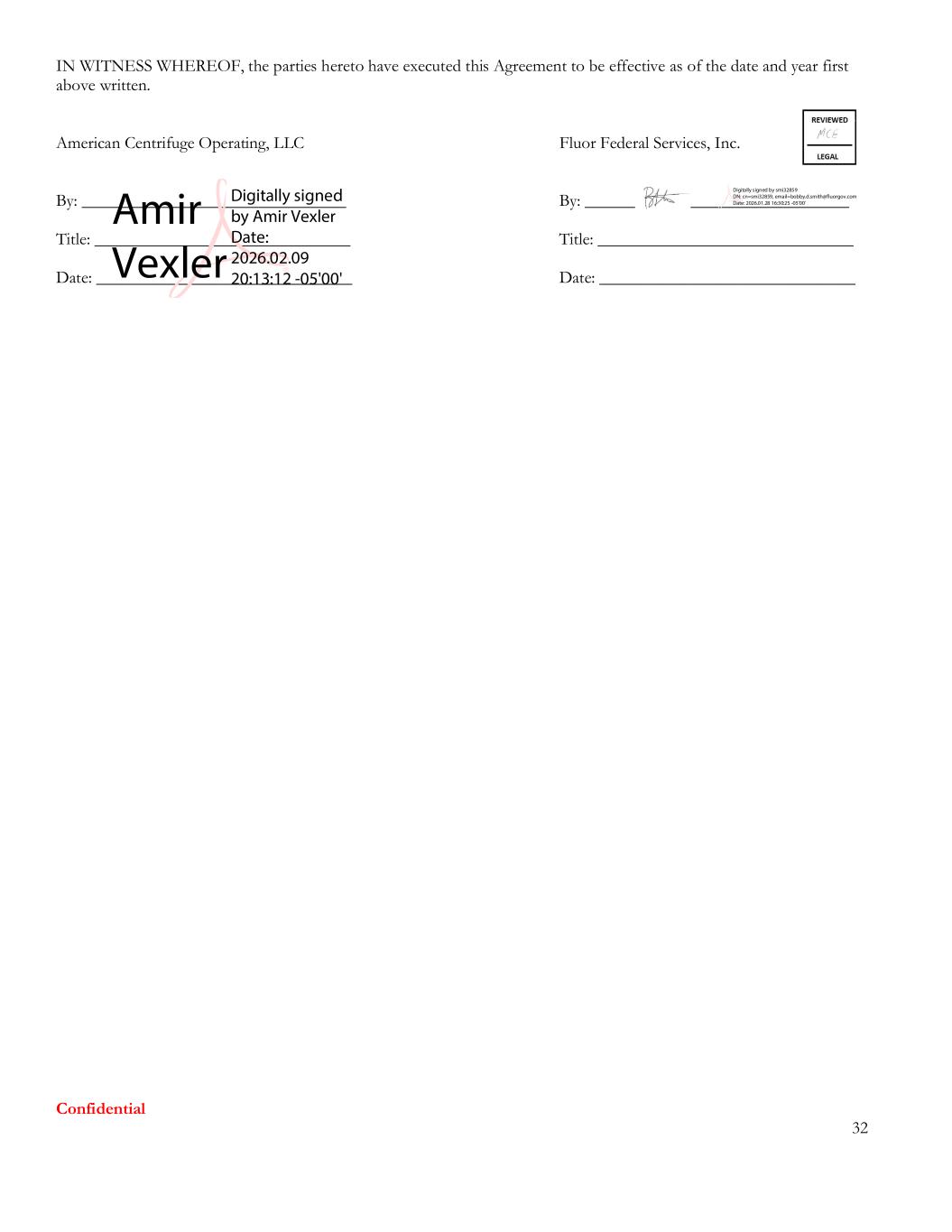
Confidential 32 IN WITNESS WHEREOF, the parties hereto have executed this Agreement to be effective as of the date and year first above written. American Centrifuge Operating, LLC Fluor Federal Services, Inc. By: _______________________________ By: _______________________________ Title: ______________________________ Title: ______________________________ Date: ______________________________ Date: ______________________________ Digitally signed by smi32859 DN: cn=smi32859, email=bobby.d.smith@fluorgov.com Date: 2026.01.28 16:30:25 -05'00'Amir Vexler Digitally signed by Amir Vexler Date: 2026.02.09 20:13:12 -05'00'
EXHIBIT 31.1
CERTIFICATION OF CHIEF EXECUTIVE OFFICER
I, Amir V. Vexler, certify that:
1.I have reviewed this quarterly report on Form 10-Q of Centrus Energy Corp.;
2.Based on my knowledge, this report does not contain any untrue statement of a material fact or omit to state a material fact necessary to make the statements made, in light of the circumstances under which such statements were made, not misleading with respect to the period covered by this report;
3.Based on my knowledge, the financial statements, and other financial information included in this report, fairly present in all material respects the financial condition, results of operations and cash flows of the registrant as of, and for, the periods presented in this report;
4.The registrant's other certifying officer(s) and I are responsible for establishing and maintaining disclosure controls and procedures (as defined in Exchange Act Rules 13a-15(e) and 15d-15(e)) and internal control over financial reporting (as defined in Exchange Act Rules 13a-15(f) and 15d-15(f)) for the registrant and have:
(a)Designed such disclosure controls and procedures, or caused such disclosure controls and procedures to be designed under our supervision, to ensure that material information relating to the registrant, including its consolidated subsidiaries, is made known to us by others within those entities, particularly during the period in which this report is being prepared;
(b)Designed such internal control over financial reporting, or caused such internal control over financial reporting to be designed under our supervision, to provide reasonable assurance regarding the reliability of financial reporting and the preparation of financial statements for external purposes in accordance with generally accepted accounting principles;
(c)Evaluated the effectiveness of the registrant's disclosure controls and procedures and presented in this report our conclusions about the effectiveness of the disclosure controls and procedures, as of the end of the period covered by this report based on such evaluation; and
(d)Disclosed in this report any change in the registrant's internal control over financial reporting that occurred during the registrant's most recent fiscal quarter (the registrant's fourth fiscal quarter in the case of an annual report) that has materially affected, or is reasonably likely to materially affect, the registrant's internal control over financial reporting; and
5. The registrant's other certifying officer(s) and I have disclosed, based on our most recent evaluation of internal control over financial reporting, to the registrant's auditors and the audit committee of the registrant's board of directors (or persons performing the equivalent functions):
(a)All significant deficiencies and material weaknesses in the design or operation of internal control over financial reporting that are reasonably likely to adversely affect the registrant's ability to record, process, summarize and report financial information; and
(b)Any fraud, whether or not material, that involves management or other employees who have a significant role in the registrant's internal control over financial reporting.
May 6, 2026 | /s/ Amir V. Vexler | ||||
| Amir V. Vexler | |||||
| President and Chief Executive Officer | |||||
EXHIBIT 31.2
CERTIFICATION OF CHIEF FINANCIAL OFFICER
I, Todd M. Tinelli, certify that:
1.I have reviewed this quarterly report on Form 10-Q of Centrus Energy Corp.;
2.Based on my knowledge, this report does not contain any untrue statement of a material fact or omit to state a material fact necessary to make the statements made, in light of the circumstances under which such statements were made, not misleading with respect to the period covered by this report;
3.Based on my knowledge, the financial statements, and other financial information included in this report, fairly present in all material respects the financial condition, results of operations and cash flows of the registrant as of, and for, the periods presented in this report;
4.The registrant's other certifying officer(s) and I are responsible for establishing and maintaining disclosure controls and procedures (as defined in Exchange Act Rules 13a-15(e) and 15d-15(e)) and internal control over financial reporting (as defined in Exchange Act Rules 13a-15(f) and 15d-15(f)) for the registrant and have:
(a)Designed such disclosure controls and procedures, or caused such disclosure controls and procedures to be designed under our supervision, to ensure that material information relating to the registrant, including its consolidated subsidiaries, is made known to us by others within those entities, particularly during the period in which this report is being prepared;
(b)Designed such internal control over financial reporting, or caused such internal control over financial reporting to be designed under our supervision, to provide reasonable assurance regarding the reliability of financial reporting and the preparation of financial statements for external purposes in accordance with generally accepted accounting principles;
(c)Evaluated the effectiveness of the registrant's disclosure controls and procedures and presented in this report our conclusions about the effectiveness of the disclosure controls and procedures, as of the end of the period covered by this report based on such evaluation; and
(d)Disclosed in this report any change in the registrant's internal control over financial reporting that occurred during the registrant's most recent fiscal quarter (the registrant's fourth fiscal quarter in the case of an annual report) that has materially affected, or is reasonably likely to materially affect, the registrant's internal control over financial reporting; and
5. The registrant's other certifying officer(s) and I have disclosed, based on our most recent evaluation of internal control over financial reporting, to the registrant's auditors and the audit committee of the registrant's board of directors (or persons performing the equivalent functions):
(a)All significant deficiencies and material weaknesses in the design or operation of internal control over financial reporting that are reasonably likely to adversely affect the registrant's ability to record, process, summarize and report financial information; and
(b)Any fraud, whether or not material, that involves management or other employees who have a significant role in the registrant's internal control over financial reporting.
May 6, 2026 | /s/ Todd M. Tinelli | ||||
| Todd M. Tinelli | |||||
| Senior Vice President, Chief Financial Officer, and Treasurer | |||||
EXHIBIT 32.1
CERTIFICATION OF CEO AND CFO PURSUANT TO
18 U.S.C. SECTION 1350,
AS ADOPTED PURSUANT TO
SECTION 906 OF THE SARBANES-OXLEY ACT OF 2002
In connection with the quarterly report on Form 10-Q of Centrus Energy Corp. for the period ended March 31, 2026, as filed with the Securities and Exchange Commission on the date hereof (the “Report”), pursuant to 18 U.S.C. § 1350, Amir V. Vexler, President and Chief Executive Officer, and Todd M. Tinelli, Senior Vice President, Chief Financial Officer, and Treasurer, each hereby certifies, that, to his knowledge:
(1) The Report fully complies with the requirements of Section 13(a) or 15(d) of the Securities Exchange Act of 1934; and
(2) The information contained in the Report fairly presents, in all material respects, the financial condition and results of operations of Centrus Energy Corp.
May 6, 2026 | /s/ Amir V. Vexler | ||||
| Amir V. Vexler | |||||
| President and Chief Executive Officer | |||||
May 6, 2026 | /s/ Todd M. Tinelli | ||||
| Todd M. Tinelli | |||||
| Senior Vice President, Chief Financial Officer, and Treasurer | |||||